

Ramaroshan Trek: Into the Wild Beauty of Far West Nepal
Trip Snapshot
Everything you need to know at a glance
Trip Overview
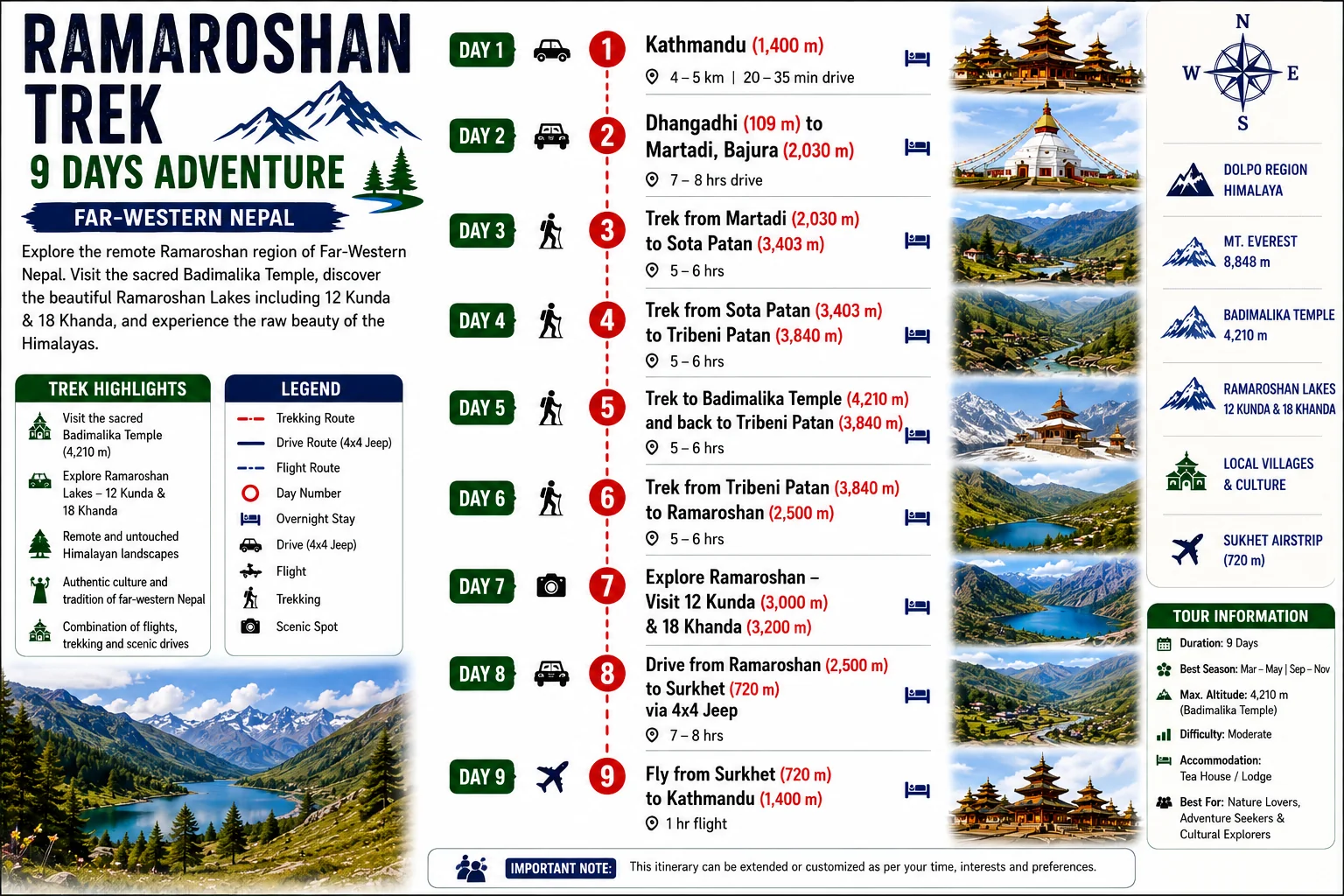
The Ramaroshan Trek is a spectacular journey into the remote and pristine landscapes of Far-Western Nepal. This 9-day adventure combines scenic flights, rugged mountain trails, traditional villages, lush forests, high-altitude landscapes, and the remarkable natural beauty of the Ramaroshan region. The trek also includes an excursion to Badimalika Temple at 4,210 m, followed by exploration of the beautiful Ramaroshan lakes and Kundas. It is an ideal adventure for travelers seeking an authentic, less-crowded trekking experience away from Nepal's popular trekking routes.
The journey begins with a flight from Kathmandu to Dhangadhi, followed by a scenic drive toward Martadi in Bajura. From Martadi, the trail climbs through remote mountain landscapes to Sota Patan and Tribeni Patan before reaching Badimalika Temple. The route then descends toward Ramaroshan, where you can explore its spectacular lakes, hills, forests, and traditional surroundings before returning by 4×4 Jeep to Surkhet and flying back to Kathmandu.
Trip Highlights
- Explore the remote and untouched Ramaroshan region of Far-Western Nepal.
- Visit the sacred Badimalika Temple at 4,210 m / 13,812 ft.
- Trek through dramatic Himalayan landscapes, forests, alpine meadows, and remote villages.
- Discover the beautiful 12 Kunda and 18 Khanda around Ramaroshan.
- Experience the peaceful natural beauty of the Ramaroshan Lake region.
- Enjoy spectacular mountain views and authentic rural landscapes away from crowded trekking routes.
- Experience a combination of flight, trekking, scenic mountain drives, and 4×4 Jeep travel.
- Discover the culture, traditions, and lifestyle of communities in Bajura and Far-Western Nepal.
- Enjoy an authentic off-the-beaten-path Himalayan adventure.
Important Note: We can extend or customize the itinerary to fit your preferred duration, interests, fitness level, travel dates, and available time. We can also arrange customized trekking programs, transportation, accommodation, and additional sightseeing upon request.
Departure Dates & Availability
No guaranteed departures available for this tour.
Detailed Day-by-Day Itinerary
Inclusions / Exclusions
Included
Excluded
Route Map
Gear List / Packing Guide
| Category | Essential Gear |
|---|---|
| Clothing | Warm layers, fleece, down & waterproof jacket |
| Footwear | Trekking boots, warm socks |
| Backpack | 40–50L backpack & rain cover |
| Sleeping | Warm sleeping bag |
| Accessories | Trekking poles, headlamp, water bottle |
| Protection | Sunglasses, sunscreen, sun hat, gloves |
| Personal | Toiletries, first-aid kit, medicines |
| Electronics | Phone, camera, power bank |
| Documents | Passport/ID, permits, travel insurance |
Important: The Ramaroshan Trek reaches 4,210 m / 13,812 ft at Badimalika Temple, so warm layers, waterproof clothing, proper trekking boots, and a suitable sleeping bag are particularly important.
FAQ
The Ramaroshan Trek is a 9-day off-the-beaten-path adventure in Far-Western Nepal, combining trekking, scenic mountain drives, and exploration of the beautiful Ramaroshan region.
The Ramaroshan Trek is located in Far-Western Nepal, covering remote areas of Bajura and Achham and featuring the spectacular landscapes around Ramaroshan.
The standard Ramaroshan Trek itinerary takes 9 days from Kathmandu to Kathmandu, including flights, trekking, exploration, and road travel.
The best seasons for the Ramaroshan Trek are spring (March to May) and autumn (September to November), when conditions are generally favorable for trekking and enjoying mountain scenery.
The maximum altitude is 4,210 m / 13,812 ft at Badimalika Temple, which is the highest point of the itinerary.
The Ramaroshan Trek is a moderate to challenging trek because it includes high-altitude sections, steep terrain, and remote trekking trails.
The trek is ideal for adventure travelers, experienced hikers, nature lovers, and travelers seeking an authentic off-the-beaten-path experience in Nepal.
Ramaroshan combines remote Himalayan landscapes, sacred Badimalika Temple, high-altitude trekking, beautiful lakes and natural attractions, and the traditional lifestyle of Far-Western Nepal.
The main activities include trekking through remote mountain trails, visiting Badimalika Temple, exploring Ramaroshan, and discovering 12 Kunda and 18 Khanda.
The major attractions include Badimalika Temple, Ramaroshan, 12 Kunda, 18 Khanda, mountain landscapes, forests, remote villages, and traditional local culture.
Yes. Ramaroshan is considered an offbeat and less-crowded destination in Nepal, making it suitable for travelers who want to explore beyond the country's popular trekking routes.
The main places to explore include 12 Kunda at 3,000 m / 9,843 ft and 18 Khanda at 3,200 m / 10,499 ft, along with the surrounding hills, forests, and natural landscapes.
The trek can be suitable for fit and well-prepared beginners, although the high-altitude sections and remote terrain require good physical preparation and trekking readiness.
Nepal offers many short trekking options, but Ramaroshan Trek is a strong choice for travelers looking for a less-crowded and authentic trekking experience in a remote region.
The Ramaroshan Trek is an excellent choice for an offbeat Nepal trekking experience, particularly for travelers interested in remote landscapes and less-visited destinations.
Ramaroshan in Far-Western Nepal offers an opportunity to experience mountain scenery, remote trails, natural attractions, and traditional villages away from Nepal's busiest trekking routes.
Essential gear includes trekking boots, warm layers, a waterproof jacket, trekking pants, sleeping bag, backpack, trekking poles, sunglasses, sunscreen, headlamp, water bottle, personal medicines, and a first-aid kit.
Accommodation is provided in hotels in cities and tea houses or homestays in trekking areas, depending on the location along the route.
Yes. The Ramaroshan Trek can be extended or customized according to your preferred duration, interests, fitness level, travel requirements, and available time.
A local travel agency can help arrange transportation, accommodation, trekking logistics, local guidance, and customized itineraries, making it easier to explore this remote region of Nepal.
More Details
 Ramaroshan Trek Accommodation
The Ramaroshan Trek offers a simple and authentic accommodation experience that combines comfortable hotels in the cities with local tea houses and homestays along the trekking route. Since Ramaroshan is a remote destination in Far-Western Nepal, accommodation facilities are more basic than those found on popular trekking routes. However, staying with local communities gives trekkers an opportunity to experience the traditional lifestyle, hospitality, food, and culture of the region.
During the trekking section, tea houses and homestays provide a place to rest after each day's journey. These accommodations are generally simple, clean, and locally operated. In Kathmandu, Dhangadhi, and Surkhet, you will stay in hotels with comparatively better facilities.
Accommodation Overview
| Location | Accommodation Type |
|---|---|
| Kathmandu | Hotel |
| Dhangadhi | Hotel |
| Martadi | Tea House / Homestay |
| Sota Patan | Tea House / Homestay |
| Tribeni Patan | Tea House / Homestay |
| Ramaroshan | Tea House / Homestay |
| Surkhet | Hotel |
The accommodation arrangement follows the nature of the journey. City stays provide a comfortable environment before, during, or after transportation, while the trekking section focuses on local hospitality and a more authentic experience.
Hotel Accommodation
Before beginning the remote trekking section and after completing the trek, accommodation is provided in hotels in the relevant city locations.
Hotel accommodation provides a comfortable environment for relaxing, freshening up, organizing trekking equipment, and preparing for the next stage of the journey.
Depending on the selected package and availability, hotel facilities may include:
- Comfortable beds and rooms
- Private or shared bathroom facilities
- Electricity
- Dining facilities
- Hot water where available
- Space to organize trekking equipment
- Luggage storage where available
Tea House and Homestay Accommodation
During the trekking days, accommodation is provided mainly in local tea houses and homestays. These are generally small, family-run establishments designed to accommodate trekkers and travelers visiting remote communities.
The facilities are basic compared with city hotels, but they provide the essential requirements for an overnight stay.
You can generally expect:
- Simple beds and mattresses
- Twin-sharing or shared rooms
- Blankets where available
- Basic furniture
- Shared bathroom facilities in many locations
- Dining area
- Locally prepared meals
- Warm local hospitality
Because Ramaroshan is a less-developed trekking destination, facilities can vary from one location to another. Accommodation availability may also depend on local conditions, season, and group size.
Room Facilities
The rooms along the Ramaroshan trekking route are designed primarily for rest after a long day of walking. Trekkers should expect simple mountain accommodation rather than luxury lodging.
Common facilities may include:
- Basic beds and mattresses
- Twin-sharing or multiple-sharing rooms
- Blankets where available
- Simple wooden or local furniture
- Shared bathrooms
- Basic washing facilities
- Limited heating facilities
A warm sleeping bag is recommended, particularly for nights at higher elevations and during colder trekking seasons.
Dining Facilities
Food and accommodation are closely connected during the Ramaroshan Trek. Tea houses and homestays generally have a simple dining area where trekkers can enjoy their meals and spend time with local hosts.
Your package includes Breakfast, Lunch, and Dinner throughout the trek.
Meals may include:
- Traditional Nepali meals
- Dal Bhat
- Rice and curry
- Noodles
- Soups
- Seasonal vegetables
- Eggs and simple breakfast items
- Tea and coffee
- Other locally available dishes
The exact food options can vary according to the location and availability of ingredients. In remote areas, meals are generally prepared using locally available products.
Additional Facilities
Facilities in remote trekking locations are limited compared with hotels in Kathmandu, Dhangadhi, or Surkhet.
| Facility | Availability |
|---|---|
| Hot Shower | Limited, depending on location |
| Wi-Fi | Limited or unavailable in remote areas |
| Mobile Charging | Available in selected locations |
| Electricity | Available but may be limited |
| Drinking Water | Available locally, treatment recommended |
| Laundry | Very limited |
| Heating | Limited and location dependent |
These facilities should be considered basic and location-dependent, as Ramaroshan is a remote trekking destination.
What to Expect
Accommodation is an important part of the Ramaroshan experience because it allows you to connect directly with the communities of Far-Western Nepal. As you move farther into the trekking region, modern hotel facilities give way to simple tea houses and homestays.
You can expect:
- Simple and comfortable places to rest
- Genuine local hospitality
- Traditional village surroundings
- Home-style meals
- A peaceful environment away from crowded tourist routes
- Opportunities to interact with local families
- A more authentic rural Nepal experience
The accommodation may not offer the same facilities as commercial trekking lodges in Everest or Annapurna, but its simplicity is part of what makes the Ramaroshan Trek special.
Accommodation Tips
For a more comfortable experience during the trek:
- Carry a warm sleeping bag.
- Bring warm clothes for cold mornings and evenings.
- Carry a power bank because charging facilities may be limited.
- Keep some Nepalese Rupees for personal expenses.
- Carry basic toiletries and personal hygiene items.
- Keep valuables safely inside your daypack.
- Be respectful of local customs and homestay rules.
- Do not expect luxury facilities in remote trekking locations.
- Inform your trekking team about any special accommodation requirements before departure.
Why You'll Love Staying on the Ramaroshan Trek
Accommodation on the Ramaroshan Trek is more than simply a place to spend the night. It forms part of the cultural experience of traveling through one of Nepal's less-visited regions.
Staying in local tea houses and homestays gives you the opportunity to experience rural life, local food, traditional hospitality, and the peaceful atmosphere of Far-Western Nepal. After a day of trekking through the hills, forests, meadows, and remote landscapes, these simple accommodations provide a welcoming place to rest and prepare for the next day's adventure.
 What to Expect on the Ramaroshan Trek
The Ramaroshan Trek is a remote and rewarding trekking experience in Far-Western Nepal, combining mountain landscapes, peaceful forests, high-altitude meadows, sacred sites, traditional villages, and the beautiful lakes and natural scenery of the Ramaroshan region. Unlike Nepal's more commercial trekking destinations, this journey takes you into a less-visited part of the country where the trails are quieter and the connection with local communities is much stronger.
The trek includes a combination of domestic flights, long mountain drives, trekking, and 4×4 Jeep transportation. You should be prepared for changing road and trail conditions, basic accommodation in remote areas, and significant altitude changes during the journey.
Remote and Less-Crowded Trails
One of the main things to expect is a peaceful trekking environment. Ramaroshan is still relatively less explored compared with popular destinations such as Everest and Annapurna.
The quieter trails allow you to enjoy:
- Peaceful mountain landscapes
- Less crowded trekking paths
- Traditional villages and rural settlements
- Forests and open Himalayan landscapes
- Local culture and everyday village life
- A genuine off-the-beaten-path experience
This makes Ramaroshan particularly appealing to travelers who want to explore a different side of Nepal.
Changing Landscapes and Elevation
The journey passes through a variety of landscapes as you travel from the lowlands toward the higher trekking areas.
You can expect to experience:
- Lowland landscapes around Dhangadhi
- Mountain roads toward Martadi
- Forested trekking trails
- High-altitude meadows
- Open mountain terrain
- Sacred high-altitude areas
- Lakes and natural landscapes around Ramaroshan
The highest point of the itinerary is Badimalika Temple at 4,210 m / 13,812 ft, so proper preparation and gradual acclimatization are important.
A Combination of Flight, Drive and Trek
The Ramaroshan journey is not a trekking-only itinerary. It combines several forms of transportation to reach this remote region.
The journey includes:
- Kathmandu to Dhangadhi by flight
- Dhangadhi to Martadi by road
- Trekking from Martadi toward Sota Patan
- Trekking from Sota Patan to Tribeni Patan
- Trek to Badimalika Temple and back
- Trekking from Tribeni Patan to Ramaroshan
- Ramaroshan exploration
- Ramaroshan to Surkhet by 4×4 Jeep
- Surkhet to Kathmandu by flight
This combination allows travelers to explore a remote region without requiring an extremely long overland journey from Kathmandu.
High-Altitude Trekking
The Ramaroshan Trek reaches elevations above 4,000 meters, particularly during the journey to Badimalika Temple.
At higher elevations, you may experience:
- Colder temperatures
- Strong sunlight
- Changing weather
- Steeper and more demanding trails
- Reduced oxygen availability
- Longer walking days
Trekkers should maintain a comfortable pace, stay hydrated, eat properly, and communicate with the trekking team if they feel unwell.
Badimalika Temple Experience
A major highlight of the journey is the trek to Badimalika Temple, situated at approximately 4,210 m / 13,812 ft.
The temple is an important pilgrimage destination and is surrounded by dramatic high-altitude landscapes. Reaching the temple involves trekking through challenging mountain terrain, making the experience both physically demanding and rewarding.
The journey offers an opportunity to combine nature, spirituality, mountain scenery, and local culture in one experience.
Ramaroshan and Its Natural Beauty
After completing the Badimalika section, the trek continues toward Ramaroshan, a beautiful and peaceful area known for its natural landscapes and high-altitude surroundings.
During the Ramaroshan exploration day, you can visit areas including:
- 12 Kunda
- 18 Khanda
- Ramaroshan's surrounding landscapes
- High-altitude meadows
- Natural lakes and water bodies
- Traditional rural surroundings
The exploration day provides time to enjoy the destination without the pressure of immediately moving to another trekking point.
Local Culture and Hospitality
Ramaroshan provides a strong opportunity to experience local Far-Western Nepali culture. As you travel through villages and stay in local tea houses or homestays, you can interact with local people and observe traditional ways of life.
You may experience:
- Traditional Nepali hospitality
- Local food
- Village lifestyles
- Traditional customs
- Local architecture
- Community-based accommodation
- Interactions with local families
Respect for local traditions and customs is an important part of responsible travel in the region.
Simple Trekking Facilities
Because Ramaroshan is a remote trekking destination, facilities are more basic than those available on highly developed trekking routes.
You should be prepared for:
- Simple tea houses and homestays
- Basic rooms
- Limited hot water
- Limited internet connectivity
- Limited charging facilities
- Basic bathroom facilities
- Fewer shops and services in remote areas
The simplicity of the facilities is part of the experience and allows travelers to experience a less-commercialized side of Nepal.
Changing Weather Conditions
Weather can change quickly in mountainous areas. Conditions may vary depending on the season, altitude, and location.
Trekkers should be prepared for:
- Cold mornings and evenings
- Sunshine during the day
- Rain in suitable seasons
- Strong winds at higher elevations
- Sudden changes in mountain weather
Carrying appropriate layers, waterproof clothing, warm clothing, and sun protection is recommended.
What Makes the Experience Special
The Ramaroshan Trek is particularly suitable for travelers looking for an authentic, peaceful, and less-commercialized Himalayan experience.
What makes the journey special is the combination of:
- Remote Far-Western Nepal
- Badimalika Temple
- Ramaroshan's natural landscapes
- 12 Kunda and 18 Khanda
- Traditional villages
- Local tea houses and homestays
- Quiet trekking trails
- High-altitude mountain scenery
- A unique combination of culture, nature, and adventure
Things to Keep in Mind
Before choosing the Ramaroshan Trek, travelers should understand that this is a remote trekking adventure, not a luxury holiday.
It is important to:
- Be physically prepared for trekking and altitude
- Carry appropriate trekking equipment
- Expect basic facilities in remote areas
- Be flexible with transportation and local conditions
- Respect local communities and cultural practices
- Stay hydrated throughout the trek
- Follow the guidance of your trekking team
- Prepare for changing weather
- Keep some flexibility in the itinerary for unforeseen local conditions
The Ramaroshan Trek is best suited to travelers who value adventure, nature, culture, solitude, and authentic experiences over luxury and highly developed trekking infrastructure.
 Best Time / Season for Ramaroshan Trek
The best time for the Ramaroshan Trek is generally during the spring and autumn seasons, when the weather is more suitable for trekking and mountain views are usually clearer. The recommended trekking periods are March to May and September to November.
Ramaroshan experiences changing weather conditions because the route passes through different elevations, from the lower areas around Dhangadhi to high-altitude locations such as Tribeni Patan and Badimalika Temple. Choosing the right season can make the trekking experience more comfortable and enjoyable.
Best Seasons for Ramaroshan Trek
| Season | Months | Trekking Conditions |
|---|---|---|
| Spring | March to May | Excellent |
| Summer / Monsoon | June to August | Less suitable |
| Autumn | September to November | Excellent |
| Winter | December to February | Cold and challenging |
Spring Season: March to May
Spring is one of the best seasons for the Ramaroshan Trek. During this period, temperatures gradually become warmer and trekking conditions are generally favorable.
The landscape becomes particularly attractive during spring, with fresh vegetation and pleasant conditions in many parts of the route.
Why Trek in Spring?
- Pleasant trekking temperatures
- Fresh and green landscapes
- Beautiful natural surroundings
- Generally favorable trail conditions
- Good season for exploring Ramaroshan
- Suitable period for high-altitude trekking
March can still be relatively cold at higher elevations, while April and May generally offer warmer conditions.
Autumn Season: September to November
Autumn is another excellent season for the Ramaroshan Trek. After the monsoon period, the weather generally becomes more stable, making September to November a popular period for trekking in Nepal.
The combination of favorable weather, clear mountain environments, and comfortable trekking conditions makes autumn particularly suitable for exploring the remote Ramaroshan region.
Why Trek in Autumn?
- Stable weather conditions
- Clearer mountain landscapes
- Comfortable trekking temperatures
- Good visibility
- Generally better trail conditions after the monsoon
- Excellent conditions for photography and sightseeing
October and November are generally among the most favorable months within the autumn season.
Summer and Monsoon Season: June to August
The June to August period coincides with Nepal's summer and monsoon season. Rainfall can affect roads and trekking trails, particularly in remote mountain areas.
Travel during this period may require greater flexibility because weather conditions can affect transportation and trekking conditions.
Possible challenges include:
- Rainfall
- Wet and slippery trails
- Cloudy mountain views
- Mud on trekking paths
- Difficult road conditions
- Possible transportation delays
Although trekking may still be possible depending on conditions, this period is less preferred for the Ramaroshan Trek.
Winter Season: December to February
Winter brings cold temperatures, particularly at higher elevations. Areas around Tribeni Patan and Badimalika can become considerably colder, and snow or difficult weather conditions may affect parts of the route.
Winter trekking may therefore require additional preparation and appropriate cold-weather equipment.
Trekkers should be prepared for:
- Very cold mornings and nights
- Cold conditions at higher elevations
- Possible snowfall
- Frozen or difficult trail sections
- Shorter daylight hours
- More challenging trekking conditions
Winter can offer a different experience for experienced trekkers, but it is generally not the first choice for travelers seeking easier trekking conditions.
Best Months for Ramaroshan Trek
For travelers looking for the most favorable combination of weather and trekking conditions, the following months are recommended:
March, April, May, September, October, and November
Among these, April, October, and November can be particularly attractive for travelers seeking comfortable conditions and good visibility.
Best Season for Photography
The spring and autumn seasons are also excellent for photography. The route offers a variety of landscapes, from rural villages and forests to high-altitude meadows, mountain scenery, Badimalika Temple, and the natural surroundings of Ramaroshan.
Photographers can capture:
- Mountain landscapes
- High-altitude meadows
- Traditional villages
- Local people and culture
- Badimalika Temple
- Ramaroshan landscapes
- 12 Kunda and 18 Khanda
- Sunrise and sunset views
Weather and Trekking Preparation
Regardless of the season, weather conditions can change quickly in the mountains. Trekkers should therefore pack according to the expected conditions while keeping additional layers available.
Essential items include:
- Warm layers
- Waterproof jacket
- Fleece or down jacket
- Comfortable trekking boots
- Warm socks
- Gloves
- Sun hat
- Sunglasses
- Sunscreen
- Rain protection
- Warm sleeping bag
Which Season Should You Choose?
For the best overall Ramaroshan Trek experience, we recommend traveling during March to May or September to November.
Spring is ideal for travelers who enjoy fresh landscapes and pleasant trekking conditions, while autumn is excellent for stable weather, visibility, and comfortable trekking.
If your travel dates fall outside these periods, the trek may still be possible depending on current weather, trail, road, and local conditions. The itinerary can also be customized or extended according to your travel dates, interests, and trekking requirements.
 Places to Explore Around Ramaroshan
The Ramaroshan Trek takes you through one of the less-explored regions of Far-Western Nepal, where natural landscapes, high-altitude meadows, sacred sites, lakes, and traditional villages come together to create a unique trekking experience. The journey also includes the important pilgrimage destination of Badimalika Temple and the beautiful landscapes of Ramaroshan.
Ramaroshan
Ramaroshan is the main destination of this trekking journey and is known for its peaceful natural environment, green landscapes, high-altitude terrain, and beautiful water bodies. The area provides an opportunity to experience the natural beauty of Far-Western Nepal away from crowded trekking routes.
The Ramaroshan area is ideal for:
- Nature exploration
- Photography
- Walking through peaceful landscapes
- Exploring local surroundings
- Experiencing rural Far-Western Nepal
- Enjoying high-altitude scenery
12 Kunda
12 Kunda is one of the notable natural attractions explored during the Ramaroshan sightseeing day. The area features a collection of high-altitude water bodies surrounded by beautiful mountain landscapes and natural terrain.
Exploring the Kunda area provides opportunities to enjoy:
- Natural lakes and water bodies
- Mountain scenery
- Peaceful surroundings
- High-altitude landscapes
- Nature photography
The visit to 12 Kunda is an important part of the Ramaroshan exploration experience.
18 Khanda
18 Khanda is another important area explored around Ramaroshan. Located at approximately 3,200 m / 10,499 ft, it offers an opportunity to experience the distinctive high-altitude landscape of the region.
Visitors can enjoy:
- Open mountain landscapes
- High-altitude surroundings
- Peaceful natural scenery
- Photography opportunities
- Remote Himalayan environments
Badimalika Temple
Badimalika Temple, located at approximately 4,210 m / 13,812 ft, is one of the major highlights of the trek. The journey to the temple combines natural scenery with religious and cultural significance.
The surrounding area offers impressive high-altitude landscapes, making the trek to Badimalika both a spiritual and adventurous experience.
Tribeni Patan
Tribeni Patan, situated at approximately 3,840 m / 12,598 ft, is an important point on the trekking route. It serves as the base for the journey toward Badimalika Temple and later connects the trekking route toward Ramaroshan.
The area offers:
- High-altitude landscapes
- Mountain views
- Open meadows
- Peaceful surroundings
- A remote trekking environment
Sota Patan
Sota Patan, located at approximately 3,403 m / 11,165 ft, is another important overnight stop along the route. The trek from Martadi to Sota Patan gradually takes travelers into higher mountain terrain.
The journey provides opportunities to experience:
- Mountain trails
- Forested surroundings
- High-altitude landscapes
- Remote settlements
- Traditional trekking environments
Martadi
Martadi, at approximately 2,030 m / 6,660 ft, is the starting point of the main trekking section. After traveling from Dhangadhi, trekkers begin their journey toward the higher areas of the Ramaroshan and Badimalika region.
Martadi provides an introduction to the mountainous landscape and rural lifestyle of Bajura before the trek moves toward higher elevations.
Far-Western Nepal's Rural Villages
One of the most rewarding aspects of the journey is traveling through rural communities of Far-Western Nepal. The route provides opportunities to observe traditional lifestyles and interact with local communities.
Travelers can experience:
- Traditional village life
- Local hospitality
- Rural landscapes
- Traditional food
- Local customs and culture
- Less-developed mountain settlements
Mountain Landscapes and High-Altitude Meadows
Beyond individual attractions, the route itself is one of the major highlights. The changing landscape from lower mountain areas to high-altitude terrain creates a diverse trekking experience.
You can expect to encounter:
- Green hills
- Forests
- Mountain trails
- Open meadows
- High-altitude landscapes
- Natural water bodies
- Peaceful Himalayan surroundings
Why Explore These Places?
The attractions around Ramaroshan offer a combination of nature, culture, spirituality, and adventure. From the sacred Badimalika Temple and high-altitude landscapes to 12 Kunda, 18 Khanda, and traditional villages, the journey provides a different perspective on Nepal beyond the country's busiest trekking destinations.
For travelers looking for an off-the-beaten-path trekking experience, Ramaroshan provides an opportunity to discover the natural and cultural character of Far-Western Nepal in a peaceful and authentic setting.
 Food and Meals During Ramaroshan Trek
Food is an important part of the Ramaroshan Trek, providing the energy needed for walking through remote villages, forests, high-altitude trails, and mountain landscapes. Since the trek passes through less-developed areas of Far-Western Nepal, meals are generally simple, nutritious, and prepared using locally available ingredients.
Your Ramaroshan Trek package includes Breakfast, Lunch, and Dinner, allowing you to enjoy regular meals throughout the journey.
Meals Included During the Trek
The trekking package includes three main meals each day:
- Breakfast
- Lunch
- Dinner
Meals are generally served at the tea house or homestay where you stay, or at suitable local stops along the trekking route.
Breakfast
Breakfast is served before beginning the day's trekking activities. A good breakfast provides the energy needed for long walking days and higher-altitude sections.
Depending on availability, breakfast may include:
- Tea or coffee
- Bread
- Eggs
- Porridge
- Noodles
- Rice-based dishes
- Simple local breakfast items
The available options may vary depending on the location and local supplies.
Lunch
Lunch is generally taken during the trekking day at a suitable tea house, homestay, or local food stop. Since trekking can require considerable physical effort, lunch focuses on providing sufficient carbohydrates and energy.
Possible lunch options include:
- Dal Bhat
- Rice and vegetables
- Noodles
- Vegetable curry
- Soups
- Egg dishes
- Other locally available meals
Dinner
Dinner is usually served at the tea house or homestay after completing the day's trek. It provides an opportunity to relax, recover, and prepare for the following day's journey.
Dinner may include:
- Dal Bhat
- Rice
- Vegetable curry
- Noodles
- Soup
- Seasonal vegetables
- Eggs
- Traditional Nepali dishes
Dal Bhat
Dal Bhat is one of the most common meals you can expect during trekking in Nepal. It generally consists of rice, lentil soup, vegetables, and curry.
It is particularly suitable for trekkers because it provides a filling and familiar source of energy during physically demanding trekking days.
Local Nepali Food
The Ramaroshan Trek provides an opportunity to experience traditional food from rural communities in Far-Western Nepal. Local tea houses and homestays may prepare meals using ingredients available within the surrounding communities.
Trying local food is also a way to experience the culture and lifestyle of the region.
Food Availability in Remote Areas
Ramaroshan is a remote trekking destination, so food choices can be more limited than in Kathmandu or other major trekking regions.
Travelers should expect:
- Simple meals
- Locally available ingredients
- Fewer menu choices
- Seasonal food availability
- Basic tea house and homestay dining facilities
The exact menu can vary depending on the trekking location, season, weather, and availability of supplies.
Drinking Water
Safe drinking water is important throughout the trek, particularly while walking at higher elevations.
Trekkers should carry a refillable water bottle and use appropriate water purification methods when necessary. Your trekking team can help identify suitable water sources and advise on safe drinking practices along the route.
Tea and Coffee
Tea and coffee are commonly available at tea houses and local accommodation. A warm drink can be especially enjoyable during colder mornings and evenings in the higher trekking areas.
Food for Energy During Trekking
Because the Ramaroshan Trek includes high-altitude sections and trekking days, maintaining adequate energy intake is important.
It is useful to carry small personal snacks such as:
- Energy bars
- Chocolate
- Dry fruits
- Nuts
- Biscuits
- Trail mix
These can provide additional energy between meals during longer trekking sections.
Dietary Requirements
If you have a vegetarian, vegan, allergy-related, or other dietary requirement, inform us before the trek so that appropriate arrangements can be considered.
Food choices can be more limited in remote areas, so advance communication is particularly important for special dietary needs.
Food Hygiene and Responsible Eating
When eating in remote trekking areas, basic food hygiene is important.
We recommend:
- Drink treated or safely sourced water.
- Choose freshly prepared meals.
- Wash or sanitize your hands before eating.
- Avoid unfamiliar raw food when hygiene is uncertain.
- Carry personal snacks for additional energy.
- Inform the trekking team about food allergies or dietary restrictions.
What Makes Food on the Ramaroshan Trek Special?
Food during the Ramaroshan Trek is not about luxury dining. It is about simple, filling meals, local ingredients, and authentic hospitality.
Eating in local tea houses and homestays allows you to experience the traditional side of Far-Western Nepal while sharing meals with local communities. Combined with the natural landscapes, remote villages, and peaceful trekking environment, the food experience becomes an important part of the overall Ramaroshan adventure.
 Culture and Local Etiquette for Ramaroshan Trek
The Ramaroshan Trek offers more than beautiful landscapes and mountain trails. It is also an opportunity to experience the traditional culture, lifestyle, hospitality, and communities of Far-Western Nepal. As the route passes through remote villages and local settlements, travelers have the opportunity to interact with local people and experience a way of life that is different from Nepal's major tourist destinations.
Respecting local traditions and behaving responsibly helps create a positive experience for both travelers and the communities they visit.
Local Culture of Far-Western Nepal
The communities along the Ramaroshan and Badimalika region have strong connections with their local traditions, customs, religious practices, and rural lifestyle.
During the trek, you may encounter:
- Traditional villages
- Local homes and settlements
- Traditional food
- Religious and cultural practices
- Local festivals and customs
- Traditional hospitality
- Agricultural and rural lifestyles
The experience provides a chance to see a less-commercialized side of Nepal.
Local Hospitality
One of the memorable parts of the Ramaroshan Trek is the warm hospitality of local communities. Staying in tea houses and homestays allows travelers to interact more closely with local families.
You may have opportunities to:
- Talk with local residents
- Share meals with local families
- Learn about village life
- Experience traditional hospitality
- Learn about local customs and traditions
- Support locally operated accommodation and services
A respectful and friendly attitude makes these interactions more meaningful.
Respect Local Customs
Ramaroshan and Badimalika include areas of cultural and religious importance. Travelers should respect local customs when visiting villages, temples, religious sites, and other culturally significant places.
We recommend:
- Dress modestly when visiting religious and cultural sites.
- Ask permission before entering private homes or restricted areas.
- Follow instructions provided by local guides or community members.
- Avoid disturbing religious ceremonies or rituals.
- Respect local traditions even when they differ from your own.
Temple and Religious Etiquette
Badimalika Temple is one of the important religious highlights of the journey. When visiting the temple and other sacred areas, travelers should behave respectfully.
Remember to:
- Remove shoes where required.
- Follow local temple rules.
- Avoid loud conversations near sacred areas.
- Do not touch religious objects unless permitted.
- Ask before taking photographs of religious ceremonies or people.
- Follow the guidance of local representatives or your trekking team.
Photography Etiquette
The Ramaroshan region provides excellent opportunities for photography, including landscapes, villages, local culture, and traditional lifestyles. However, it is important to respect people's privacy.
Before photographing local people:
- Ask for permission.
- Respect their response if they decline.
- Avoid photographing private activities without permission.
- Be particularly respectful around religious ceremonies.
- Avoid intrusive photography.
Food and Dining Etiquette
Meals are an important part of the local hospitality experience. When staying in homestays or eating with local families, travelers should respect local dining customs.
Simple practices include:
- Wash or sanitize your hands before meals.
- Respect local eating traditions.
- Avoid wasting food.
- Inform your hosts about dietary requirements in advance.
- Thank your hosts for their hospitality.
Supporting Local Communities
Traveling through remote areas provides an opportunity to contribute directly to local communities. Choosing locally operated accommodation, eating local food, and purchasing appropriate local products can help support the people living along the trekking route.
Travelers can contribute by:
- Staying in local tea houses and homestays
- Eating locally prepared food
- Hiring local guides and support staff
- Purchasing locally made products
- Respecting local businesses
- Avoiding unnecessary bargaining over small amounts
Environmental Responsibility
Ramaroshan is known for its natural beauty, so protecting the environment is an important responsibility for every traveler.
During the trek:
- Do not throw waste on trails.
- Carry your rubbish until you reach an appropriate disposal point.
- Avoid unnecessary use of plastic.
- Do not damage plants or natural surroundings.
- Avoid disturbing wildlife.
- Use water responsibly.
- Leave natural and cultural sites as you found them.
Responsible Trekking Behavior
The Ramaroshan Trek takes place in remote communities where tourism infrastructure is still developing. Responsible behavior helps preserve the region's natural and cultural character.
A responsible traveler should:
- Respect local people and their traditions.
- Follow designated trails.
- Respect private property.
- Avoid excessive noise in villages and homestays.
- Dispose of waste properly.
- Use local services whenever possible.
- Follow the guidance of local trekking staff.
What Makes the Cultural Experience Special?
The cultural experience is one of the reasons to choose the Ramaroshan Trek. Instead of traveling through highly commercialized trekking areas, you have the opportunity to experience traditional villages, local hospitality, rural lifestyles, religious sites, and the natural environment of Far-Western Nepal.
By traveling respectfully and responsibly, you not only enjoy a more authentic journey but also help ensure that the communities and environment of Ramaroshan continue to benefit from responsible tourism.
 Safety and Security on the Ramaroshan Trek
The Ramaroshan Trek is a remote and adventurous journey through the mountains of Far-Western Nepal. The route includes long road journeys, high-altitude trekking, remote settlements, and limited infrastructure. Although the trek can be enjoyed safely with proper preparation, travelers should understand the conditions and follow appropriate safety practices throughout the journey.
Trekking at High Altitude
The highest point of the itinerary is Badimalika Temple at 4,210 m / 13,812 ft. As you gain altitude, the amount of available oxygen decreases, and some trekkers may experience symptoms related to altitude.
Common symptoms can include:
- Headache
- Dizziness
- Tiredness
- Shortness of breath
- Loss of appetite
- Difficulty sleeping
Trekking at a comfortable pace, staying hydrated, eating regularly, and allowing your body to adjust to the altitude are important.
Altitude Sickness Awareness
Altitude sickness should be taken seriously during any trek reaching higher elevations. Do not ignore unusual or worsening symptoms.
If you feel unwell:
- Inform your guide immediately.
- Stop ascending if symptoms are developing.
- Rest and monitor your condition.
- Follow the advice of your trekking team.
- Descend to a lower elevation if necessary.
Your trekking team should be informed about any health concerns before and during the trek.
Physical Preparation
The Ramaroshan Trek involves walking on mountain trails with changing terrain and elevation. Good physical preparation can make the journey more comfortable and enjoyable.
Before the trek, consider:
- Regular walking or hiking
- Cardiovascular exercise
- Strength training
- Stair climbing
- Gradually increasing walking duration
- Practicing with your trekking shoes and backpack
Weather Safety
Mountain weather can change quickly, particularly at higher elevations. Rain, cold temperatures, strong winds, fog, and other conditions can affect trekking and transportation.
Trekkers should carry:
- Waterproof jacket
- Warm layers
- Fleece or down jacket
- Warm gloves
- Sun protection
- Rain protection
- Suitable trekking boots
Your itinerary may need to be adjusted if weather or local conditions make a particular section unsafe.
Road and Transportation Safety
The Ramaroshan journey includes road travel through mountainous areas, including the drive from Dhangadhi to Martadi and the 4×4 Jeep journey from Ramaroshan to Surkhet.
Mountain roads can be winding and may be affected by weather and local road conditions. Travelers should:
- Follow the instructions of the driver and trekking team.
- Remain seated while the vehicle is moving.
- Use seat belts where available.
- Keep personal belongings secure.
- Allow flexibility in the schedule for road conditions.
Trail Safety
Some sections of the Ramaroshan Trek pass through remote mountain terrain where services may be limited. Staying with your trekking group is therefore important.
For a safer trek:
- Follow the designated route.
- Stay with your guide or trekking group.
- Avoid walking alone in unfamiliar areas.
- Take extra care on steep, rocky, or slippery sections.
- Use trekking poles when useful.
- Wear appropriate footwear.
- Inform your guide before leaving the group.
Drinking Water and Food Safety
Proper hydration is particularly important while trekking at altitude. Travelers should carry a reusable water bottle and use safe or appropriately treated drinking water.
For food safety:
- Choose freshly prepared meals.
- Maintain good hand hygiene.
- Drink treated or safely sourced water.
- Avoid food that appears unhygienically prepared.
- Carry personal snacks for additional energy.
Personal Belongings and Valuables
Although the trek takes place in relatively quiet and remote areas, travelers should take normal precautions with their belongings.
We recommend:
- Keep your passport and important documents secure.
- Carry valuables in your daypack.
- Avoid carrying unnecessary valuables.
- Keep electronic devices protected from moisture.
- Use a secure bag for money and important documents.
Travel Insurance
Travel insurance is strongly recommended for the Ramaroshan Trek because the itinerary reaches a high altitude and travels through remote areas.
A suitable policy should ideally cover:
- Trekking activities
- High-altitude travel
- Emergency medical treatment
- Emergency evacuation where applicable
- Trip interruption or cancellation
- Transportation-related disruptions
Check your policy carefully to ensure that the coverage applies to the maximum altitude of 4,210 m / 13,812 ft.
Emergency Preparedness
Because Ramaroshan is a remote destination, access to advanced medical and emergency facilities can be limited in some areas.
Our trekking team helps travelers manage the journey by monitoring conditions and coordinating transportation or other necessary assistance when required.
Travelers should:
- Carry essential personal medicines.
- Keep emergency contact information accessible.
- Inform the team about important medical or dietary requirements.
- Follow guide instructions during difficult conditions.
- Remain flexible if the itinerary needs to change for safety reasons.
Responsible Travel and Safety
Safety also means protecting the natural and cultural environment. Travelers should avoid risky behavior around cliffs, steep slopes, rivers, lakes, and other natural features.
Always:
- Respect warning signs and local instructions.
- Avoid dangerous shortcuts.
- Do not climb unstable slopes or structures.
- Respect religious and cultural sites.
- Avoid disturbing local wildlife.
- Keep the trekking environment clean.
What Makes the Trek Safe and Enjoyable?
With proper preparation, suitable equipment, responsible trekking behavior, and guidance from an experienced trekking team, the Ramaroshan Trek can be a rewarding and memorable adventure.
The most important principles are to walk at a comfortable pace, respect the altitude, stay hydrated, monitor weather conditions, remain with your group, and communicate any concerns immediately. Because conditions can vary in remote mountain areas, flexibility and good judgment are essential throughout the journey.
 Transportation Facilities for Ramaroshan Trek
Transportation is an important part of the Ramaroshan Trek because the destination is located in the remote Far-Western region of Nepal. Unlike many popular trekking routes that can be reached relatively easily from Kathmandu, the Ramaroshan journey combines domestic flights, mountain road travel, trekking, and 4×4 Jeep transportation.
This combination makes it possible to reach the remote trekking areas while also experiencing the changing landscapes of western Nepal.
Transportation Overview
The Ramaroshan itinerary uses different forms of transportation at different stages of the journey.
| Route | Transportation |
|---|---|
| Kathmandu to Dhangadhi | Domestic Flight |
| Dhangadhi to Martadi | Road Drive |
| Martadi to Sota Patan | Trekking |
| Sota Patan to Tribeni Patan | Trekking |
| Tribeni Patan to Badimalika Temple | Trekking |
| Badimalika Temple to Tribeni Patan | Trekking |
| Tribeni Patan to Ramaroshan | Trekking |
| Ramaroshan to Surkhet | 4×4 Jeep |
| Surkhet to Kathmandu | Domestic Flight |
Kathmandu to Dhangadhi by Flight
The journey begins with a domestic flight from Kathmandu to Dhangadhi. Dhangadhi is an important gateway to Nepal's Far-Western region and provides access to the road journey toward the mountain areas.
Flying this section saves considerable overland travel time and allows you to begin the journey into Far-Western Nepal more efficiently.
Dhangadhi to Martadi by Road
From Dhangadhi, the journey continues by road toward Martadi in Bajura.
This drive takes you away from the lowland Terai environment and gradually into the mountainous landscapes of Far-Western Nepal. The changing scenery along the route is an important part of the journey.
Because mountain road conditions can vary, travelers should be prepared for a long and sometimes winding drive.
Trekking from Martadi
Once you reach Martadi at approximately 2,030 m / 6,660 ft, the main trekking section begins.
From Martadi, the route continues on foot toward:
- Sota Patan
- Tribeni Patan
- Badimalika Temple
- Ramaroshan
Walking these sections allows travelers to experience the landscape at a much closer level, including local settlements, forests, mountain terrain, and high-altitude surroundings.
Trekking to Sota Patan
The route from Martadi to Sota Patan is completed on foot. Sota Patan is situated at approximately 3,403 m / 11,165 ft.
As the elevation increases, the landscape changes and the trekking environment becomes more mountainous. Travelers should maintain a comfortable pace and stay with their trekking team.
Trekking to Tribeni Patan
The journey continues from Sota Patan to Tribeni Patan, reaching approximately 3,840 m / 12,598 ft.
This section takes you further into the high-altitude landscape and prepares you for the following trek toward Badimalika Temple.
Trek to Badimalika Temple
The journey to Badimalika Temple at approximately 4,210 m / 13,812 ft is completed by trekking.
This is one of the highest and most significant sections of the itinerary. There is no road transportation to replace this trekking experience, so appropriate physical preparation and trekking equipment are important.
After visiting the temple, you return to Tribeni Patan on foot.
Trekking from Tribeni Patan to Ramaroshan
After completing the Badimalika section, the trek continues from Tribeni Patan to Ramaroshan, located at approximately 2,500 m / 8,202 ft.
This section brings you from the higher mountain terrain toward the Ramaroshan region, where you can enjoy its natural surroundings and explore attractions such as 12 Kunda and 18 Khanda.
Ramaroshan to Surkhet by 4×4 Jeep
After completing the Ramaroshan exploration, transportation changes from trekking to a 4×4 Jeep.
The Jeep journey from Ramaroshan to Surkhet provides a practical way to leave the remote trekking area and continue toward the next stage of the journey.
Mountain roads can be affected by weather and local conditions, so the travel schedule may require flexibility.
Surkhet to Kathmandu by Flight
The final transportation section is a domestic flight from Surkhet to Kathmandu.
After arriving in Kathmandu, the Ramaroshan Trek comes to an end, completing the journey through the remote landscapes of Far-Western Nepal.
Mountain Road Conditions
Road travel in the Far-Western mountain region can be different from travel on major highways and urban roads. Some sections can be rough, winding, or affected by seasonal weather conditions.
Travelers should therefore be prepared for:
- Uneven mountain roads
- Winding routes
- Long driving periods
- Changing road conditions
- Possible delays
- Weather-related changes
The actual road conditions can vary depending on the season and local circumstances.
Transportation and Weather
Weather can influence both road and air transportation in mountainous regions. Rain, fog, strong winds, or other unfavorable conditions may occasionally affect travel schedules.
For this reason, travelers should maintain some flexibility in their itinerary, particularly when connecting flights with mountain road transportation.
Why Transportation Is Part of the Adventure
Transportation on the Ramaroshan Trek is not simply a way to move between destinations. The combination of flight, mountain drive, trekking, and 4×4 Jeep travel allows you to experience the dramatic transition from Nepal's lowland regions to the remote mountains of Far-Western Nepal.
This varied transportation experience is one of the defining features of the Ramaroshan Trek, making the journey itself an important part of the adventure.
 Ramaroshan Trek Difficulty and Physical Fitness
The Ramaroshan Trek is a moderate to challenging trekking adventure that requires a reasonable level of physical fitness and preparation. The route combines long mountain drives, continuous trekking, changing elevations, and high-altitude sections, with the highest point reaching Badimalika Temple at 4,210 m / 13,812 ft.
Because the trek takes place in a remote part of Far-Western Nepal, trekkers should be comfortable walking on uneven mountain trails and should prepare themselves physically before starting the journey.
Ramaroshan Trek Difficulty Level
The trek can be considered moderate to challenging, mainly because of the altitude, changing terrain, and remote nature of the route.
The difficulty is influenced by:
- Maximum altitude of 4,210 m / 13,812 ft
- Steep and uneven mountain trails
- Multiple days of trekking
- Changing weather conditions
- Remote trekking locations
- Limited facilities in higher areas
- Long transportation sections
The trek does not require technical mountaineering skills, but good preparation is important.
Altitude and Trekking Difficulty
Altitude is one of the main factors that makes the Ramaroshan Trek challenging. The route gradually moves from Martadi at 2,030 m / 6,660 ft toward higher areas such as Sota Patan at 3,403 m / 11,165 ft and Tribeni Patan at 3,840 m / 12,598 ft.
The highest point is Badimalika Temple at 4,210 m / 13,812 ft.
As altitude increases, trekking can become more physically demanding. Maintaining a steady pace and allowing your body time to adjust is important.
Trail Conditions
The Ramaroshan Trek follows mountain trails through remote landscapes. Trail conditions can vary depending on the location and season.
You should be prepared for:
- Uneven trails
- Rocky sections
- Steep uphill walking
- Downhill sections
- Natural mountain paths
- Wet or slippery sections during rainy conditions
- Changing trail conditions at higher elevations
Good trekking footwear is therefore essential.
Physical Fitness Required
You do not need to be an elite athlete to complete the Ramaroshan Trek, but you should have good general fitness and endurance.
It is helpful if you can comfortably:
- Walk for several hours
- Walk uphill and downhill
- Handle uneven terrain
- Carry a daypack
- Maintain a steady walking pace
- Continue walking on consecutive trekking days
How to Prepare for the Trek
Starting physical preparation several weeks before the trek can make the journey considerably more comfortable.
Recommended preparation includes:
- Regular walking and hiking
- Stair climbing
- Cardiovascular exercises
- Leg-strengthening exercises
- Longer weekend hikes
- Walking with a backpack
- Practicing on uphill and downhill terrain
Gradually increasing the duration and intensity of your training is better than beginning with very demanding exercise immediately before the trek.
Fitness Level by Trekking Section
| Section | Altitude | General Challenge |
|---|---|---|
| Martadi | 2,030 m / 6,660 ft | Moderate |
| Sota Patan | 3,403 m / 11,165 ft | Moderate to Challenging |
| Tribeni Patan | 3,840 m / 12,598 ft | Challenging |
| Badimalika Temple | 4,210 m / 13,812 ft | Challenging |
| Ramaroshan | 2,500 m / 8,202 ft | Moderate |
The exact experience can vary depending on an individual's fitness, trekking experience, weather, trail conditions, and pace.
Can Beginners Do the Ramaroshan Trek?
Fit beginners with proper preparation can consider the Ramaroshan Trek, particularly if they have previous hiking experience or are comfortable with long-distance walking.
However, beginners should not underestimate the route because of its remote setting and high altitude.
First-time trekkers should:
- Train before the trek
- Choose a comfortable walking pace
- Listen to their trekking guide
- Stay hydrated
- Avoid rushing at higher elevations
- Inform the trekking team if they feel unwell
Altitude Acclimatization
Acclimatization is particularly important because the itinerary reaches above 4,000 meters. Trekkers should allow their bodies to adjust naturally as they gain altitude.
Helpful practices include:
- Walk slowly and steadily
- Stay hydrated
- Eat regular meals
- Get sufficient rest
- Avoid unnecessary physical exertion
- Communicate any unusual symptoms immediately
Mental Preparation
Physical fitness is only one part of completing a remote trek. A positive and flexible mindset is equally valuable.
You should be prepared for:
- Basic accommodation
- Changing weather
- Long travel days
- Limited facilities
- Simple meals in remote areas
- Unexpected transportation delays
- Changing trail conditions
Patience and flexibility can make the overall experience much more enjoyable.
Who Is Ramaroshan Trek Suitable For?
The Ramaroshan Trek is particularly suitable for travelers who enjoy:
- Off-the-beaten-path trekking
- Remote mountain destinations
- Nature and photography
- Cultural experiences
- High-altitude landscapes
- Peaceful trekking routes
- Adventure travel
It is a good choice for travelers who prefer an authentic trekking experience over luxury facilities and heavily developed tourist routes.
Important Fitness and Safety Considerations
Before joining the trek, travelers should honestly assess their fitness and trekking experience. Anyone with concerns about whether they can safely participate should seek appropriate professional medical advice before traveling.
During the trek, your guide's instructions should always be followed, particularly regarding altitude, weather, trail conditions, and changes to the itinerary.
How to Make the Trek More Comfortable
A few simple preparations can make a significant difference:
- Train regularly before departure.
- Break in your trekking boots before the trip.
- Carry a comfortable daypack.
- Use trekking poles if helpful.
- Drink sufficient water.
- Take adequate rest.
- Maintain a steady pace.
- Pack according to the season.
- Avoid unnecessary weight in your backpack.
Final Thoughts on Ramaroshan Trek Difficulty
The Ramaroshan Trek is a rewarding moderate-to-challenging adventure for travelers who are physically prepared and comfortable with remote mountain trekking. The combination of high-altitude trails, Badimalika Temple, Ramaroshan's natural landscapes, local communities, and less-crowded trails makes the physical effort worthwhile.
With proper preparation, suitable equipment, a steady pace, and support from an experienced trekking team, you can enjoy the journey while experiencing one of Far-Western Nepal's most distinctive trekking destinations.
 Ramaroshan Trek Cost and Expenses
The cost of the Ramaroshan Trek depends on several factors, including the duration of the trip, group size, transportation arrangements, accommodation, meals, permits, guide and porter services, and the level of customization required. Because Ramaroshan is a remote trekking destination in Far-Western Nepal, transportation and logistics can represent an important part of the overall trekking cost.
For a clear and convenient experience, it is recommended to choose a package that combines the required flights, road transportation, trekking arrangements, accommodation, meals, and local support.
What Is Included in the Ramaroshan Trek Cost?
The exact inclusions depend on the selected package, but a complete Ramaroshan Trek package can include the major services required throughout the journey.
Common package inclusions may include:
- Domestic flight tickets according to the itinerary
- Road transportation
- 4×4 Jeep transportation where required
- Hotel accommodation in city areas
- Tea house or homestay accommodation during the trek
- Breakfast, Lunch, and Dinner
- Trekking guide
- Required trekking arrangements
- Local transportation coordination
- Trip planning and logistical support
Accommodation Costs
Accommodation is one of the components considered when calculating the overall trek price.
The Ramaroshan itinerary uses different accommodation types depending on the location:
- Hotel accommodation in cities
- Tea House / Homestay accommodation in trekking areas
City hotels generally have more facilities, while tea houses and homestays in remote trekking locations provide simpler accommodation.
The cost can vary according to room type, availability, season, location, and package category.
Food and Meal Costs
The Ramaroshan Trek package includes Breakfast, Lunch, and Dinner.
Food costs are influenced by the remote nature of the trekking route. As transportation and supplies become more difficult in mountain areas, food prices can differ from those in major cities.
Meals generally consist of simple Nepali and locally available dishes, providing the energy required for trekking.
Transportation Costs
Transportation can be a significant part of the Ramaroshan Trek cost because the itinerary combines several transportation methods.
The journey includes:
| Transportation Section | Mode |
|---|---|
| Kathmandu to Dhangadhi | Domestic Flight |
| Dhangadhi to Martadi | Road Transportation |
| Trekking Route | On Foot |
| Ramaroshan to Surkhet | 4×4 Jeep |
| Surkhet to Kathmandu | Domestic Flight |
The final cost can therefore change depending on flight fares, vehicle arrangements, road conditions, season, and availability.
Guide and Trekking Support
A local trekking guide can be an important part of the Ramaroshan experience, particularly because the destination is remote and less developed than Nepal's major trekking regions.
Guide services can provide:
- Route assistance
- Local knowledge
- Trekking coordination
- Communication with local communities
- Accommodation coordination
- Support during changing trail conditions
- General assistance throughout the journey
The cost of guide and support services depends on the group size, duration, and services required.
Permit and Entrance-Related Expenses
Any applicable permits, entrance fees, or local charges should be confirmed before booking because requirements and local arrangements can vary depending on the route and current regulations.
Your travel agency can advise you about the applicable requirements for your specific itinerary before departure.
Personal Expenses
Some expenses are generally not included in the standard trekking package and should be budgeted separately.
These may include:
- Personal snacks
- Drinks and beverages outside included meals
- Personal shopping
- Tips for guides, drivers, or support staff
- Extra accommodation
- Personal medical expenses
- Travel insurance
- Personal equipment purchases or rentals
- Additional transportation caused by personal changes
Travel Insurance
Travel insurance is strongly recommended for the Ramaroshan Trek, particularly because the itinerary reaches 4,210 m / 13,812 ft and includes remote mountain areas.
The insurance cost depends on the traveler's age, nationality, trip duration, coverage level, and selected insurance provider.
A suitable policy should be checked for coverage related to:
- Trekking
- High-altitude travel
- Medical emergencies
- Emergency evacuation
- Trip cancellation or interruption
- Travel-related disruptions
Factors That Affect Ramaroshan Trek Cost
The final price can vary depending on several factors.
| Factor | Effect on Cost |
|---|---|
| Group Size | Larger groups can reduce the per-person cost |
| Travel Season | Flight and accommodation prices can vary |
| Transportation | Flight and 4×4 costs affect the total |
| Accommodation Type | Hotel category and room type influence pricing |
| Trek Duration | Longer trips require additional services |
| Guide / Porter Services | Additional staff increase the package cost |
| Customization | Special arrangements may increase the price |
| Extra Services | Additional transportation or accommodation adds cost |
Group Size and Trek Cost
The number of travelers in your group can have an impact on the per-person cost of the trek.
Private trips for individuals or very small groups may have higher per-person logistics costs, while larger groups can share certain transportation and guide-related expenses.
For this reason, travelers are encouraged to provide their group size and preferred travel dates when requesting a quotation.
Private and Customized Ramaroshan Trek
The Ramaroshan Trek can be customized or extended according to your travel requirements.
Customization may include:
- Changing the trip duration
- Adding additional destinations
- Adjusting transportation arrangements
- Adding extra hotel nights
- Private trekking arrangements
- Additional cultural or sightseeing experiences
- Different accommodation preferences
The price is then calculated according to the services and arrangements selected.
How to Get the Exact Ramaroshan Trek Cost
Because transportation, accommodation, and local logistics can vary, there is no single fixed price that applies to every traveler.
To receive an accurate quotation, travelers should provide:
- Number of travelers
- Preferred travel dates
- Nationality
- Preferred accommodation
- Guide and porter requirements
- Any additional services
- Desired trip duration
Based on these details, Khushi Travels and Consulting Group can prepare a package quotation according to your requirements.
How to Save on Ramaroshan Trek Costs
Travelers can manage their budget by planning transportation and accommodation in advance.
Some useful approaches include:
- Travel with a small group
- Book flights in advance where possible
- Choose standard accommodation
- Avoid unnecessary additional transportation
- Carry essential personal equipment
- Plan the itinerary carefully
- Confirm inclusions and exclusions before booking
Is Ramaroshan Trek Worth the Cost?
For travelers looking for a remote and less-crowded trekking experience in Nepal, the Ramaroshan Trek offers a distinctive combination of natural scenery, cultural experiences, high-altitude landscapes, Badimalika Temple, 12 Kunda, 18 Khanda, and local community interaction.
The journey requires more logistical planning than many popular trekking routes, but this is also part of what makes Ramaroshan a unique Far-Western Nepal adventure.
For the most accurate price, the package should be quoted based on your travel dates, group size, transportation requirements, accommodation preferences, and customized services.
 Essential Tips for Ramaroshan Trek
The Ramaroshan Trek is a remote and rewarding adventure that requires thoughtful preparation. From packing the right equipment and preparing physically to managing altitude, transportation, accommodation, and local conditions, a few simple preparations can make the journey more comfortable and enjoyable.
Prepare Physically Before the Trek
The route includes several days of trekking and reaches a maximum altitude of 4,210 m / 13,812 ft at Badimalika Temple. Good physical preparation can help you handle the changing terrain and altitude more comfortably.
Before the trek, consider:
- Walk or hike regularly.
- Practice uphill and downhill walking.
- Build cardiovascular endurance.
- Strengthen your legs and core.
- Practice walking with a backpack.
- Gradually increase your walking distance.
Pack According to the Season
Weather conditions can vary considerably between lower and higher elevations. Pack clothing that allows you to adjust to changing temperatures and weather.
Essential clothing includes:
- Warm base layers
- Fleece or down jacket
- Waterproof jacket
- Comfortable trekking trousers
- Warm socks
- Gloves
- Sun hat
- Sunglasses
- Rain protection
Carry the Right Trekking Equipment
Having suitable equipment can make a significant difference during the trek.
Important items include:
- Comfortable trekking boots
- 40–50L backpack with rain cover
- Warm sleeping bag
- Trekking poles
- Headlamp
- Water bottle
- Sunscreen
- Personal first-aid supplies
- Power bank
Stay Hydrated
Proper hydration is important throughout the trek, particularly as you move toward higher elevations.
Carry a reusable water bottle and make sure you have access to safe drinking water. Use appropriate water purification methods when necessary.
Avoid waiting until you feel thirsty before drinking, particularly during long trekking sections.
Walk at a Comfortable Pace
There is no advantage to rushing through the Ramaroshan Trek. Maintaining a steady and comfortable walking pace helps conserve energy during longer trekking days.
At higher elevations:
- Walk slowly and steadily.
- Take regular short breaks.
- Avoid unnecessary exertion.
- Stay with your trekking group.
- Follow your guide's recommendations.
Take Altitude Seriously
The trek reaches 4,210 m / 13,812 ft, so altitude awareness is essential.
Pay attention to symptoms such as:
- Headache
- Dizziness
- Unusual tiredness
- Shortness of breath
- Loss of appetite
- Difficulty sleeping
Inform your trekking team immediately if you feel unwell. Do not continue ascending if symptoms are worsening without appropriate guidance.
Be Prepared for Basic Facilities
Ramaroshan is an off-the-beaten-path destination, and facilities in remote areas are more basic than those in major tourist destinations.
You should be prepared for:
- Simple tea houses and homestays
- Limited hot water
- Limited internet
- Limited charging facilities
- Basic bathroom facilities
- Fewer shops and services
Embracing these conditions is part of the authentic Ramaroshan experience.
Carry Some Cash
Access to banking facilities and ATMs can be limited in remote trekking areas. It is therefore advisable to carry sufficient Nepalese Rupees for personal expenses before entering the more remote sections of the route.
Cash may be useful for:
- Personal snacks
- Drinks
- Additional services
- Souvenirs
- Tips
- Unexpected personal expenses
Keep Your Important Documents Safe
Keep your essential travel documents protected throughout the journey.
Important documents may include:
- Passport or valid identification
- Travel insurance documents
- Flight information
- Trekking and permit documents where applicable
- Emergency contact information
Keep digital copies of important documents as an additional precaution.
Prepare for Changing Weather
Mountain weather can change quickly. Even during the recommended trekking seasons, conditions may vary between different elevations.
Always keep accessible:
- Waterproof jacket
- Warm layer
- Rain protection
- Sun protection
- Extra socks
Your trekking team may also recommend changes to the day's plan if weather conditions affect safety.
Respect Local Culture
The trek passes through rural communities and culturally significant areas, including Badimalika Temple.
Travelers should:
- Dress respectfully around religious sites.
- Ask permission before photographing people.
- Respect local customs.
- Follow temple rules.
- Avoid unnecessary noise in villages and sacred areas.
- Respect local homes and private property.
Protect the Environment
Ramaroshan's natural beauty is one of the main reasons travelers visit the region. Responsible trekking helps preserve the area for future visitors and local communities.
Remember to:
- Carry your waste with you.
- Avoid unnecessary plastic.
- Do not damage plants or natural features.
- Avoid disturbing wildlife.
- Use water responsibly.
- Stay on established trails where possible.
Stay Flexible With Transportation
The itinerary includes domestic flights, mountain road transportation, trekking, and a 4×4 Jeep journey. Mountain weather and road conditions can sometimes affect transportation schedules.
Therefore:
- Allow some flexibility in your travel plans.
- Follow updates from your trekking team.
- Do not schedule important onward travel too tightly.
- Be prepared for possible changes caused by weather or local conditions.
Carry Personal Snacks
Although Breakfast, Lunch, and Dinner are included in the package, carrying a few personal snacks can be useful during longer walking sections.
Recommended options include:
- Energy bars
- Nuts
- Dry fruits
- Chocolate
- Biscuits
- Trail mix
Travel With Suitable Insurance
Travel insurance is strongly recommended for the Ramaroshan Trek because the journey reaches a high altitude and passes through remote areas.
Before departure, check that your policy provides appropriate coverage for:
- Trekking activities
- High-altitude travel
- Emergency medical treatment
- Emergency evacuation where applicable
- Trip cancellation or interruption
Listen to Your Trekking Team
Your guide and local trekking team understand the route and local conditions. Their recommendations can be particularly important when dealing with weather, altitude, trail conditions, transportation, and accommodation.
Always communicate openly if you:
- Feel unwell
- Need a rest
- Have difficulty maintaining the pace
- Have a problem with your equipment
- Need assistance
- Have concerns about the route or weather
Keep Your Itinerary Flexible
Ramaroshan is a remote destination, and local conditions can sometimes require changes to the planned schedule. A flexible attitude will help you enjoy the journey without unnecessary stress.
The itinerary can also be extended or customized according to your available time, interests, travel dates, fitness level, and additional destinations you may wish to include.
Final Tips for a Better Ramaroshan Trek
The best way to enjoy the Ramaroshan Trek is to prepare properly, travel responsibly, and remain flexible. Pack appropriately, maintain your fitness, respect the altitude, stay hydrated, follow local guidance, and be prepared for simple facilities in remote areas.
With the right preparation and mindset, the journey to Badimalika Temple, Ramaroshan, 12 Kunda, and 18 Khanda can become one of the most memorable off-the-beaten-path trekking experiences in Nepal.
 Documents Required for Ramaroshan Trek
Proper documentation is an important part of preparing for the Ramaroshan Trek. Since the journey involves domestic flights, road transportation, remote trekking areas, and travel through Far-Western Nepal, travelers should keep their essential documents organized and accessible throughout the trip.
Passport or Valid Identification
International travelers should carry a valid passport throughout the journey. Your passport may be required for flight check-in, hotel registration, and other travel-related arrangements.
Before traveling, make sure:
- Your passport is valid for your planned trip.
- Your personal details match your travel bookings.
- You have sufficient blank pages where required.
- You keep your passport safely protected during the trek.
Nepali travelers should carry an appropriate valid identification document when required for transportation and accommodation arrangements.
Flight Documents
The itinerary includes domestic flights between:
- Kathmandu to Dhangadhi
- Surkhet to Kathmandu
Keep your flight booking details and identification readily available during these journeys.
It is recommended to have:
- Flight booking confirmation
- Valid identification
- Passenger details
- Emergency contact information
Travel Insurance Documents
Travel insurance is strongly recommended for the Ramaroshan Trek, particularly because the itinerary reaches 4,210 m / 13,812 ft at Badimalika Temple and includes remote trekking areas.
Carry your insurance details, including:
- Insurance policy information
- Emergency assistance contact
- Coverage details
- Policy number
- Emergency claim information
Make sure you understand whether your policy covers trekking and high-altitude activities.
Trekking and Permit Documents
Depending on the current regulations and the exact trekking route, applicable permits, entry documents, or local permissions may be required.
Travelers should confirm the current requirements before departure rather than relying on outdated information.
Where applicable, keep:
- Trekking permits
- Entry permits
- Local permissions
- Permit receipts or confirmations
Our team can assist with the required documentation and arrangements for your selected itinerary.
Hotel and Accommodation Documents
Your accommodation details should be kept accessible during the journey, particularly when checking into hotels in Kathmandu, Dhangadhi, and Surkhet.
Useful information includes:
- Hotel booking confirmation
- Accommodation details
- Contact information
- Reservation information
For remote trekking areas, accommodation is generally arranged through tea houses and homestays as part of the trekking logistics.
Emergency Contact Information
It is useful to maintain a list of important contacts throughout the trek.
Your emergency information can include:
- Travel agency contact
- Trekking guide contact
- Insurance emergency number
- Family or emergency contact
- Relevant local emergency services
Keep this information both digitally and offline where possible.
Digital Copies of Documents
We recommend keeping digital copies of your important documents on your phone or another secure device.
Useful documents to save include:
- Passport or identification
- Travel insurance
- Flight confirmations
- Hotel bookings
- Permit documents
- Emergency contacts
It is also advisable to keep a backup copy in secure cloud storage or email.
Keep Your Documents Safe
During the trekking section, protect your documents from rain, moisture, dust, and accidental damage.
A waterproof document pouch or dry bag is useful for keeping important papers secure.
Avoid placing your passport, permits, or other essential documents in an easily accessible outside pocket of your backpack.
Document Checklist
| Document | Recommended |
|---|---|
| Passport / Valid ID | Yes |
| Domestic Flight Confirmation | Yes |
| Travel Insurance | Strongly Recommended |
| Applicable Trekking Permits | As Required |
| Hotel Booking Details | Recommended |
| Emergency Contacts | Recommended |
| Digital Document Copies | Recommended |
Before Starting the Trek
Before leaving Kathmandu or beginning the trekking section, check that you have all required documents and that your travel details are correct.
Our team can help you review the travel documentation, transportation arrangements, accommodation, and applicable trekking requirements before the journey begins.
Important Note About Permits
Permit and entry requirements can change depending on government regulations, local authorities, and the exact route being operated. Therefore, travelers should confirm the latest requirements before departure.
For a customized or extended Ramaroshan itinerary, additional documentation may also apply depending on the destinations included.
 Permits for Ramaroshan Trek
The Ramaroshan Trek takes place in the remote areas of Bajura and Achham in Far-Western Nepal. Permit and entry requirements depend on the exact trekking route, protected areas visited, and current government or local regulations. Because permit rules can change, the applicable requirements should be confirmed before departure.
Current 2026 information indicates that Badimalika is not classified as a Restricted Area, so travelers should not assume that a Restricted Area Permit is required simply because the trek reaches Badimalika. Current route information indicates that a TIMS card and a local Bajura fee may apply, while a Khaptad National Park permit is required only if the specific itinerary enters the park.
TIMS Card
The Trekkers' Information Management System (TIMS) is one of the main trekking registration systems used in Nepal.
For the Ramaroshan route, the applicable TIMS requirement should be confirmed for the specific itinerary and traveler category before departure, as Nepal's trekking registration rules have changed over time.
When applicable, the TIMS registration helps maintain information about trekkers and supports trekking management and safety.
Local Entry or Municipality Fee
The Ramaroshan and Badimalika region includes local jurisdictions that may apply local entry, tourism, or development fees.
Current route information indicates that Bajura may levy a local fee, generally a modest amount paid locally. The exact amount can change according to local government decisions.
Khaptad National Park Permit
A Khaptad National Park entry permit is not automatically required for every Ramaroshan itinerary.
It becomes relevant only if your particular route enters or passes through the Khaptad National Park area. Therefore, travelers should check the exact itinerary before adding this permit to the package.
Restricted Area Permit
The standard Ramaroshan and Badimalika route is not a Restricted Area trek. Therefore, a Restricted Area Permit issued for areas such as Upper Mustang, Dolpo, Manaslu, or other designated restricted regions should not be confused with the requirements for Ramaroshan.
Nepal's Department of Immigration issues special trekking permits for designated restricted areas, but the current official list does not make the normal Badimalika-Ramaroshan route a restricted-area trek.
Permit Requirements for Foreign Travelers
Foreign travelers should carry their valid passport, Nepal visa details, travel insurance information, and applicable trekking documentation.
Depending on the final route, documentation may include:
- Valid passport
- Nepal visa
- TIMS registration, where applicable
- Local entry or tourism fee receipt
- National park entry permit, if applicable
- Travel insurance documents
- Flight and accommodation confirmations
Permit Requirements for Nepali Travelers
Nepali travelers generally do not follow the same foreign-tourist permit structure. However, local entry fees, conservation-area charges, or other local requirements may apply depending on the route.
Travelers should carry:
- Valid Nepali identification
- Transportation documents
- Applicable local entry documents
- Emergency contact information
Who Arranges the Permits?
When you book the Ramaroshan Trek through Khushi Travels and Consulting Group, we can assist with checking and arranging the applicable trekking documentation according to the selected itinerary.
This can include:
- Checking current permit requirements
- TIMS arrangements where applicable
- Local entry fee coordination
- National park entry arrangements where applicable
- Documentation verification
- Keeping permit records organized
Documents Needed for Permit Processing
Where an official permit or registration is required, travelers may need to provide relevant personal and travel information.
Common documents can include:
- Passport copy for foreign travelers
- Passport-size photograph where required
- Nepal visa information
- Travel itinerary
- Trekker information
- Travel insurance information where applicable
- Agency documentation for permits arranged through an agency
The exact documents depend on the type of permit and the current rules.
Permit Cost
There is no single fixed permit price that should be quoted for every Ramaroshan Trek, because the applicable charges depend on the route and current local or government regulations.
Possible costs may include:
| Permit / Fee | When Applicable |
|---|---|
| TIMS | If required for the specific route |
| Local Bajura Fee | If imposed for the route |
| Khaptad National Park Entry | Only if the itinerary enters the park |
| Restricted Area Permit | Not normally required for the standard Ramaroshan route |
Current route information describes Badimalika as an open trekking area rather than a restricted area.
Why Permit Requirements Should Be Confirmed Before Travel
Permit systems and local fees can change as Nepal's tourism regulations and local government arrangements develop. This is particularly important for Ramaroshan because the Badimalika-Ramaroshan region has recently received new conservation-area status. The Badimalika-Ramaroshan Forest Conservation Area was formally declared in August 2026, covering parts of Bajura and Achham.
For this reason, travelers should use the latest applicable requirements for their exact itinerary, rather than relying on older trekking information.
Our Permit Assistance
Khushi Travels and Consulting Group can help travelers determine the current documentation and entry requirements before departure. We check the requirements according to the route being operated and assist with the necessary arrangements where applicable.
This allows travelers to focus on preparing for the trek while the required trekking documentation, local fees, and applicable permits are organized in advance.
 Booking and Payment Procedure for Ramaroshan Trek
Booking the Ramaroshan Trek with Khushi Travels and Consulting Group is designed to be simple, transparent, and convenient. Since the trek involves flights, road transportation, trekking accommodation, meals, guides, and local arrangements, confirming your trip in advance helps us organize the necessary services according to your travel dates and group requirements.
How to Book the Ramaroshan Trek
You can begin the booking process by contacting our team with your preferred travel details. We will discuss your requirements, confirm availability, and prepare the appropriate trekking package.
To start your booking, provide:
- Preferred travel dates
- Number of travelers
- Nationality
- Preferred accommodation
- Transportation requirements
- Any special requests
- Preferred trip duration
Step 1: Send Your Trekking Inquiry
Contact Khushi Travels and Consulting Group with your preferred Ramaroshan Trek dates and group information.
Our team will discuss your requirements and provide information about:
- Trekking itinerary
- Accommodation
- Transportation
- Meals
- Guide and trekking support
- Applicable permits and fees
- Package cost
- Customization options
Step 2: Customize Your Itinerary
The standard Ramaroshan itinerary can be extended or customized according to your interests, available time, fitness level, and travel requirements.
Possible changes may include:
- Extending the number of days
- Adding additional destinations
- Adjusting transportation
- Adding extra hotel nights
- Private trekking arrangements
- Additional sightseeing
- Changing accommodation preferences
Step 3: Receive Your Quotation
After understanding your requirements, we will prepare a trekking quotation based on your selected services.
The quotation can include details such as:
- Transportation
- Accommodation
- Breakfast, Lunch, and Dinner
- Guide services
- Applicable permits and fees
- Local trekking arrangements
- Other agreed services
The final price may vary depending on group size, travel dates, transportation availability, accommodation, and customization.
Step 4: Confirm Your Booking
Once you are satisfied with the itinerary and quotation, you can confirm the booking according to the agreed booking terms.
At this stage, we can proceed with arranging the required services, including:
- Domestic flights
- Hotels
- Tea houses and homestays
- Road transportation
- 4×4 Jeep transportation
- Trekking guide
- Applicable permits and local arrangements
Step 5: Make the Required Payment
The payment schedule depends on the selected package and booking arrangements. The required advance payment and remaining balance will be communicated clearly before confirmation.
Before making payment, travelers should confirm:
- Total package price
- Included services
- Excluded services
- Payment schedule
- Cancellation conditions
- Refund conditions
- Any additional charges
Step 6: Receive Booking Confirmation
After the booking and required payment arrangements are completed, you will receive confirmation of your trip details.
Your confirmed information may include:
- Final itinerary
- Transportation details
- Accommodation arrangements
- Guide information
- Flight information
- Applicable permit details
- Emergency contact information
- Pre-trek instructions
Payment Methods
Available payment options can depend on your location and the booking arrangement. Our team will provide the appropriate payment instructions when your quotation and booking are confirmed.
Travelers should use only the official payment details provided by Khushi Travels and Consulting Group.
Booking for International Travelers
International travelers should provide the required personal and travel information so that we can coordinate the necessary arrangements.
This may include:
- Full name as shown on passport
- Nationality
- Passport information
- Travel dates
- Flight information
- Emergency contact
- Travel insurance details
Providing accurate information is important when arranging flights, accommodation, and trekking documentation.
Booking for Groups
We also arrange group Ramaroshan Trek packages. Group bookings can be customized according to the group's preferred dates, budget, accommodation requirements, transportation, and trekking services.
Group travelers can request:
- Private trekking arrangements
- Group transportation
- Group accommodation
- Professional trekking support
- Customized itinerary
- Special group requirements
Cancellation and Changes
Travelers should review the applicable cancellation, postponement, refund, and change policies before confirming the trek.
Because the itinerary includes services such as domestic flights, hotels, transportation, and local trekking arrangements, cancellation or modification conditions may vary according to the service provider and booking terms.
Last-Minute Booking
Last-minute bookings may be possible depending on flight availability, accommodation availability, transportation, permits, and local conditions.
However, advance booking is recommended, particularly during the preferred trekking seasons of March to May and September to November.
Why Book Ramaroshan Trek With Us?
Booking through Khushi Travels and Consulting Group provides travelers with coordinated support throughout the journey. From initial itinerary planning to transportation, accommodation, meals, trekking arrangements, and local coordination, our team can help organize the trip according to your requirements.
Our goal is to make the booking process clear, organized, and convenient, while allowing you to focus on preparing for your Ramaroshan adventure.
Start Your Ramaroshan Trek Booking
Ready to explore Ramaroshan, Badimalika Temple, 12 Kunda, and 18 Khanda?
Contact Khushi Travels and Consulting Group with your preferred travel dates and group size. We can prepare a suitable Ramaroshan Trek package and quotation based on your requirements, including customized and extended itineraries where needed.
 Factors to Consider Before Choosing Ramaroshan Trek
The Ramaroshan Trek is an ideal choice for travelers looking for a remote, peaceful, and culturally rich trekking experience in Far-Western Nepal. However, because the route includes high-altitude trekking, remote areas, basic facilities, and varied transportation, it is important to consider several factors before booking your journey.
1. Trekking Difficulty
Consider your physical fitness and trekking experience before choosing the Ramaroshan Trek. The route reaches 4,210 m / 13,812 ft at Badimalika Temple and includes uphill and downhill sections on mountain trails.
2. Maximum Altitude
Altitude is an important consideration. The itinerary gradually reaches higher elevations, with Tribeni Patan at 3,840 m / 12,598 ft and Badimalika Temple at 4,210 m / 13,812 ft.
3. Travel Season
The recommended seasons are March to May and September to November. Weather and trail conditions can be less predictable during the monsoon and winter periods.
4. Accommodation Facilities
Accommodation during the trek is generally Tea House / Homestay, while city accommodation is provided in hotels. Travelers should be comfortable with basic facilities in remote trekking areas.
5. Transportation
The journey combines domestic flights, road transportation, trekking, and 4×4 Jeep travel. Mountain roads and flights can be affected by weather and local conditions, so some flexibility is recommended.
6. Food and Meals
The package includes Breakfast, Lunch, and Dinner. Food in remote areas is generally simple and locally prepared, with fewer choices than in major cities.
7. Remote Location
Ramaroshan is a less-developed and less-crowded trekking destination. Travelers should be prepared for limited internet connectivity, basic services, fewer shops, and simple trekking infrastructure.
8. Physical Preparation
Good preparation can make the trek considerably more comfortable. Regular walking, hiking, stair climbing, and cardiovascular exercise are recommended before departure.
9. Weather Conditions
Mountain weather can change quickly. Travelers should pack appropriate warm clothing, waterproof layers, trekking boots, sun protection, and rain protection according to the season.
10. Trekking Equipment
Suitable equipment is essential for a comfortable journey. A warm sleeping bag, trekking boots, backpack, trekking poles, headlamp, water bottle, sunscreen, and personal first-aid supplies are among the important items to carry.
11. Travel Insurance
Travel insurance is strongly recommended because the trek reaches a high altitude and passes through remote areas. Check that your policy covers trekking and high-altitude activities.
12. Local Culture
The journey passes through traditional communities and culturally significant areas. Travelers should be prepared to respect local customs, religious practices, private property, and local traditions.
13. Permits and Documentation
Applicable trekking registrations, local fees, entry requirements, and other documentation should be confirmed according to the exact route and current regulations before departure.
14. Group Size
Your group size can affect the overall cost and logistics of the trek. Private trips, small groups, and larger groups may have different transportation, accommodation, and guide arrangements.
15. Budget
Consider the total cost of flights, transportation, accommodation, meals, guides, applicable permits, insurance, and personal expenses when planning your budget.
16. Flexibility
Because the trek takes place in a remote mountain region, flexibility is important. Weather, road conditions, flight schedules, and local circumstances can occasionally require adjustments to the itinerary.
17. Trek Duration
The standard itinerary is 9 days, but the journey can be extended or customized according to your available time, interests, fitness level, and preferred travel arrangements.
18. Type of Experience You Want
Ramaroshan is best suited to travelers who prefer nature, adventure, culture, peaceful trails, local interaction, and off-the-beaten-path destinations rather than luxury trekking and highly developed tourist infrastructure.
Is Ramaroshan Trek Right for You?
If you are looking for a less-crowded trekking experience, beautiful natural landscapes, high-altitude adventure, local culture, and a chance to explore Far-Western Nepal, the Ramaroshan Trek can be an excellent choice.
With proper physical preparation, suitable equipment, appropriate travel insurance, and a flexible mindset, you can enjoy a memorable journey through Martadi, Sota Patan, Tribeni Patan, Badimalika Temple, Ramaroshan, 12 Kunda, and 18 Khanda.
Plan Your Ramaroshan Trek With Us
Khushi Travels and Consulting Group can help arrange your Ramaroshan journey, including transportation, accommodation, meals, trekking support, and applicable travel arrangements. The itinerary can also be customized or extended to match your travel plans.
Contact us to discuss your preferred dates, group size, and trekking requirements and receive a customized Ramaroshan Trek package.
Tour You Might Also Like


We are associated with