

Shey Phoksundo Lake Trek | A Scenic Himalayan Adventure in Nepal
Trip Snapshot
Everything you need to know at a glance
Trip Overview
The Shey Phoksundo Lake Trek is an unforgettable adventure into the remote and beautiful Dolpa region of western Nepal. The journey takes you through pristine forests, dramatic mountain valleys, cascading waterfalls, traditional villages, and rugged Himalayan landscapes. The main highlight of the trek is the breathtaking Phoksundo Lake at 3,610 m, famous for its deep turquoise waters and spectacular surroundings. Along the way, you will experience the unique culture, traditions, and peaceful lifestyle of the Dolpo region. This 12-day trek offers a perfect combination of natural beauty, cultural exploration, adventure, and wilderness. It is an excellent choice for travelers seeking an off-the-beaten-path Himalayan experience away from the more crowded trekking routes.
Trip Highlights
- Explore the remote and beautiful Dolpa region
- Visit spectacular Phoksundo Lake at 3,610 m
- Enjoy the lake's stunning turquoise-blue waters
- Trek through Shey Phoksundo National Park
- Experience dramatic Himalayan mountains, valleys, and cliffs
- Walk through beautiful pine, birch, and rhododendron forests
- Discover traditional villages and local mountain lifestyles
- Experience the unique Dolpo culture and traditions
- Visit ancient monasteries and peaceful mountain settlements
- See impressive waterfalls and fast-flowing mountain rivers
- Enjoy scenic flights between Kathmandu, Nepalgunj, and Juphal
- Spend a dedicated rest and exploration day at Phoksundo Lake
- Experience a peaceful and less-crowded Himalayan trekking route
Important Note: We can extend, add, shorten, or customize this itinerary according to your travel dates, group size, trekking pace, budget, accommodation preference, and interests. Additional rest days, sightseeing, cultural experiences, or other destinations in Nepal can also be added to create a personalized travel package.
Departure Dates & Availability
No guaranteed departures available for this tour.
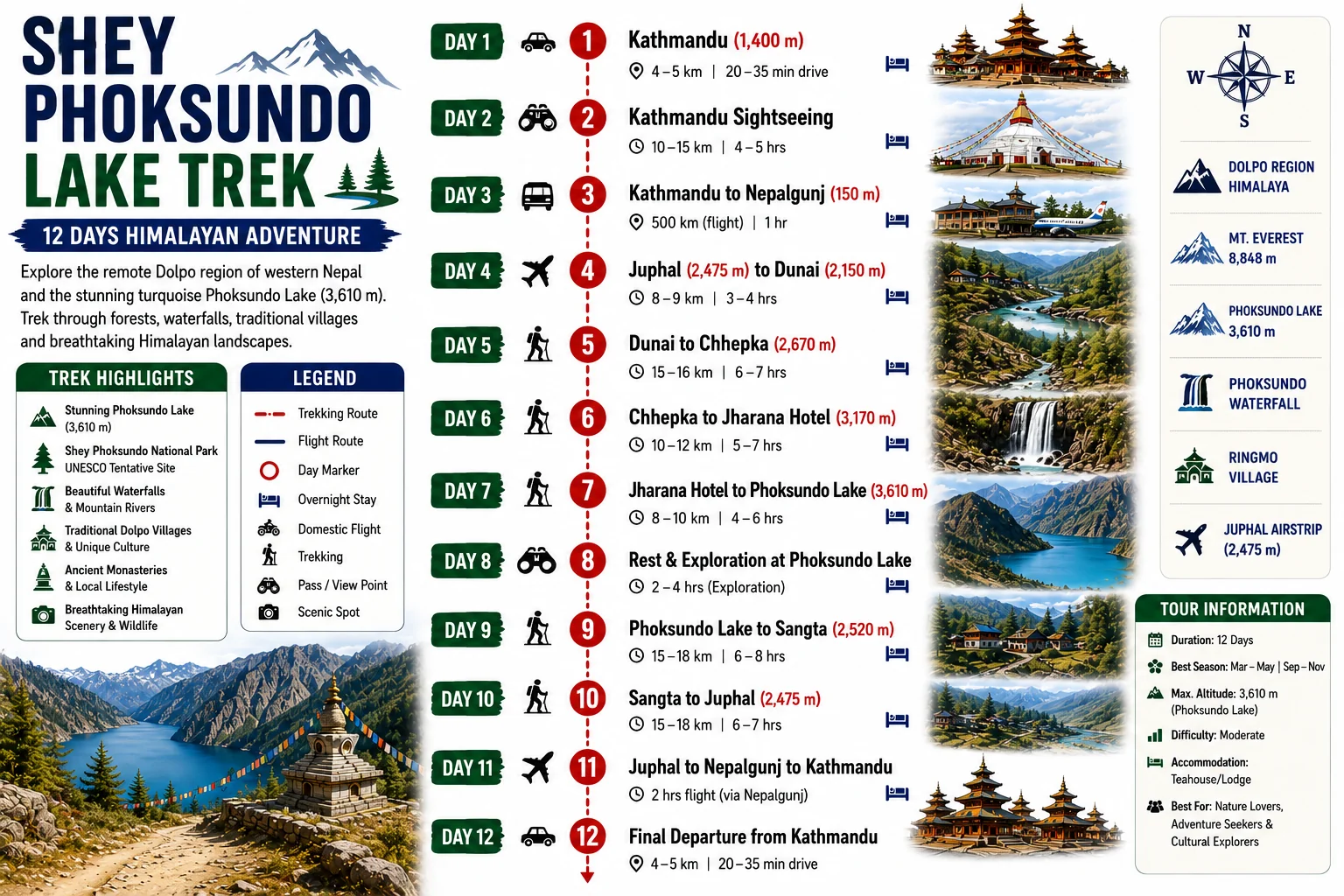
Detailed Day-by-Day Itinerary
Inclusions / Exclusions
Included
Excluded
Route Map
Gear List / Packing Guide
| Category | Items |
|---|---|
| Clothing | T-shirts, trekking pants, thermal wear, fleece, down jacket, waterproof jacket |
| Footwear | Trekking boots, trekking socks, sandals |
| Head & Hands | Sun hat, warm hat, gloves, sunglasses |
| Bags | Trekking backpack, duffel bag, rain cover |
| Trekking Gear | Trekking poles, sleeping bag, headlamp |
| Personal Items | Sunscreen, toiletries, water bottle, personal medicines |
| Electronics | Phone, camera, power bank, chargers |
| Documents | Passport, permits, travel insurance, cash |
FAQ
The Shey Phoksundo Lake Trek is a 12-day Himalayan adventure through the remote Dolpa region of western Nepal, featuring Phoksundo Lake, mountain landscapes, forests, waterfalls, and traditional Dolpo villages.
A 12-day itinerary provides time for Kathmandu preparation, flights to Dolpa, trekking to Phoksundo Lake, a rest day, and the return journey to Kathmandu.
The maximum altitude is approximately 3,610 m / 11,844 ft at Phoksundo Lake.
The best seasons are generally March to May and September to November, when trekking conditions and mountain visibility are usually favorable.
The trek is suitable for travelers with reasonable fitness and basic trekking experience. Regular walking and preparation are recommended because the route includes long trekking days and remote mountain terrain.
Major highlights include Phoksundo Lake, Shey Phoksundo National Park, Phoksundo Waterfall, Ringmo Village, traditional Dolpo culture, mountain forests, and dramatic Himalayan landscapes.
The Shey Phoksundo Lake Trek is generally considered a moderate-level trek, with several long walking days and gradual altitude gain.
The trekking section begins at Juphal, reached by a domestic flight from Nepalgunj. The overall journey starts in Kathmandu.
Travelers normally fly from Kathmandu to Nepalgunj, then fly from Nepalgunj to Juphal. The trekking route continues through Dunai, Chhepka, and Jharana Hotel toward Phoksundo Lake.
A popular 12-day route follows Kathmandu → Nepalgunj → Juphal → Dunai → Chhepka → Jharana Hotel → Phoksundo Lake → Sangta → Juphal → Nepalgunj → Kathmandu.
Accommodation is generally provided in teahouses and local lodges along the trekking route, with hotel accommodation in Kathmandu and Nepalgunj.
The package can include breakfast, lunch, and dinner during the trekking period, with meals provided according to the daily itinerary.
Trekkers require the necessary Shey Phoksundo National Park entry permit and applicable trekking permits for the Dolpa region.
Essential gear includes trekking boots, warm clothing, thermal layers, a down jacket, waterproof jacket, trekking poles, sleeping bag, backpack, headlamp, sunglasses, water bottle, sunscreen, personal medicines, and travel documents.
Yes. Day 8 is reserved for rest, acclimatization, and exploration around Phoksundo Lake, including opportunities to explore Ringmo Village and the surrounding area.
Phoksundo Lake is renowned for its striking turquoise-blue water, dramatic mountain surroundings, remote location, and unique natural and cultural environment.
Yes. The route is well suited to nature lovers interested in alpine lakes, forests, waterfalls, mountain scenery, wildlife, remote landscapes, and traditional Himalayan settlements.
Yes. The itinerary can be extended, shortened, or customized according to travel dates, group size, trekking pace, accommodation preferences, interests, and budget.
A package can include airport transfers, accommodation, domestic flights, trekking guide, porter service, meals, permits, national park fees, and applicable government taxes and service charges.
A local travel agency can assist with domestic flight arrangements, permits, accommodation, trekking staff, transportation, itinerary planning, and customized travel arrangements, making the journey easier to organize.
More Details
 Shey Phoksundo Lake Trek Accommodation Types
The Shey Phoksundo Lake Trek offers a combination of comfortable hotels in Kathmandu and Nepalgunj and simple teahouses, lodges, and local guesthouses along the trekking route. As the trail enters the remote Dolpa region, accommodation becomes more basic, while local hospitality and peaceful mountain surroundings make the overnight experience memorable.
Accommodation Overview
| Location | Accommodation Type |
|---|---|
| Kathmandu | 3★–5★ Hotels, Boutique Hotels & Guesthouses |
| Nepalgunj | Hotels & Guesthouses |
| Juphal | Local Hotels, Guesthouses & Lodges |
| Dunai | Local Guesthouses & Lodges |
| Chhepka | Basic Teahouses & Lodges |
| Jharana Hotel | Basic Lodge / Guesthouse |
| Phoksundo Lake / Ringmo | Local Teahouses & Guesthouses |
| Sangta | Basic Guesthouse / Lodge |
Room Facilities
Accommodation along the Shey Phoksundo Lake Trek is simple and primarily designed to provide trekkers with a comfortable place to rest after a day of walking.
- Twin-sharing or multiple-sharing rooms
- Basic beds and mattresses
- Blankets and pillows where available
- Simple furniture
- Shared bathrooms in most trekking locations
- Attached bathrooms mainly in Kathmandu and lower-elevation hotels
- Limited heating in remote areas
- Sleeping bag recommended for colder nights
Dining Facilities
Local teahouses and lodges generally provide freshly prepared meals using locally available ingredients.
Dining facilities may include:
- Communal dining areas
- Breakfast, lunch, and dinner
- Nepali, Tibetan, Indian, and simple Continental dishes
- Dal Bhat, noodles, rice, pasta, momos, and soups
- Tea, coffee, lemon tea, and other hot beverages
- Warm dining areas at selected lodges
Additional Facilities
| Facility | Availability |
|---|---|
| Hot Shower | Limited, depending on location |
| Wi-Fi | Limited or unavailable in remote areas |
| Mobile Charging | Available at selected lodges |
| Drinking Water | Boiled, filtered, or treated water |
| Laundry | Limited |
| Heating | Mainly in dining/common areas where available |
Additional Charges
| Service | Availability / Cost |
|---|---|
| Hot Shower | Selected locations, additional charge |
| Mobile Charging | Additional charge where available |
| Wi-Fi | Selected locations, additional charge |
| Boiled Drinking Water | Additional charge |
| Laundry | Limited and charged separately |
What to Expect
As the trek progresses deeper into the Dolpa region, accommodation becomes more traditional and basic. Small teahouses and local guesthouses provide simple rooms, home-style meals, and genuine local hospitality.
Trekkers can expect:
- Basic but comfortable accommodation
- Warm local hospitality
- Freshly prepared meals
- Peaceful mountain surroundings
- Communal dining areas
- Local cultural interaction
- Simple facilities in remote sections
Accommodation Tips
- Carry a warm four-season sleeping bag.
- Bring a power bank because charging facilities can be limited.
- Carry sufficient Nepalese Rupees for personal expenses.
- Pack warm clothing for mornings and evenings.
- Carry personal toiletries.
- Keep valuables in your daypack.
- Expect limited internet and mobile connectivity.
- Respect local customs and shared facilities.
Why You'll Love Staying on the Shey Phoksundo Lake Trek
Accommodation along the Shey Phoksundo Lake Trek provides more than a place to sleep. Local teahouses and guesthouses offer opportunities to experience the hospitality, food, culture, and peaceful lifestyle of the Dolpa region. The simple facilities, remote surroundings, and authentic local atmosphere become an important part of the Himalayan trekking experience.
 What to Expect from the Shey Phoksundo Lake Trek
The Shey Phoksundo Lake Trek is an off-the-beaten-path Himalayan adventure through the remote landscapes of Dolpa in western Nepal. The journey combines dramatic mountain valleys, peaceful forests, traditional villages, waterfalls, rugged trails, and the spectacular turquoise waters of Phoksundo Lake at 3,610 meters. Trekkers can also experience the natural and cultural character of Shey Phoksundo National Park while traveling through one of Nepal's less-crowded trekking regions.
Himalayan Mountain Views
The Shey Phoksundo Lake Trek offers impressive views of the surrounding Himalayan mountains, rocky cliffs, deep valleys, and high mountain landscapes. Clear weather provides excellent opportunities to enjoy panoramic scenery along elevated sections of the trail.
| Mountain / View | Experience |
|---|---|
| Dolpo Mountain Range | Dramatic mountain scenery surrounding the trekking route |
| Phoksundo Valley | Deep Himalayan valley with spectacular natural landscapes |
| Phoksundo Lake | Turquoise alpine lake surrounded by mountains and cliffs |
| Rocky Mountain Cliffs | Impressive formations along the trail |
| Himalayan Landscapes | Panoramic scenery from elevated trekking sections |
Diverse Landscapes
The Shey Phoksundo Lake Trek passes through different natural environments as the trail gradually gains elevation.
You will walk through:
- Deep mountain valleys
- Pine, birch, and mixed forests
- Rocky Himalayan trails
- Waterfall areas
- River valleys
- Traditional mountain settlements
- High-altitude landscapes
- Scenic viewpoints
- Alpine surroundings near Phoksundo Lake
Phoksundo Lake Experience
Phoksundo Lake is the main highlight of the trek and one of the most remarkable natural attractions in Dolpa. Located at approximately 3,610 meters, the lake is famous for its striking turquoise-blue water and dramatic mountain surroundings.
Visitors can enjoy:
- Turquoise alpine lake scenery
- Dramatic cliffs surrounding the lake
- Peaceful mountain environment
- Photography opportunities
- Nature walks around the lake
- Views of the surrounding Himalayan landscape
- Traditional settlements near the lake
Traditional Villages and Local Communities
The trek passes through remote mountain settlements where travelers can experience the traditional lifestyle of Dolpa. Local communities, traditional houses, simple guesthouses, and mountain agriculture provide opportunities to observe everyday life away from Nepal's major tourist centers.
Popular locations include:
- Juphal
- Dunai
- Chhepka
- Jharana Hotel area
- Ringmo
- Phoksundo Lake area
- Sangta
These areas offer:
- Traditional mountain lifestyles
- Local hospitality
- Rural communities
- Traditional houses and settlements
- Local food experiences
- Mountain landscapes
- Cultural interaction
Flora and Wildlife
The trekking route passes through forests, valleys, rivers, and high-altitude environments within the Shey Phoksundo National Park.
You may encounter:
- Pine forests
- Birch forests
- Rhododendron vegetation
- Juniper and alpine plants
- Wildflowers during spring
- Himalayan birds
- Mountain wildlife
- Diverse native vegetation
Wildlife sightings depend on season, location, weather, and natural conditions.
Waterfalls and Rivers
Waterfalls and mountain rivers add another scenic element to the Shey Phoksundo Lake Trek. The sound of flowing water, forest surroundings, rocky cliffs, and narrow valleys create memorable sections along the trekking route.
Highlights include:
- Mountain waterfalls
- Clear streams
- River valleys
- Rocky river crossings
- Forest waterfalls
- Scenic water sources
Photography Opportunities
The Shey Phoksundo Lake Trek provides excellent opportunities for landscape, nature, cultural, and village photography.
Popular photography locations include:
- Dunai
- Chhepka
- Jharana Hotel area
- Phoksundo Waterfall
- Phoksundo Lake
- Ringmo village
- Traditional mountain settlements
- Himalayan valleys and cliffs
- Forest trails
- Local cultural activities
Cultural and Natural Heritage
The Shey Phoksundo region combines remarkable natural scenery with the traditional culture of Dolpa. The journey provides opportunities to observe remote mountain settlements, local customs, traditional architecture, religious practices, and the relationship between communities and the surrounding Himalayan environment.
Along the trail, you can experience:
- Traditional Dolpo culture
- Local customs and traditions
- Mountain communities
- Traditional settlements
- Buddhist cultural influences
- Local hospitality
- Mountain agriculture
- Sacred and natural landscapes
Ringmo Village Experience
Ringmo Village is one of the memorable cultural locations near Phoksundo Lake. The traditional settlement provides an opportunity to observe local architecture and experience the peaceful atmosphere of the Phoksundo region.
Visitors can enjoy:
- Traditional village surroundings
- Local culture
- Mountain scenery
- Traditional houses
- Peaceful Himalayan atmosphere
- Photography opportunities
A Typical Day on the Trek
Each trekking day follows a simple routine focused on walking, sightseeing, photography, rest, and enjoying the surrounding natural environment.
| Time | Activity |
|---|---|
| Early Morning | Wake up and enjoy breakfast |
| Morning | Begin trekking through forests, valleys, and mountain trails |
| Midday | Stop for lunch and rest |
| Afternoon | Continue trekking with sightseeing and photography breaks |
| Late Afternoon | Arrive at the next destination and check into accommodation |
| Evening | Dinner, relaxation, and trek briefing |
What Makes the Shey Phoksundo Lake Trek Special?
The Shey Phoksundo Lake Trek is more than a mountain hike. The journey combines the turquoise beauty of Phoksundo Lake, remote Dolpa landscapes, traditional villages, forests, waterfalls, dramatic cliffs, and authentic Himalayan culture. The quieter trekking environment makes the route especially appealing to travelers seeking a remote and nature-focused adventure in western Nepal.
The major experiences include:
- Exploring remote Dolpa
- Visiting Phoksundo Lake at 3,610 meters
- Walking through Shey Phoksundo National Park
- Experiencing traditional mountain villages
- Enjoying waterfalls and river valleys
- Photographing dramatic Himalayan landscapes
- Experiencing local Dolpo culture
- Trekking through peaceful and less-crowded trails
 Best Time / Season to Visit Shey Phoksundo Lake Trek
The best time for the Shey Phoksundo Lake Trek depends on weather, trail conditions, visibility, temperature, and personal trekking preferences. The most favorable trekking seasons are spring from March to May and autumn from September to November. These periods generally offer pleasant trekking conditions, clearer mountain views, and better opportunities to enjoy the landscapes of Dolpa.
Spring Season: March to May
Spring is one of the most popular seasons for the Shey Phoksundo Lake Trek. The weather becomes warmer, forests become greener, and mountain landscapes become increasingly attractive.
March
March marks the beginning of the spring trekking season. Temperatures gradually rise, while higher elevations can still remain cold.
April
April generally provides comfortable trekking conditions with good visibility and pleasant daytime temperatures. Spring vegetation adds color to the trekking landscapes.
May
May is the final month of the spring season. The lower regions become warmer, while higher sections remain comparatively cool.
| Month | Weather | Trekking Conditions | Main Highlights |
|---|---|---|---|
| March | Cool to mild | Good | Fresh landscapes and fewer trekkers |
| April | Mild and pleasant | Excellent | Clear views and spring scenery |
| May | Warm at lower elevations | Very Good | Green landscapes and comfortable trails |
Autumn Season: September to November
Autumn is another excellent period for the Shey Phoksundo Lake Trek. Weather conditions are generally stable following the monsoon period, and clearer skies can provide impressive views of the surrounding mountains.
September
September marks the beginning of the autumn trekking season. The landscapes remain fresh after the monsoon, while trekking conditions gradually improve.
October
October is one of the most favorable months for trekking in Nepal. Stable weather, clear skies, and good mountain visibility make October particularly suitable for the Phoksundo region.
November
November brings cooler temperatures, especially during mornings and evenings. Clear mountain views can still make November an excellent month for trekking.
| Month | Weather | Trekking Conditions | Main Highlights |
|---|---|---|---|
| September | Mild and improving | Good | Fresh landscapes |
| October | Stable and clear | Excellent | Mountain views and pleasant trails |
| November | Cool and clear | Very Good | Crisp views and quieter trails |
Winter Season: December to February
Winter brings colder temperatures and potentially challenging conditions at higher elevations. Snow and freezing temperatures can affect trekking conditions, particularly around higher sections of the route.
Winter trekking requires appropriate cold-weather clothing, suitable trekking equipment, and careful itinerary planning.
| Month | Weather | Trekking Conditions | Considerations |
|---|---|---|---|
| December | Cold | Moderate | Cold mornings and nights |
| January | Very cold | Challenging | Possible snow and freezing temperatures |
| February | Cold | Moderate to Challenging | Conditions gradually begin improving |
Monsoon Season: June to August
The monsoon season can bring rainfall, cloud cover, slippery trails, and reduced mountain visibility in many parts of Nepal. Flight operations can also be affected by weather conditions.
For travelers planning the Shey Phoksundo Lake Trek, monsoon months require greater flexibility because transportation and trail conditions can change according to weather.
| Month | Weather | Trekking Conditions | Considerations |
|---|---|---|---|
| June | Rainy | Moderate | Increasing rainfall |
| July | Wet | Challenging | Rain and slippery trails |
| August | Wet | Challenging | Cloudy conditions and rainfall |
Best Month for Shey Phoksundo Lake Trek
October is generally one of the best months for the Shey Phoksundo Lake Trek. Stable autumn weather, comfortable trekking temperatures, clear mountain views, and favorable trail conditions make October highly suitable for exploring Phoksundo Lake and the surrounding Dolpa landscapes.
April and November are also excellent choices for travelers seeking good weather and relatively comfortable trekking conditions.
Best Season for Clear Mountain Views
Autumn, particularly October and November, is highly suitable for clear Himalayan scenery. Stable weather and lower atmospheric moisture can provide better visibility of mountains, valleys, cliffs, and Phoksundo Lake.
Best Season for Spring Landscapes
April and May are excellent months for travelers interested in greenery, forest scenery, and spring vegetation. The trekking route becomes visually vibrant as plants and flowers develop across the lower and middle elevations.
Best Season for Fewer Trekkers
Traveling during the shoulder periods, particularly March, May, September, and November, can provide a quieter trekking experience compared with the busiest periods.
Recommended Trekking Seasons
For most travelers, the recommended periods are:
- March to May: Best for spring landscapes and comfortable trekking
- September to November: Best for stable weather and mountain visibility
- October: Excellent overall choice
- April: Excellent spring option
- November: Good option for cooler weather and quieter trails
Seasonal Packing Considerations
Packing requirements change according to the trekking season.
Spring: Light layers, warm fleece, rain protection, sun protection, and comfortable trekking clothing.
Autumn: Warm layers, fleece, down jacket, sun protection, and rain protection.
Winter: Heavy down jacket, thermal layers, warm gloves, insulated clothing, and suitable cold-weather trekking gear.
Monsoon: Waterproof jacket, rain cover, quick-drying clothing, waterproof bags, and suitable footwear.
When Should You Book the Shey Phoksundo Lake Trek?
Travelers planning to trek during April, May, October, or November should arrange flights, accommodation, permits, guides, and trekking logistics in advance. Early planning can provide better flexibility for transportation and accommodation arrangements.
 Nearby Places to Explore from the Shey Phoksundo Lake Trek
The Shey Phoksundo Lake Trek takes travelers through remote areas of Dolpa with opportunities to explore natural landscapes, traditional settlements, waterfalls, rivers, and culturally significant locations. Several attractions can be visited along the trekking route or incorporated into a customized Dolpa itinerary.
Phoksundo Lake
Phoksundo Lake is the principal attraction of the trek and one of the most spectacular alpine lakes in Nepal. Located at approximately 3,610 meters, the lake is surrounded by steep cliffs, mountains, and peaceful Himalayan landscapes.
Main experiences:
- Turquoise-blue lake
- Dramatic mountain cliffs
- Himalayan scenery
- Photography
- Nature walks
- Peaceful lakeside surroundings
Ringmo Village
Ringmo Village is a traditional settlement near Phoksundo Lake. The village provides an opportunity to experience the traditional lifestyle, architecture, and cultural environment of the Dolpo region.
Visitors can explore:
- Traditional houses
- Local settlement patterns
- Mountain culture
- Buddhist cultural influences
- Local lifestyle
- Scenic surroundings
Phoksundo Waterfall
Phoksundo Waterfall is a major natural attraction associated with the Phoksundo region. Flowing through the rugged Himalayan landscape, the waterfall creates an impressive combination of water, cliffs, forests, and mountains.
Highlights include:
- Scenic waterfall views
- Rocky cliffs
- Forest surroundings
- Photography opportunities
- Natural landscapes
Shey Phoksundo National Park
Shey Phoksundo National Park protects a large area of the Dolpa region and contains diverse Himalayan landscapes, forests, wildlife habitats, rivers, waterfalls, and high-altitude environments.
The national park offers opportunities to experience:
- Himalayan forests
- Alpine landscapes
- Mountain valleys
- Native wildlife habitats
- High-altitude vegetation
- Remote wilderness
Dunai
Dunai is an important settlement and administrative center in Dolpa. The town serves as a major point along trekking routes toward Phoksundo and other parts of Dolpa.
Travelers can experience:
- Local markets
- Traditional settlements
- Mountain lifestyle
- Local food
- River valleys
- Dolpa culture
Juphal
Juphal is an important gateway to the Dolpa trekking region. The local airport connects the area with Nepalgunj, making Juphal a significant transportation point for trekkers visiting Phoksundo.
Juphal offers:
- Mountain village scenery
- Local communities
- Traditional lifestyle
- Access to trekking routes
- Himalayan landscapes
Chhepka
Chhepka is a trekking settlement along the route toward Phoksundo Lake. The surrounding forests and mountain scenery make the area a pleasant overnight stop during the trek.
Highlights include:
- Forest trails
- Mountain landscapes
- Local teahouses
- River surroundings
- Peaceful trekking environment
Jharana Hotel Area
The Jharana Hotel area provides a scenic overnight stop along the trekking route toward Phoksundo Lake. Waterfalls, forests, mountain terrain, and surrounding wilderness create a memorable trekking environment.
Travelers can enjoy:
- Waterfall scenery
- Forest landscapes
- Mountain trails
- Quiet surroundings
- Photography opportunities
Dolpa Villages and Mountain Settlements
The trekking route provides opportunities to visit small settlements and observe traditional Himalayan lifestyles. Remote villages offer a different experience from the major tourist destinations of Nepal.
Cultural experiences may include:
- Traditional houses
- Local agriculture
- Mountain hospitality
- Village lifestyles
- Local customs
- Traditional food
Sangta
Sangta can be included as a stop according to the selected trekking itinerary. The surrounding area provides opportunities to experience remote mountain landscapes and local settlements away from busy trekking routes.
Possible experiences include:
- Rural mountain scenery
- Local communities
- Quiet trails
- Traditional settlements
- Himalayan landscapes
Nearby Attractions at a Glance
| Place | Main Attraction | Best Experience |
|---|---|---|
| Phoksundo Lake | Turquoise alpine lake | Scenic views and photography |
| Ringmo Village | Traditional settlement | Culture and local lifestyle |
| Phoksundo Waterfall | Dramatic waterfall | Nature and photography |
| Shey Phoksundo National Park | Protected Himalayan wilderness | Nature and wildlife |
| Dunai | Major Dolpa settlement | Local culture and lifestyle |
| Juphal | Gateway to Dolpa | Village scenery and access |
| Chhepka | Forest and mountain trail | Trekking and nature |
| Jharana Hotel Area | Waterfall and forest scenery | Scenic overnight stop |
| Sangta | Remote mountain settlement | Rural Himalayan experience |
Best Places for Photography
Travelers interested in photography should pay particular attention to Phoksundo Lake, Ringmo Village, Phoksundo Waterfall, mountain cliffs, forest trails, river valleys, and traditional settlements.
Early morning and late afternoon can provide attractive natural light for mountain, village, and landscape photography.
Best Places for Cultural Experiences
For cultural experiences, Ringmo Village, Dunai, Juphal, and other traditional Dolpa settlements offer opportunities to observe local architecture, customs, lifestyles, and community activities.
Respect for local traditions, religious sites, private homes, and photography preferences is important throughout the trek.
Extending the Dolpa Adventure
Travelers with additional time can combine the Shey Phoksundo Lake Trek with longer Dolpa trekking routes, including destinations toward Shey and Upper Dolpo, subject to route conditions, permits, logistics, and itinerary requirements.
The longer routes require additional trekking days and preparation compared with the standard Phoksundo Lake itinerary.
 Foods Available on the Shey Phoksundo Lake Trek
Food is an important part of the Shey Phoksundo Lake Trek, especially during long trekking days in remote Dolpa. Meals are generally simple, nutritious, and prepared with locally available ingredients. Teahouses and lodges along the route usually serve traditional Nepali meals alongside common trekking foods.
Traditional Nepali Food
Dal Bhat Tarkari is one of the most common meals available during trekking in Nepal. Rice, lentil soup, vegetable curry, pickles, and seasonal vegetables provide a filling combination of carbohydrates and protein.
Common Nepali meals include:
- Dal Bhat Tarkari
- Vegetable curry
- Lentil soup
- Rice
- Roti
- Vegetable noodles
- Potato dishes
- Pickles
- Seasonal vegetables
Breakfast Options
Breakfast provides energy for the day's trekking. Available options depend on the lodge and location.
Common breakfast choices include:
- Tibetan bread
- Chapati
- Toast
- Pancakes
- Porridge
- Eggs
- Boiled potatoes
- Tea
- Coffee
- Hot milk
Lunch Options
Lunch is usually served at a teahouse or lodge along the trekking route. Simple meals are preferred because they are easy to prepare and provide sufficient energy for continuing the trek.
Popular lunch choices include:
- Dal Bhat
- Vegetable noodles
- Fried rice
- Pasta
- Soup
- Roti with vegetables
- Potatoes
- Momo where available
Dinner Options
Dinner is generally a warm and filling meal after a long trekking day.
Common dinner options include:
- Dal Bhat Tarkari
- Rice and vegetables
- Noodles
- Pasta
- Soup
- Potato dishes
- Roti
- Momo where available
Tibetan and Dolpo-Style Food
The Dolpo region has strong Himalayan and Tibetan cultural influences. Travelers may encounter traditional foods and locally prepared dishes in villages and remote settlements.
Possible local food experiences include:
- Tibetan-style bread
- Thukpa
- Tsampa
- Local vegetable dishes
- Potato-based meals
- Traditional soups
- Locally prepared snacks
Food availability can vary considerably between settlements.
Snacks During the Trek
Carrying personal snacks is recommended for longer trekking days, particularly along remote sections where shops and food choices can be limited.
Useful trekking snacks include:
- Energy bars
- Chocolate
- Biscuits
- Nuts
- Dried fruits
- Trail mix
- Granola bars
- Dry fruits
Tea and Hot Drinks
Hot drinks are commonly available at trekking lodges and teahouses. Warm beverages can be especially useful during cold mornings and evenings.
Common choices include:
- Black tea
- Milk tea
- Lemon tea
- Ginger tea
- Herbal tea
- Coffee
- Hot water
Vegetarian Food
Vegetarian meals are generally available along the main trekking route. Dal Bhat, vegetable curry, noodles, fried rice, pasta, soup, potatoes, and roti are common vegetarian choices.
Travelers with specific dietary requirements should inform the trekking agency before departure so suitable meal arrangements can be planned.
Drinking Water
Safe drinking water is essential throughout the Shey Phoksundo Lake Trek. Bottled water, boiled water, or treated water can be used depending on availability.
Recommended options include:
- Boiled drinking water
- Filtered water
- Water purification tablets
- Portable water filters
- Reusable water bottles
Avoid drinking untreated natural water directly from streams or rivers.
Food Hygiene and Safety
Food hygiene becomes particularly important in remote trekking areas. Travelers should choose freshly prepared meals and maintain good personal hygiene.
Recommended practices:
- Drink treated or boiled water
- Wash hands before meals
- Eat freshly cooked food
- Avoid questionable raw foods
- Carry personal snacks
- Keep reusable bottles clean
- Avoid excessive alcohol during trekking
Food Availability by Location
| Location | Typical Food Availability |
|---|---|
| Kathmandu | Wide range of Nepali, Asian, and international cuisine |
| Nepalgunj | Nepali, Indian, and common hotel restaurant meals |
| Juphal | Basic local meals and trekking food |
| Dunai | Dal Bhat, noodles, rice, vegetables, soups, and basic lodge meals |
| Chhepka | Simple teahouse meals and local food |
| Jharana Hotel Area | Basic trekking meals and hot drinks |
| Phoksundo / Ringmo | Simple local and teahouse meals |
| Sangta | Basic meals depending on lodge availability |
Best Food Choices for Energy
Long trekking days require meals containing sufficient carbohydrates, protein, and fluids.
Good choices include:
- Dal Bhat with vegetables
- Rice-based meals
- Porridge
- Potatoes
- Eggs
- Noodles
- Soup
- Nuts and dried fruits
- Fresh seasonal vegetables
Food Preparation in Remote Dolpa
Food choices become simpler as the trek moves deeper into remote areas. Local lodges generally prepare meals using ingredients transported from lower settlements or available locally.
Travelers should maintain realistic expectations about menu variety while appreciating the authentic mountain hospitality and locally prepared meals.
Dietary Requirements
Travelers with vegetarian, vegan, gluten-free, or other dietary requirements should communicate food preferences during the booking process. Advance information helps the trekking team coordinate suitable meals with lodges along the route.
Food Tips for the Shey Phoksundo Lake Trek
- Choose freshly cooked meals.
- Eat enough carbohydrates for trekking energy.
- Include protein and vegetables when available.
- Drink sufficient treated water.
- Carry personal snacks.
- Avoid excessive alcohol.
- Inform the trekking team about dietary requirements.
- Expect simpler menus in remote settlements.
- Maintain good food and hand hygiene.
 Culture and Etiquette of the Shey Phoksundo Lake Trek
The Shey Phoksundo Lake Trek passes through remote communities of Dolpa where traditional lifestyles, Buddhist cultural influences, local customs, and close-knit village communities remain important parts of daily life. Respectful behavior toward local people, religious places, traditional practices, and the natural environment helps create a positive trekking experience.
Respect Local Culture
Dolpa has a distinct Himalayan culture shaped by centuries of mountain living and Tibetan Buddhist traditions. Travelers should remain respectful when interacting with local communities and observing traditional practices.
Recommended practices include:
- Greet local people politely.
- Respect traditional customs.
- Ask permission before entering private homes.
- Avoid disturbing village activities.
- Follow local instructions.
- Dress respectfully around villages and religious sites.
- Show patience when communicating across language differences.
Buddhist Religious Practices
Several communities around the Phoksundo region follow Buddhist traditions. Monasteries, chortens, mani walls, prayer flags, and other religious structures should be treated with respect.
When visiting religious places:
- Remove hats when appropriate.
- Keep voices low.
- Avoid touching religious objects without permission.
- Ask before taking photographs.
- Follow the guidance of local residents or guides.
- Walk around stupas and chortens in a respectful direction.
- Avoid climbing on religious structures.
Prayer Flags and Mani Walls
Prayer flags and mani walls are important cultural and religious features across Himalayan settlements. Prayer flags carry religious significance, while mani stones and walls commonly contain Buddhist inscriptions.
Travelers should:
- Avoid stepping over mani stones.
- Avoid moving prayer flags.
- Avoid sitting on religious structures.
- Avoid writing or carving names on stones.
- Follow local customs when passing religious sites.
Photography Etiquette
The landscapes and villages of Dolpa provide excellent photography opportunities, but local people may have different preferences regarding photography.
Good photography practices include:
- Ask permission before photographing people.
- Ask before photographing inside homes or religious buildings.
- Respect requests not to be photographed.
- Avoid intrusive close-up photography.
- Avoid photographing private activities without consent.
- Follow photography restrictions at religious sites.
Dress Code
The trekking route includes remote villages and culturally significant locations. Comfortable trekking clothing is appropriate for hiking, while modest clothing is recommended when visiting villages, monasteries, and religious sites.
Recommended clothing includes:
- Comfortable trekking pants
- T-shirts
- Fleece or warm layers
- Long trousers
- Modest shirts
- Warm jackets
- Appropriate footwear
Interaction with Local Communities
Friendly interaction with local communities can make the trek more meaningful. Simple greetings and respectful conversations are usually appreciated.
Travelers can:
- Learn about local traditions.
- Ask respectful questions about village life.
- Support local lodges and shops.
- Purchase locally produced goods.
- Appreciate traditional architecture.
- Respect local privacy.
Food and Dining Etiquette
Meals along the trekking route are generally served in local teahouses and lodges. Travelers should remain respectful of local dining customs and avoid wasting food.
Useful practices include:
- Wait for meals to be served.
- Avoid unnecessary food waste.
- Keep dining areas clean.
- Respect shared dining spaces.
- Inform lodge staff about dietary requirements.
- Follow local dining customs when eating with local families.
Environmental Etiquette
The Shey Phoksundo region contains sensitive Himalayan ecosystems. Responsible trekking practices help protect forests, rivers, wildlife habitats, villages, and the surroundings of Phoksundo Lake.
Follow responsible trekking practices:
- Carry personal waste until a suitable disposal point.
- Avoid single-use plastic whenever possible.
- Do not litter.
- Avoid disturbing wildlife.
- Stay on established trails.
- Do not damage plants.
- Avoid polluting streams and rivers.
- Use designated toilet facilities.
Water and Natural Resources
Water resources are valuable in remote mountain communities. Travelers should avoid unnecessary water consumption and keep natural water sources clean.
Good practices include:
- Use water responsibly.
- Avoid washing with soap directly in streams.
- Do not throw waste into rivers.
- Carry reusable water bottles.
- Use treated drinking water.
Supporting Local Communities
Choosing local services can contribute directly to communities along the trekking route.
Travelers can support local communities by:
- Staying in locally operated lodges.
- Eating locally prepared meals.
- Purchasing local products.
- Hiring local guides and porters through responsible agencies.
- Respecting local businesses.
- Paying fairly for services.
Responsible Trekking Behavior
Remote trekking requires patience and flexibility. Transportation, accommodation, food supplies, and trail conditions can vary between locations.
Travelers should:
- Follow the guide's instructions.
- Respect local schedules.
- Maintain patience during delays.
- Avoid unnecessary arguments.
- Respect other trekkers.
- Keep noise levels low in villages.
- Follow national park regulations.
Cultural Etiquette at a Glance
| Situation | Recommended Etiquette |
|---|---|
| Villages | Respect local privacy and customs |
| Monasteries | Maintain quiet and follow local instructions |
| Chortens | Treat religious structures respectfully |
| Mani Walls | Avoid touching, climbing, or stepping over stones |
| Prayer Flags | Do not move or damage flags |
| Photography | Ask permission before photographing people |
| Local Homes | Ask permission before entering |
| Meals | Avoid food waste and respect dining customs |
| Environment | Carry waste and avoid pollution |
| Wildlife | Observe from a safe distance |
Important Cultural Tips for Shey Phoksundo Lake Trek
- Respect Dolpo traditions and local communities.
- Ask permission before photographing people.
- Maintain respectful behavior around monasteries and religious structures.
- Avoid touching religious objects without permission.
- Dress modestly around villages and religious sites.
- Keep trekking routes and natural areas clean.
- Respect local wildlife and vegetation.
- Support locally operated lodges and businesses.
- Follow guidance from local guides and national park authorities.
- Travel with patience and an open mind.
 Safety and Security on the Shey Phoksundo Lake Trek
The Shey Phoksundo Lake Trek takes place in a remote Himalayan region where trekking conditions can change according to altitude, weather, trail conditions, transportation schedules, and availability of local facilities. Proper preparation, responsible trekking practices, and guidance from an experienced trekking team help travelers enjoy a safer journey through Dolpa.
Altitude Safety
The highest point of the standard Shey Phoksundo Lake Trek is approximately 3,610 meters at Phoksundo Lake. Gradual altitude gain, adequate rest, hydration, and awareness of altitude-related symptoms are important during the trek.
Recommended practices include:
- Trek at a comfortable pace.
- Stay properly hydrated.
- Take scheduled rest periods.
- Avoid unnecessary physical exertion.
- Inform the guide about unusual symptoms.
- Allow sufficient time for acclimatization.
- Follow the planned trekking schedule.
Acclimatization and Rest
A rest day around Phoksundo Lake provides time to relax and explore the surrounding area without continuing to higher elevations. Rest periods can help the body adjust to the mountain environment.
During rest periods:
- Take short and easy walks.
- Drink sufficient fluids.
- Eat regular meals.
- Avoid strenuous activities.
- Get adequate sleep.
- Inform the guide about any discomfort.
Weather and Trail Conditions
Weather conditions in Dolpa can change quickly, particularly in mountainous areas. Rain, snow, strong winds, cold temperatures, and cloud cover can affect trekking conditions and visibility.
Travelers should carry:
- Waterproof jacket
- Warm layers
- Down jacket
- Trekking boots
- Gloves
- Warm hat
- Sunglasses
- Backpack rain cover
Flight Safety
The Kathmandu-Nepalgunj-Juphal flight connections form an important part of the trekking journey. Mountain weather can affect flight schedules, so travelers should maintain flexibility in the itinerary.
Good planning practices include:
- Keep additional time for possible delays.
- Follow airline instructions.
- Arrive at airports on schedule.
- Keep essential items in hand luggage.
- Maintain flexibility around the trekking itinerary.
Trekking with a Guide
Traveling with an experienced guide provides additional support along remote sections of the Shey Phoksundo Lake Trek. Guides can assist with navigation, accommodation coordination, local communication, weather-related decisions, and emergency procedures.
A trekking guide can assist with:
- Route navigation
- Daily trekking pace
- Local communication
- Accommodation arrangements
- Weather-related decisions
- Basic first aid support
- Emergency coordination
Emergency Preparedness
Remote areas of Dolpa have fewer medical facilities than major cities. Carrying essential medication, travel insurance, and a basic first-aid kit is strongly recommended.
Useful items include:
- Personal medicines
- First-aid supplies
- Blister treatment
- Pain-relief medicine
- Oral rehydration supplies
- Water purification supplies
- Travel insurance documents
- Emergency contact information
Travel Insurance
Travel insurance is an important part of preparation for the Shey Phoksundo Lake Trek. Insurance should provide appropriate coverage for trekking activities and potential emergency transportation according to the policy terms.
Travelers should check coverage for:
- Trekking activities
- Emergency medical treatment
- Emergency evacuation
- Flight delays or cancellations
- Trip interruption
- Lost or delayed baggage
Food and Drinking Water Safety
Safe food and drinking water practices are important during remote trekking.
Recommended practices include:
- Drink boiled, filtered, or treated water.
- Carry a reusable water bottle.
- Avoid untreated stream water.
- Eat freshly prepared meals.
- Maintain hand hygiene.
- Carry personal snacks.
- Avoid excessive alcohol consumption.
Personal Belongings and Valuables
Remote trekking requires careful management of personal belongings.
Travelers should:
- Keep passports secure.
- Store cash safely.
- Carry important documents in waterproof protection.
- Avoid carrying unnecessary valuables.
- Keep electronic devices protected from moisture.
- Use a secure daypack for essential belongings.
Wildlife and Environmental Safety
The trekking route passes through Shey Phoksundo National Park, where travelers should maintain a safe distance from wildlife and avoid disturbing natural habitats.
Follow responsible practices:
- Do not feed wildlife.
- Do not approach wild animals.
- Avoid loud noise near wildlife.
- Stay on established trails.
- Do not damage vegetation.
- Dispose of waste responsibly.
- Avoid polluting rivers and water sources.
Local Community Safety
Respectful interaction with local communities contributes to a safe and comfortable trekking experience.
Travelers should:
- Respect local customs.
- Ask permission before entering private areas.
- Follow guide instructions.
- Avoid unnecessary disputes.
- Respect religious places.
- Ask permission before photographing local people.
Communication During the Trek
Mobile connectivity can be limited or unavailable across remote sections of Dolpa. Travelers should not depend entirely on mobile communication for emergencies.
Recommended preparations include:
- Share the itinerary with family members.
- Keep emergency contact information accessible.
- Carry a fully charged power bank.
- Follow guide communication procedures.
- Inform the trekking team before leaving the group.
Safety Tips at a Glance
| Safety Area | Recommended Practice |
|---|---|
| Altitude | Trek gradually and monitor symptoms |
| Weather | Carry suitable warm and waterproof clothing |
| Flights | Allow flexibility for weather-related delays |
| Navigation | Follow the guide and established trails |
| Water | Drink boiled, filtered, or treated water |
| Food | Choose freshly prepared meals |
| Insurance | Obtain suitable trekking coverage |
| Emergency | Carry essential medicines and first-aid supplies |
| Wildlife | Maintain a safe distance |
| Environment | Avoid littering and pollution |
| Documents | Keep passport and permits secure |
| Communication | Carry backup power and emergency contacts |
Important Safety Tips for Shey Phoksundo Lake Trek
- Prepare physically before the trek.
- Follow the recommended itinerary.
- Maintain a steady trekking pace.
- Stay hydrated throughout the journey.
- Take adequate rest.
- Inform the guide about health concerns during the trek.
- Carry appropriate clothing for changing weather.
- Keep essential documents and valuables secure.
- Follow national park regulations.
- Maintain flexibility for weather and flight changes.
- Travel with appropriate insurance coverage.
- Follow instructions from experienced guides and local authorities.
 Transportation Facilities for the Shey Phoksundo Lake Trek
The Shey Phoksundo Lake Trek combines domestic flights and trekking because the Phoksundo region lies in remote Dolpa. Air transportation provides access from Kathmandu toward western Nepal, while trekking connects the airports and settlements with the Phoksundo Lake area. Transportation arrangements can vary according to weather, flight schedules, road conditions, and the selected itinerary.
Kathmandu to Nepalgunj Flight
The journey toward Dolpa generally begins with a domestic flight from Kathmandu to Nepalgunj. Nepalgunj serves as an important transportation hub for travelers continuing toward the Dolpa region.
Travelers can expect:
- Domestic flight from Kathmandu
- Short airport transfer arrangements
- Scenic views during the flight
- Overnight stay or transit arrangements in Nepalgunj
Nepalgunj to Juphal Flight
The next major transportation connection is the flight from Nepalgunj to Juphal Airport. Juphal is an important gateway for trekking toward Dunai and Phoksundo Lake.
Key points:
- Mountain flight experience
- Limited flight schedules
- Weather-dependent operations
- Baggage restrictions according to airline policy
- Early airport reporting may be required
Juphal to Dunai
After arriving at Juphal, transportation arrangements depend on the selected trekking itinerary and local road conditions. The route toward Dunai forms an important connection before beginning the main trekking sections.
For trekking-focused itineraries, travelers may continue on foot according to the planned route.
Trekking Transportation
Walking is the primary form of transportation during the Shey Phoksundo Lake Trek. The trekking route passes through forests, river valleys, mountain settlements, waterfalls, and rugged Himalayan terrain.
Main trekking sections include:
- Dunai to Chhepka
- Chhepka to Jharana Hotel area
- Jharana Hotel area to Phoksundo Lake
- Phoksundo Lake to the return-route settlements
- Return toward Juphal
Local Road Transportation
Local road transportation may be available on selected sections depending on road access, weather, and current trail conditions. Road availability in remote Dolpa can change, so transportation should be confirmed before departure.
Possible local transportation includes:
- Local jeeps
- Private vehicles
- Shared vehicles
- Local buses on accessible sections
Road transportation should only be used where suitable and permitted by the current route conditions.
Porter Support
Porters are commonly used to transport trekking equipment and personal luggage during remote Himalayan treks. Porter support allows trekkers to carry a lighter daypack while walking.
Porter services can assist with:
- Carrying duffel bags
- Transporting trekking equipment
- Managing luggage between lodges
- Supporting longer trekking days
Airport Transfers
Airport transfers can be arranged in Kathmandu and Nepalgunj according to the package itinerary. Private vehicles are generally more convenient for organized trekking groups.
Airport transfer services may include:
- Airport pickup
- Hotel transfer
- Airport drop-off
- Domestic terminal transportation
- Group transportation arrangements
Transportation Between Major Points
| Route | Transportation |
|---|---|
| Kathmandu to Nepalgunj | Domestic flight |
| Nepalgunj to Juphal | Domestic flight |
| Juphal to Dunai | Trekking / local transportation depending on itinerary |
| Dunai to Chhepka | Trekking |
| Chhepka to Jharana Hotel Area | Trekking |
| Jharana Hotel Area to Phoksundo Lake | Trekking |
| Phoksundo Lake Return Route | Trekking |
| Juphal to Nepalgunj | Domestic flight |
| Nepalgunj to Kathmandu | Domestic flight |
Flight Schedule and Weather Conditions
Flights to remote mountain airports can be affected by weather conditions. Strong winds, cloud cover, poor visibility, or other operational factors may cause delays or cancellations.
Travelers should:
- Keep flexible travel arrangements.
- Allow buffer time in the itinerary.
- Follow airline instructions.
- Stay in contact with the trekking agency.
- Avoid scheduling tight international connections immediately after remote-area flights.
Baggage Considerations
Domestic flights toward remote mountain airports generally have specific baggage allowances. Travelers should check the current airline baggage policy before departure.
Recommended approach:
- Keep essential items in hand luggage.
- Use a durable trekking duffel bag.
- Protect electronics and documents from moisture.
- Keep valuables with personal carry-on belongings.
- Confirm baggage limits before the flight.
Transportation for Private Groups
Private groups can arrange transportation according to group size and itinerary requirements. Private airport transfers, vehicle arrangements, porters, guides, and flight coordination can be incorporated into a customized trekking package.
Transportation Tips for Shey Phoksundo Lake Trek
- Confirm domestic flight schedules before departure.
- Keep additional time for possible flight delays.
- Follow current baggage restrictions.
- Protect luggage from rain and moisture.
- Use experienced local trekking support.
- Keep important documents accessible.
- Maintain flexibility during remote-area transportation.
- Confirm road conditions before relying on local vehicles.
- Avoid tight connections after Juphal flights.
- Follow guide instructions during trekking and transportation changes.
Why Transportation Planning Matters
The Shey Phoksundo Lake Trek takes place in a remote Himalayan region with limited transportation infrastructure. Proper coordination of flights, airport transfers, local transportation, porters, and trekking stages helps create a smoother journey from Kathmandu to Phoksundo Lake and back to Kathmandu.
 Shey Phoksundo Lake Trek Difficulty and Physical Fitness Required
The Shey Phoksundo Lake Trek is considered a moderate-level trekking adventure through the remote landscapes of Dolpa. The route includes forest trails, rocky paths, river valleys, uphill and downhill sections, and gradual altitude gain toward Phoksundo Lake at approximately 3,610 meters. A reasonable level of physical fitness, proper preparation, and a steady trekking pace are important for completing the journey comfortably.
Overall Trek Difficulty
The Shey Phoksundo Lake Trek is suitable for travelers with basic to moderate trekking experience and good general fitness. Previous high-altitude trekking experience is helpful but not always essential for prepared travelers.
The main difficulty factors include:
- Daily walking for several hours
- Uneven and rocky trails
- Uphill and downhill sections
- Gradual altitude gain
- Remote mountain conditions
- Variable weather
- Limited facilities in remote settlements
- Long transportation connections
Altitude of the Trek
The maximum altitude of the standard itinerary reaches approximately 3,610 meters at Phoksundo Lake. Although the elevation is lower than many popular high-altitude Himalayan trekking destinations, travelers still need time to adapt to reduced oxygen levels.
| Location | Approx. Elevation |
|---|---|
| Kathmandu | 1,400 m |
| Nepalgunj | 150 m |
| Juphal | 2,475 m |
| Dunai | 2,150 m |
| Chhepka | 2,670 m |
| Jharana Hotel Area | 3,170 m |
| Phoksundo Lake | 3,610 m |
Daily Walking Requirement
Most trekking days involve several hours of walking. The actual walking duration can vary according to the selected route, weather, trail conditions, group pace, and rest stops.
Trekkers should be comfortable with:
- Long-distance walking
- Moderate uphill climbs
- Descents on uneven trails
- Rocky mountain paths
- Walking with a daypack
- Consecutive trekking days
Physical Fitness Required
Good cardiovascular fitness and leg strength can make the trek considerably more comfortable.
Useful preparation includes:
- Regular walking
- Hiking on uneven terrain
- Stair climbing
- Leg-strength exercises
- Cardiovascular training
- Weekend hikes
- Gradually increasing walking distance
Recommended Training Plan
A training routine started several weeks before departure can help prepare the body for trekking.
| Training | Recommended Focus |
|---|---|
| Walking | Regular long-distance walks |
| Hiking | Hills and uneven terrain |
| Stair Climbing | Leg endurance |
| Squats | Thigh and leg strength |
| Lunges | Leg stability |
| Cardio | Walking, cycling, jogging, or swimming |
| Core Training | Balance and posture |
| Endurance Training | Longer sessions over consecutive days |
Beginner Suitability
The Shey Phoksundo Lake Trek can be suitable for beginners who have good fitness and prepare adequately before departure. Travelers without previous trekking experience should focus on physical preparation and follow the planned itinerary rather than rushing through trekking stages.
A professional guide can provide pacing support and help manage daily trekking conditions.
Altitude Acclimatization
Altitude adaptation is an important consideration as the route climbs toward Phoksundo Lake. The itinerary includes gradual elevation gain and a rest day around the lake.
Good acclimatization practices include:
- Walk at a steady pace.
- Drink enough water.
- Get adequate sleep.
- Avoid excessive physical exertion.
- Take regular breaks.
- Inform the guide about unusual symptoms.
- Follow the planned itinerary.
Mental Preparation
Remote trekking requires patience, flexibility, and a positive attitude. Accommodation, food choices, transportation, and trail conditions can be more basic than in major tourist areas.
Travelers should be prepared for:
- Simple accommodation
- Basic meals
- Limited communication
- Weather changes
- Flight delays
- Long trekking days
- Remote mountain environments
Trekking with a Daypack
Trekkers normally carry essential personal items in a daypack while porters can carry larger trekking bags when porter services are included.
A daypack can contain:
- Water bottle
- Sunglasses
- Sunscreen
- Rain jacket
- Warm layer
- Personal medicines
- Camera or phone
- Snacks
- Important documents
Rest and Recovery
Adequate rest is important during the trek. A comfortable sleeping routine, regular meals, hydration, and short breaks during walking can help maintain energy throughout the journey.
Recommended habits include:
- Sleep sufficiently.
- Eat regular meals.
- Stay hydrated.
- Stretch after trekking.
- Keep a comfortable walking pace.
- Avoid unnecessary late-night activities.
Trek Difficulty by Category
| Category | Difficulty Level |
|---|---|
| Overall Difficulty | Moderate |
| Altitude | Moderate |
| Trail Condition | Moderate to challenging in some sections |
| Daily Walking | Moderate |
| Technical Climbing | Not generally required |
| Physical Fitness | Good fitness recommended |
| Trekking Experience | Helpful but not mandatory |
| Acclimatization | Important |
Who Can Join the Trek?
The trek can be appropriate for:
- Physically fit beginners
- Experienced trekkers
- Nature enthusiasts
- Adventure travelers
- Photographers
- Travelers interested in remote Himalayan culture
- Small private trekking groups
Who Should Prepare More Carefully?
Travelers with limited hiking experience should begin physical training before departure. Individuals with concerns about their ability to handle altitude or prolonged walking should obtain appropriate professional medical advice before undertaking a high-altitude trek.
Tips for Making the Trek Easier
- Start physical preparation early.
- Build walking endurance gradually.
- Practice hiking on uphill and downhill terrain.
- Use comfortable, broken-in trekking boots.
- Carry only essential items in the daypack.
- Maintain a steady pace.
- Drink sufficient water.
- Take adequate rest.
- Follow guide instructions.
- Avoid rushing to higher elevations.
Is Shey Phoksundo Lake Trek Worth the Difficulty?
For travelers seeking remote Himalayan scenery, Phoksundo Lake, Dolpo culture, waterfalls, forests, dramatic valleys, and less-crowded trekking routes, the moderate physical challenge is well balanced by the natural and cultural experiences along the journey.
 10 Shey Phoksundo Lake Trek Cost Breakdown
The Shey Phoksundo Lake Trek cost depends on trekking duration, accommodation category, transportation, guide and porter services, permits, meals, group size, and personal expenses. A well-planned package combines the major trekking costs into a clear budget so travelers can prepare financially before departure.
Main Factors Affecting Trek Cost
Several factors influence the overall price of a Shey Phoksundo Lake Trek package.
| Cost Factor | Impact on Total Cost |
|---|---|
| Domestic Flights | Major transportation expense |
| Accommodation | Cost varies by hotel and lodge category |
| Meals | Depends on meal plan and location |
| Guide Service | Depends on trekking duration and service level |
| Porter Service | Depends on luggage requirements and trekking days |
| Permits | Required according to the trekking route |
| Private Transportation | Depends on vehicle type and group size |
| Group Size | Larger groups can reduce per-person operational costs |
| Travel Season | Prices may vary during peak trekking periods |
| Personal Expenses | Depends on individual spending habits |
Domestic Flight Cost
Domestic flights form an important part of the Shey Phoksundo Lake Trek budget. The itinerary generally involves flights between Kathmandu, Nepalgunj, and Juphal.
Flight costs can vary according to:
- Airline
- Travel season
- Availability
- Baggage allowance
- Booking date
- Flight schedule
- Operational conditions
Mountain flight schedules can also change because of weather conditions.
Accommodation Cost
Accommodation costs depend on the location and available facilities.
| Location | Typical Accommodation |
|---|---|
| Kathmandu | Tourist-standard hotel |
| Nepalgunj | Hotel or guesthouse |
| Juphal | Local lodge or guesthouse |
| Dunai | Local lodge or guesthouse |
| Chhepka | Basic teahouse |
| Jharana Hotel Area | Basic lodge or guesthouse |
| Phoksundo / Ringmo | Local teahouse or guesthouse |
| Sangta | Basic lodge or guesthouse |
Accommodation becomes simpler in remote sections of Dolpa, while Kathmandu and Nepalgunj offer a wider range of hotel categories.
Food Cost
Meals are generally included in organized trekking packages according to the selected meal plan. Food prices can increase in remote areas because supplies require transportation from lower regions.
Common trekking meals include:
- Dal Bhat
- Noodles
- Fried rice
- Pasta
- Soup
- Roti
- Vegetables
- Eggs
- Tea and coffee
Guide Cost
A professional trekking guide is an important part of a remote Dolpa trekking package. Guide costs generally depend on:
- Number of trekking days
- Group size
- Guide experience
- Services included
- Route complexity
- Transportation requirements
A guide can assist with navigation, local communication, accommodation coordination, and trekking logistics.
Porter Cost
Porter services can be added according to luggage requirements. Porters carry larger trekking bags while trekkers normally carry a lighter daypack.
Porter service can cover:
- Luggage transportation
- Trekking equipment transportation
- Lodge-to-lodge luggage transfer
- Support during long trekking stages
Permit and Entry Fees
The Shey Phoksundo region falls within a protected national park area. Trekking permits and applicable entry fees depend on the selected route and current regulations.
Travelers should confirm the latest permit requirements before departure because fees and regulations can change.
Travel Insurance
Travel insurance is normally a personal travel expense rather than a trekking package cost. Insurance should provide appropriate coverage for trekking activities and emergency services according to the policy terms.
Potential coverage may include:
- Emergency medical treatment
- Emergency evacuation
- Trip interruption
- Flight disruption
- Baggage loss or delay
Personal Expenses
Personal spending varies between travelers.
Common personal expenses include:
- Snacks
- Bottled or treated water
- Hot drinks
- Phone calls
- Internet services where available
- Personal medicines
- Laundry
- Tips
- Souvenirs
- Extra accommodation
- Extra transportation
Typical Cost Structure
| Expense Category | Usually Included in Trek Package |
|---|---|
| Kathmandu Hotel | Usually included |
| Nepalgunj Hotel | Usually included |
| Domestic Flights | Usually included in organized packages |
| Trekking Accommodation | Usually included |
| Meals | According to package meal plan |
| Guide | Usually included |
| Porter | Depends on package |
| Permits | Usually included |
| Airport Transfers | Usually included |
| Travel Insurance | Usually excluded |
| Personal Expenses | Usually excluded |
| Tips | Usually excluded |
| Extra Nights | Usually excluded |
Budget Trekking Package
A budget-oriented package focuses on essential trekking services and basic accommodation.
Usually includes:
- Standard domestic transportation
- Basic trekking accommodation
- Standard meals
- Licensed guide
- Required permits
- Basic airport transfers
Budget packages are suitable for travelers who prioritize the trekking experience over premium accommodation and additional services.
Standard Trekking Package
A standard package provides a balanced combination of comfort and essential trekking services.
Possible services include:
- Tourist-standard Kathmandu accommodation
- Comfortable transportation
- Experienced trekking guide
- Porter support
- Trekking meals
- Required permits
- Airport transfers
- Organized trekking logistics
Private Trekking Package
Private trekking packages provide greater flexibility for individuals, couples, families, and small groups.
Private packages can offer:
- Flexible departure dates
- Customized itinerary
- Private guide
- Private airport transfers
- Personalized trekking pace
- Customized accommodation
- Additional sightseeing
- Route adjustments where feasible
How Group Size Affects Cost
Group size can influence the per-person cost of a Shey Phoksundo Lake Trek. Shared guide, porter, transportation, and logistical expenses can often reduce the average cost per traveler in larger groups.
| Group Type | Cost Consideration |
|---|---|
| Solo Traveler | Higher per-person operational cost |
| Couple | Moderate private-trip cost |
| Small Group | Balanced cost and personalized experience |
| Larger Group | Potentially lower per-person cost |
How to Reduce Trekking Costs
Travelers can manage the overall trekking budget by planning transportation and accommodation in advance.
Useful cost-saving tips:
- Travel with a small group.
- Book domestic flights early.
- Choose standard accommodation.
- Avoid unnecessary extra nights.
- Carry essential trekking equipment from home.
- Use reusable water bottles.
- Plan personal expenses before departure.
- Choose a package with transparent inclusions.
What Is Usually Excluded from the Trek Cost?
Common exclusions may include:
- International airfare
- Nepal visa fee
- Travel insurance
- Personal expenses
- Alcoholic beverages
- Personal snacks
- Laundry
- Tips for guides and porters
- Emergency evacuation costs
- Extra accommodation caused by delays
- Expenses caused by itinerary changes
Exact inclusions and exclusions should be confirmed with the selected trekking package before booking.
Shey Phoksundo Lake Trek Cost Planning Tips
- Compare complete package inclusions rather than headline prices.
- Confirm domestic flight costs.
- Check permit and entry-fee coverage.
- Confirm guide and porter services.
- Ask about accommodation standards.
- Verify meal inclusions.
- Keep an emergency budget.
- Maintain extra time and funds for flight delays.
- Confirm cancellation and refund policies before payment.
- Request a detailed cost breakdown from the trekking agency.
Why Choose a Complete Trekking Package?
A complete Shey Phoksundo Lake Trek package simplifies coordination of flights, accommodation, permits, guides, porters, meals, airport transfers, and trekking logistics. A clearly defined package also helps travelers understand the actual trip budget before departure and reduces unexpected expenses during the journey.
 Tips for Your Shey Phoksundo Lake Trek
The Shey Phoksundo Lake Trek takes travelers through remote Himalayan landscapes, traditional settlements, forests, waterfalls, and high-altitude terrain. Proper preparation can make the journey more comfortable, organized, and enjoyable. Good planning should cover physical fitness, trekking gear, accommodation, transportation, permits, food, safety, and personal expenses.
Prepare Physically Before the Trek
Regular physical preparation helps build endurance for consecutive trekking days. Walking, hiking, stair climbing, and cardiovascular exercises are useful preparation activities.
Recommended preparation includes:
- Walk regularly before departure.
- Practice hiking on uphill and downhill terrain.
- Increase walking distance gradually.
- Train with a light backpack.
- Strengthen legs and core muscles.
- Include regular cardiovascular exercise.
- Practice longer weekend hikes.
Choose the Right Trekking Season
The recommended seasons for the Shey Phoksundo Lake Trek are spring from March to May and autumn from September to November. October and April are particularly favorable months for travelers seeking pleasant trekking conditions and good mountain visibility.
Pack Appropriate Trekking Gear
Proper equipment is important because weather and trail conditions can change during the trek.
Essential gear includes:
- Comfortable trekking boots
- Trekking pants
- T-shirts
- Thermal layers
- Fleece jacket
- Down jacket
- Waterproof jacket
- Warm hat
- Gloves
- Sunglasses
- Trekking poles
- Sleeping bag
- Headlamp
- Backpack
- Duffel bag
- Rain cover
Carry a Suitable Daypack
A lightweight daypack should contain items required during daily trekking.
Useful daypack items include:
- Water bottle
- Snacks
- Sunscreen
- Sunglasses
- Rain jacket
- Warm layer
- Personal medicines
- Phone
- Camera
- Power bank
- Important documents
Stay Hydrated
Adequate hydration is important throughout the trek, particularly during longer walking days and higher-altitude sections.
Recommended practices:
- Carry a reusable water bottle.
- Drink water regularly.
- Use boiled, filtered, or treated water.
- Carry water purification tablets or a portable filter.
- Avoid drinking untreated stream water.
Maintain a Comfortable Trekking Pace
A steady pace is more sustainable than walking too quickly. Allow sufficient time for rest, photography, meals, and gradual altitude gain.
Good pacing practices include:
- Walk slowly and consistently.
- Take regular short breaks.
- Avoid unnecessary rushing.
- Follow the guide's recommended pace.
- Rest when needed.
- Maintain adequate hydration.
Take Care of Altitude Acclimatization
The trek reaches approximately 3,610 meters at Phoksundo Lake. Gradual altitude gain and a planned rest day help provide time for adaptation.
Useful altitude practices include:
- Ascend gradually.
- Stay hydrated.
- Eat regular meals.
- Sleep adequately.
- Avoid excessive physical exertion.
- Inform the guide about unusual symptoms.
- Follow the planned itinerary.
Keep Important Documents Safe
Important travel documents should remain protected throughout the journey.
Carry:
- Passport
- Nepal visa
- Trekking permits
- Travel insurance documents
- Flight tickets
- Emergency contact details
- Copies of important documents
A waterproof document pouch can help protect paperwork from rain and moisture.
Arrange Travel Insurance
Travel insurance is strongly recommended for remote Himalayan trekking. Travelers should review policy terms carefully and confirm coverage for trekking activities and emergency transportation.
Check coverage for:
- Emergency medical treatment
- Emergency evacuation
- Trip interruption
- Flight disruption
- Baggage loss or delay
Prepare for Flight Delays
Flights to remote mountain airports can be affected by weather and operational conditions. Travelers should maintain flexibility in the itinerary and avoid tight connections following the Juphal flight.
Helpful planning tips:
- Keep buffer days when possible.
- Monitor flight schedules.
- Follow airline instructions.
- Keep essential items in hand luggage.
- Maintain flexible onward travel arrangements.
Carry Personal Snacks
Food availability becomes more limited in remote sections of Dolpa. Carrying a few lightweight snacks can provide additional energy during long trekking days.
Good options include:
- Energy bars
- Chocolate
- Nuts
- Dried fruits
- Biscuits
- Granola bars
- Trail mix
Respect Local Culture
The Dolpa region has distinctive traditions and strong Buddhist cultural influences. Respectful behavior is important when visiting villages, monasteries, chortens, mani walls, and other cultural locations.
Remember to:
- Ask permission before photographing people.
- Respect religious structures.
- Avoid touching religious objects without permission.
- Dress modestly around cultural sites.
- Ask permission before entering private homes.
- Follow local customs.
Protect the Environment
The trekking route passes through environmentally sensitive Himalayan landscapes within Shey Phoksundo National Park.
Practice responsible trekking by:
- Avoiding litter.
- Carrying personal waste.
- Reducing plastic use.
- Avoiding pollution of water sources.
- Staying on established trails.
- Not disturbing wildlife.
- Avoiding damage to plants.
Prepare for Basic Accommodation
Accommodation becomes simpler in remote sections of the route. Travelers should expect basic teahouses, lodges, and guesthouses with limited facilities compared with hotels in Kathmandu.
Travelers should expect:
- Basic private or shared rooms
- Simple beds
- Limited heating
- Shared bathroom facilities in some locations
- Simple dining areas
- Limited electricity
- Basic hot-water availability
Carry Some Cash
Card payment facilities and ATMs can be limited in remote parts of Dolpa. Carry sufficient Nepalese cash for personal expenses.
Cash may be useful for:
- Snacks
- Drinks
- Personal purchases
- Tips
- Additional services
- Emergency expenses
Protect Electronics
Remote mountain environments can expose electronic devices to moisture, cold temperatures, and limited charging facilities.
Useful precautions include:
- Carry a power bank.
- Keep electronics in waterproof protection.
- Carry spare batteries when possible.
- Charge devices whenever electricity is available.
- Keep phones and cameras protected from rain.
Respect the National Park Regulations
Travelers should follow regulations established for Shey Phoksundo National Park.
Important practices include:
- Carry required permits.
- Follow designated trekking routes.
- Respect wildlife.
- Avoid littering.
- Follow guide instructions.
- Respect protected areas and natural resources.
Travel with an Experienced Trekking Team
A reliable trekking agency, experienced guide, and appropriate porter support can simplify logistics throughout the remote Dolpa journey.
Professional trekking support can help with:
- Flight coordination
- Accommodation arrangements
- Permit preparation
- Route navigation
- Local communication
- Meal coordination
- Luggage transportation
- Emergency coordination
Shey Phoksundo Lake Trek Tips at a Glance
| Area | Important Tip |
|---|---|
| Fitness | Train regularly before departure |
| Altitude | Ascend gradually and stay hydrated |
| Gear | Carry warm and waterproof clothing |
| Water | Use boiled, filtered, or treated water |
| Food | Carry personal energy snacks |
| Documents | Keep passport and permits secure |
| Flights | Allow flexibility for delays |
| Accommodation | Expect basic facilities in remote areas |
| Culture | Respect local traditions |
| Environment | Carry waste and avoid pollution |
| Money | Carry sufficient Nepalese cash |
| Electronics | Carry power banks and waterproof protection |
| Insurance | Obtain suitable trekking coverage |
| Guides | Follow experienced guide instructions |
Final Tips for a Comfortable Trek
- Start preparation several weeks before departure.
- Choose a suitable trekking season.
- Pack according to weather and altitude.
- Use comfortable, broken-in trekking boots.
- Maintain a steady walking pace.
- Stay hydrated and eat regular meals.
- Protect important documents and electronics.
- Keep flexibility for mountain flight delays.
- Respect local culture and religious practices.
- Follow environmental guidelines.
- Carry sufficient personal cash.
- Maintain appropriate travel insurance.
- Listen carefully to the trekking guide throughout the journey.
 Documents Required for the Shey Phoksundo Lake Trek
Proper documentation is essential for a smooth Shey Phoksundo Lake Trek. Travelers should prepare personal identification, Nepal entry documents, trekking permits, travel insurance documents, flight details, and emergency contact information before starting the journey.
Passport
A valid passport is the primary identification document required for international travelers visiting Nepal.
Travelers should:
- Carry the original passport.
- Keep passport validity sufficient for the planned Nepal stay.
- Carry photocopies of the passport.
- Keep a digital backup of important passport pages.
- Protect the passport from rain and moisture during trekking.
Nepal Visa
International travelers generally require a valid Nepal tourist visa unless eligible for a visa exemption under applicable regulations.
Visa preparation may include:
- Valid passport
- Visa application
- Passport-size photograph where required
- Visa fee
- Arrival and departure information
Travelers should verify current Nepal visa requirements before departure.
Trekking Permits
The Shey Phoksundo Lake Trek passes through a protected area, so applicable entry permits should be arranged before entering the trekking region.
Permit documentation may include:
- Shey Phoksundo National Park entry permit
- Applicable trekking permits according to the selected route
- Required identification documents
Permit requirements can vary according to route and current government regulations.
Travel Insurance Documents
Travel insurance is strongly recommended for the trek, particularly because the route passes through remote Himalayan areas.
Insurance documentation should ideally show coverage for:
- Trekking activities
- Emergency medical treatment
- Emergency evacuation
- Trip interruption
- Flight disruption
- Baggage loss or delay
Keep both printed and digital copies of the insurance policy.
Domestic Flight Tickets
The trekking itinerary involves domestic flights between major transportation points. Travelers should keep flight confirmation details accessible throughout the journey.
Important flight documents include:
- Kathmandu to Nepalgunj ticket
- Nepalgunj to Juphal ticket
- Juphal to Nepalgunj ticket
- Nepalgunj to Kathmandu ticket
- Flight booking confirmation
Hotel and Accommodation Confirmation
Accommodation confirmations can be useful during the travel journey, particularly in Kathmandu and Nepalgunj.
Keep records of:
- Hotel booking confirmation
- Hotel contact details
- Check-in and check-out information
- Emergency accommodation contact information
Emergency Contact Information
Travelers should maintain an emergency contact sheet containing important information.
Useful details include:
- Family or emergency contact
- Travel agency contact
- Trekking guide contact
- Insurance provider
- Airline contact
- Embassy or consular contact where applicable
Copies of Important Documents
Remote trekking conditions can make document replacement difficult. Keeping multiple copies provides additional security.
Recommended copies include:
- Passport identification page
- Nepal visa
- Travel insurance
- Trekking permits
- Flight tickets
- Hotel confirmations
- Emergency contacts
Store copies separately from the original documents.
Passport-Size Photographs
A few recent passport-size photographs can be useful for travel documentation and permit-related requirements.
Recommended preparation:
- Carry several printed photographs.
- Keep digital copies on a secure device.
- Store photographs in a waterproof document pouch.
Medical and Personal Information
Travelers who regularly use prescribed medication should carry appropriate documentation and sufficient personal medication for the entire trip.
Useful information includes:
- Medication list
- Prescription documentation where applicable
- Emergency medical information
- Doctor or healthcare provider contact details
Cash and Financial Documents
Remote parts of Dolpa have limited banking and payment facilities. Travelers should carry sufficient Nepalese cash for personal expenses.
Financial preparation can include:
- Nepalese cash
- Backup payment method
- Bank card
- Emergency funds
- Secure wallet
Document Checklist
| Document | Recommended |
|---|---|
| Passport | Essential |
| Nepal Visa | Essential for applicable travelers |
| Trekking Permits | Essential according to route |
| National Park Entry Permit | Required where applicable |
| Travel Insurance | Strongly recommended |
| Domestic Flight Tickets | Essential |
| Hotel Confirmation | Recommended |
| Emergency Contacts | Recommended |
| Passport Copies | Recommended |
| Passport Photos | Recommended |
| Medication Information | Recommended where applicable |
| Cash / Payment Method | Recommended |
How to Keep Documents Safe
Remote trekking involves rain, dust, cold temperatures, and changing weather conditions. Waterproof document protection is recommended.
Useful practices include:
- Use a waterproof document pouch.
- Keep original documents in a secure daypack.
- Store digital copies securely.
- Keep backup copies separate from originals.
- Avoid carrying unnecessary documents.
- Check documents before leaving each accommodation.
Before Departure Checklist
Before starting the Shey Phoksundo Lake Trek, confirm:
- Passport validity
- Nepal visa status
- Required trekking permits
- National park entry requirements
- Travel insurance
- Domestic flight bookings
- Hotel reservations
- Emergency contact details
- Copies of important documents
- Sufficient Nepalese cash
Important Note About Permit Requirements
Permit rules and entry fees can change according to government regulations and the selected trekking route. Travelers should confirm the latest permit requirements with the trekking agency before departure to ensure all required documentation is prepared correctly.
 Permits Needed for the Shey Phoksundo Lake Trek
The Shey Phoksundo Lake Trek passes through the protected landscapes of Shey Phoksundo National Park in Dolpa. Travelers need the applicable entry permits and supporting documents before entering the trekking area. Permit requirements can depend on the selected route, trekking duration, and current regulations.
Shey Phoksundo National Park Entry Permit
The Shey Phoksundo National Park Entry Permit is the primary protected-area permit associated with the Phoksundo Lake trekking route.
The permit supports access to the protected area covering forests, mountain valleys, wildlife habitats, waterfalls, rivers, and the Phoksundo Lake region.
Travelers should carry:
- Valid passport
- Passport details
- Applicable permit documentation
- Permit confirmation or receipt
Trekkers' Information Management System (TIMS)
TIMS requirements can depend on the current trekking regulations, route, and trekking arrangement. Travelers should confirm whether a TIMS card is required for the selected Shey Phoksundo itinerary before departure.
A registered trekking agency can assist with checking and arranging applicable requirements.
Restricted Area Permit
A Restricted Area Permit may be required for trekking routes that enter restricted areas of Dolpa, particularly itineraries extending toward Upper Dolpo and other controlled sections.
The standard Phoksundo Lake itinerary does not automatically mean a Restricted Area Permit is required. Permit requirements should be confirmed according to the exact route.
Required Documents for Permit Processing
Permit processing generally requires traveler identification and trekking information.
Common requirements include:
- Valid passport
- Passport-size photographs where applicable
- Passport details
- Trekking itinerary
- Entry and exit information
- Required permit fees
- Agency documentation where applicable
Who Arranges the Permits?
For an organized Shey Phoksundo Lake Trek, the trekking agency generally coordinates applicable permits and entry documentation on behalf of travelers.
Permit assistance can include:
- Checking current permit requirements
- Preparing application information
- Submitting required documents
- Paying applicable fees
- Collecting permits
- Keeping permit records during the trek
Permit Requirements by Route
| Trekking Route | Possible Permit Requirement |
|---|---|
| Juphal to Dunai to Phoksundo Lake | Shey Phoksundo National Park Entry Permit |
| Phoksundo Lake and Ringmo Area | Shey Phoksundo National Park Entry Permit |
| Standard Phoksundo Trek | Applicable protected-area permits |
| Upper Dolpo Extension | Additional restricted-area permits may apply |
| Customized Dolpa Routes | Requirements depend on the selected route |
Permit Fees
Permit fees are subject to change according to government regulations and protected-area policies. The final trekking package should specify applicable permit costs before booking.
Travelers should avoid relying on old permit prices found in outdated trekking guides or websites.
Why Permits Are Important
Trekking permits help authorities manage tourism within protected and regulated Himalayan areas. Permit systems also support conservation, visitor management, and monitoring of trekking activities.
Travelers should keep permits available during the trek because officials may request documentation at designated checkpoints.
Permit Checkpoints
Trekking permits may be checked at designated points along the trekking route. Travelers should keep permit documents secure and accessible throughout the journey.
Recommended practices:
- Keep permits inside a waterproof document pouch.
- Carry passport identification details.
- Follow checkpoint instructions.
- Do not lose permit receipts.
- Inform the guide immediately if documents are misplaced.
Permit Tips for Shey Phoksundo Lake Trek
- Confirm current permit requirements before departure.
- Provide accurate passport information.
- Carry the original passport during the trek.
- Keep permit documents protected from rain and moisture.
- Follow the approved trekking itinerary.
- Do not enter restricted areas without the required authorization.
- Keep copies of important documents.
- Use a registered trekking agency for permit coordination when required.
Permit Checklist
| Document / Permit | Requirement |
|---|---|
| Passport | Essential |
| Shey Phoksundo National Park Entry Permit | Required for the protected area |
| TIMS | Depends on current regulations and route |
| Restricted Area Permit | Required for applicable restricted routes |
| Passport Photos | May be required |
| Trekking Itinerary | Recommended for permit processing |
| Permit Receipts | Keep during the trek |
Important Permit Information
Permit regulations, fees, and documentation requirements can change. The exact requirements should be verified according to the current itinerary and official regulations before the trek begins. A trekking agency can coordinate the applicable permits and ensure required documentation is prepared correctly.
 Booking and Payment Procedures for the Shey Phoksundo Lake Trek
Booking the Shey Phoksundo Lake Trek in advance helps organize domestic flights, accommodation, trekking permits, guide and porter services, meals, airport transfers, and other required logistics. A clear booking process also allows travelers to understand package inclusions, exclusions, payment requirements, cancellation terms, and itinerary arrangements before confirming the trek.
Trek Inquiry and Package Selection
The booking process begins by sharing the preferred travel dates, number of travelers, trekking duration, and service requirements.
Useful information includes:
- Preferred trekking dates
- Number of travelers
- Nationality
- Preferred accommodation category
- Private or group trekking preference
- Guide and porter requirements
- Additional sightseeing requirements
- Dietary requirements
- Special travel arrangements
Customized Itinerary Planning
The Shey Phoksundo Lake Trek can be planned according to available travel dates, group size, preferred trekking pace, and transportation requirements.
The trekking agency reviews the requested itinerary and confirms the practical arrangements for:
- Domestic flights
- Trekking route
- Accommodation
- Meals
- Guide services
- Porter services
- Permits
- Airport transfers
- Additional nights
Cost Quotation
After receiving the required trip information, the trekking agency provides a package quotation.
A clear quotation should specify:
- Total package price
- Price per person
- Accommodation category
- Domestic flight arrangements
- Guide services
- Porter services
- Permit costs
- Meal plan
- Airport transfers
- Included services
- Excluded services
Booking Confirmation
Travelers can confirm the Shey Phoksundo Lake Trek after reviewing and accepting the proposed itinerary, package price, inclusions, exclusions, and booking conditions.
The agency then proceeds with the required reservations and logistical arrangements.
Advance Payment
An advance payment is generally required to confirm trekking services, particularly domestic flights, accommodation, permits, transportation, and guide arrangements.
The exact deposit amount and payment deadline should be confirmed by the trekking agency before payment.
Payment Methods
Payment options can vary according to the trekking agency and traveler location.
Common payment methods may include:
- Bank transfer
- Online payment
- Card payment
- Cash payment in Nepal
- Other approved payment methods offered by the agency
Travelers should confirm applicable transaction fees and payment conditions before completing the payment.
Required Information for Booking
The trekking agency may request personal and travel information for flight bookings, permits, accommodation, and other services.
Common booking information includes:
- Full name as shown on passport
- Passport number
- Nationality
- Date of birth
- Passport expiry date
- Contact information
- Emergency contact
- Travel dates
- Flight details where applicable
Domestic Flight Reservation
Domestic flights are an important component of the Shey Phoksundo Lake Trek. Flight reservations should be arranged according to the confirmed itinerary.
Flight booking information may include:
- Kathmandu to Nepalgunj
- Nepalgunj to Juphal
- Juphal to Nepalgunj
- Nepalgunj to Kathmandu
Flight schedules remain subject to airline operations and weather conditions.
Permit Processing
After receiving the required traveler information, the trekking agency can arrange applicable permits and protected-area entry documentation according to the selected route.
Travelers should provide accurate passport information to avoid problems during permit processing.
Accommodation Reservation
Accommodation can be reserved according to the selected package.
Possible accommodation locations include:
- Kathmandu
- Nepalgunj
- Juphal
- Dunai
- Chhepka
- Jharana Hotel area
- Phoksundo / Ringmo
- Sangta
Accommodation standards become more basic in remote trekking areas.
Payment Schedule
A payment schedule should be agreed upon before the booking is finalized.
| Booking Stage | Payment / Action |
|---|---|
| Initial Inquiry | Share travel requirements |
| Quotation | Review itinerary and package cost |
| Booking Confirmation | Approve itinerary and terms |
| Advance Payment | Confirm required services |
| Pre-Trek Balance | Complete remaining payment according to agreed terms |
| Trek Departure | Begin organized trekking services |
Exact payment percentages and deadlines depend on the agency's booking policy.
Cancellation and Refund Policy
Travelers should review cancellation and refund conditions before making payment. Cancellation terms may vary according to the services already booked.
Cancellation conditions can depend on:
- Cancellation date
- Domestic flight reservations
- Hotel bookings
- Permit processing
- Transportation reservations
- Trekking agency policy
- Supplier cancellation policies
Non-refundable charges should be clearly communicated before booking confirmation.
Changes to the Itinerary
Travelers can request itinerary changes before departure, subject to transportation schedules, accommodation availability, permits, weather conditions, and additional costs.
Possible changes include:
- Additional Kathmandu nights
- Additional Pokhara stay
- Different departure date
- Additional trekking days
- Accommodation upgrades
- Private transportation
- Additional sightseeing
Booking Confirmation Documents
After booking confirmation, travelers should receive relevant trip information and documentation.
Useful documents include:
- Confirmed itinerary
- Package invoice
- Payment receipt
- Flight confirmations
- Hotel confirmations
- Permit information
- Emergency contact details
- Trekking preparation information
Final Payment
The remaining balance should be paid according to the agreed payment schedule. Travelers should retain payment receipts and booking confirmations for personal records.
Pre-Trek Briefing
A trek briefing can be arranged before departure to explain the itinerary, trekking conditions, equipment, transportation, safety procedures, and meeting arrangements.
The briefing can cover:
- Daily trekking schedule
- Accommodation
- Meals
- Transportation
- Packing requirements
- Safety information
- Altitude considerations
- Guide and porter arrangements
- Emergency procedures
Booking and Payment Checklist
| Item | Status Before Departure |
|---|---|
| Travel Dates | Confirmed |
| Number of Travelers | Confirmed |
| Itinerary | Approved |
| Package Cost | Confirmed |
| Advance Payment | Completed |
| Domestic Flights | Reserved |
| Accommodation | Reserved |
| Permits | Arranged |
| Guide | Confirmed |
| Porter | Confirmed if required |
| Travel Insurance | Arranged by traveler |
| Final Payment | Completed according to agreement |
| Trek Briefing | Completed |
Important Booking Tips
- Confirm the complete itinerary before payment.
- Review package inclusions and exclusions carefully.
- Confirm domestic flight arrangements.
- Check cancellation and refund conditions.
- Ask about additional charges.
- Provide accurate passport information.
- Keep payment receipts.
- Obtain suitable travel insurance.
- Maintain flexibility for mountain flight delays.
- Keep copies of booking documents.
Why Book the Trek in Advance?
Advance booking allows the trekking agency to coordinate domestic flights, accommodation, permits, guides, porters, transportation, and meals before the trekking journey begins. Early planning can also provide better flexibility for preferred travel dates and group arrangements, particularly during the busy spring and autumn trekking seasons.
 Factors to Consider Before Choosing the Shey Phoksundo Lake Trek
Choosing the Shey Phoksundo Lake Trek requires consideration of trekking difficulty, travel season, physical fitness, transportation, accommodation, budget, permits, food, trekking duration, and personal travel preferences. Proper planning helps travelers select a suitable itinerary and prepare for the remote Himalayan environment of Dolpa.
Trekking Duration
The standard package can be planned according to the traveler's available time and preferred trekking pace. A 12-day itinerary provides time for Kathmandu, transportation through Nepalgunj and Juphal, trekking toward Phoksundo Lake, a rest day, return travel, and final departure.
Consider the following:
- Total trip duration
- Number of trekking days
- Rest and acclimatization requirements
- Domestic flight schedule
- Additional sightseeing days
- Extra days for possible flight delays
Trekking Difficulty
The Shey Phoksundo Lake Trek is generally considered a moderate trek. Travelers should be comfortable with several hours of walking across uneven trails, forests, river valleys, uphill sections, and downhill terrain.
Consider personal ability to:
- Walk for several hours per day
- Trek on uneven terrain
- Handle uphill and downhill sections
- Carry a light daypack
- Trek on consecutive days
- Adjust to increasing altitude
Physical Fitness
Good physical fitness can make the trekking experience more comfortable. Previous trekking experience is useful but not mandatory for travelers who prepare properly.
Recommended preparation includes:
- Regular walking
- Hiking
- Stair climbing
- Cardiovascular training
- Leg-strength exercises
- Weekend hikes
- Walking with a light backpack
Maximum Altitude
The itinerary reaches approximately 3,610 meters at Phoksundo Lake. Altitude should be considered when choosing the trek, particularly for travelers with limited high-altitude trekking experience.
Preparation should include:
- Gradual ascent
- Adequate hydration
- Regular rest
- Proper nutrition
- Comfortable trekking pace
- Awareness of altitude-related symptoms
Best Trekking Season
The preferred trekking seasons are spring from March to May and autumn from September to November.
| Season | Main Advantage |
|---|---|
| March to May | Pleasant weather and spring landscapes |
| September to November | Stable weather and clearer mountain views |
| December to February | Colder conditions and possible snow |
| June to August | Rain and more challenging travel conditions |
April and October are particularly attractive choices for many travelers.
Transportation Conditions
Transportation is an important consideration because Dolpa is a remote Himalayan destination. The journey generally involves domestic flights and trekking.
Travelers should consider:
- Kathmandu to Nepalgunj flight
- Nepalgunj to Juphal flight
- Return flights
- Weather-related delays
- Limited flight schedules
- Local transportation availability
- Additional buffer days
Accommodation Standards
Accommodation becomes more basic as the route enters remote areas. Kathmandu and Nepalgunj offer more accommodation choices, while trekking settlements generally provide simple lodges and teahouses.
Expect:
- Basic rooms
- Simple beds
- Shared facilities in some locations
- Limited heating
- Simple dining areas
- Limited electricity
- Basic hot-water facilities
Food Availability
Food choices can become more limited in remote sections of Dolpa. Travelers should be comfortable with simple trekking meals.
Common meals include:
- Dal Bhat
- Rice
- Noodles
- Fried rice
- Pasta
- Soup
- Vegetables
- Eggs
- Roti
- Tea and coffee
Travelers with dietary restrictions should communicate requirements before departure.
Permit Requirements
The trekking route enters Shey Phoksundo National Park, so applicable protected-area entry permits are required. Additional permits can apply if the itinerary extends into restricted areas of Dolpa.
Permit requirements should be confirmed according to the exact route and current regulations.
Budget
The total Shey Phoksundo Lake Trek cost depends on transportation, accommodation, meals, permits, guide services, porter services, group size, and personal expenses.
Consider the following expenses:
- Domestic flights
- Accommodation
- Meals
- Guide
- Porter
- Permits
- Airport transfers
- Travel insurance
- Personal expenses
- Tips
- Extra accommodation
Travel Insurance
Travel insurance is strongly recommended for remote Himalayan trekking. The policy should provide appropriate coverage for trekking activities and emergency services.
Check coverage for:
- Medical treatment
- Emergency evacuation
- Trekking activities
- Trip interruption
- Flight disruption
- Baggage loss or delay
Remote Trekking Environment
The Shey Phoksundo region offers a remote wilderness experience with fewer facilities than popular trekking destinations such as Everest and Annapurna.
Travelers should be comfortable with:
- Basic accommodation
- Limited communication
- Simple food choices
- Limited charging facilities
- Weather changes
- Flight delays
- Remote mountain environments
Local Culture
The Dolpa region has distinctive cultural traditions and strong Buddhist influences. Travelers interested in traditional villages, local lifestyles, monasteries, religious structures, and Himalayan communities can find significant cultural value along the route.
Respectful travel includes:
- Asking permission before photographing people
- Respecting monasteries and religious structures
- Following local customs
- Dressing modestly around cultural sites
- Avoiding unnecessary disturbance of local communities
Nature and Wildlife
The trek passes through Shey Phoksundo National Park, providing opportunities to experience forests, waterfalls, mountain valleys, rivers, alpine environments, and wildlife habitats.
Nature-focused travelers should be prepared to follow conservation rules and responsible trekking practices.
Personal Travel Preferences
The trek is particularly suitable for travelers who enjoy remote destinations, natural landscapes, cultural experiences, photography, and less-crowded trekking routes.
The trek can be a good choice for:
- Adventure travelers
- Nature enthusiasts
- Photographers
- Experienced trekkers
- Physically fit beginners
- Travelers interested in Dolpo culture
- Travelers seeking quieter Himalayan trails
Group Size
Group size can influence both cost and trekking experience.
| Group Type | Suitable For |
|---|---|
| Solo | Travelers seeking independence |
| Couple | Private and flexible experience |
| Small Group | Balanced cost and personalized service |
| Large Group | Shared logistics and potentially lower per-person cost |
Trekking Guide and Porter Services
A guide can provide valuable support throughout a remote trek. Porter services can reduce the physical burden of carrying larger luggage.
Consider whether the package includes:
- Licensed trekking guide
- Porter support
- Accommodation coordination
- Permit assistance
- Flight coordination
- Emergency support
- Local transportation
Connectivity and Electricity
Communication and electricity can be limited in remote trekking settlements. Travelers should prepare for periods without reliable mobile connectivity or charging facilities.
Useful preparations include:
- Power bank
- Spare batteries
- Offline maps
- Important phone numbers
- Digital copies of documents
- Waterproof protection for electronics
Environmental Responsibility
Responsible trekking is particularly important in protected Himalayan areas.
Travelers should:
- Avoid littering.
- Carry reusable water bottles.
- Reduce plastic waste.
- Avoid polluting water sources.
- Stay on established trails.
- Respect wildlife.
- Protect vegetation.
- Follow national park regulations.
Factors to Consider at a Glance
| Factor | Key Consideration |
|---|---|
| Duration | Allow sufficient time for trekking and transportation |
| Difficulty | Moderate with uneven and mountainous terrain |
| Altitude | Maximum approximately 3,610 m |
| Fitness | Good physical preparation recommended |
| Season | March to May and September to November |
| Transportation | Domestic flights and trekking |
| Accommodation | Basic in remote areas |
| Food | Simple trekking meals |
| Permits | Required according to route |
| Budget | Depends on services and group size |
| Insurance | Strongly recommended |
| Culture | Respect local customs and traditions |
| Connectivity | Limited in remote sections |
| Environment | Responsible trekking required |
Who Should Choose the Shey Phoksundo Lake Trek?
The Shey Phoksundo Lake Trek is an excellent option for travelers seeking a remote Himalayan adventure with dramatic landscapes, turquoise Phoksundo Lake, traditional Dolpo communities, waterfalls, forests, and a quieter trekking environment. Travelers should choose the route after considering physical fitness, trekking expectations, travel season, budget, accommodation preferences, and tolerance for remote mountain conditions.
Final Considerations Before Booking
Before confirming the Shey Phoksundo Lake Trek, travelers should:
- Confirm the complete itinerary.
- Check the trekking season.
- Assess personal fitness.
- Review the maximum altitude.
- Confirm domestic flight arrangements.
- Understand accommodation standards.
- Check meal arrangements.
- Confirm permit requirements.
- Review package inclusions and exclusions.
- Arrange suitable travel insurance.
- Prepare appropriate trekking equipment.
- Allow flexibility for weather-related delays.
- Choose a reliable trekking agency and experienced trekking team.
Tour You Might Also Like


We are associated with