

Upper Mustang Tiji Festival Tour 2027: Explore Lo Manthang & Ancient Himalayan Culture
Trip Snapshot
Everything you need to know at a glance
Trip Overview
Tour Overview
Experience the unique culture, ancient traditions, and spectacular landscapes of Upper Mustang on this 12-day Tiji Festival Tour 2027. Begin your journey in Kathmandu and travel through Pokhara, Marpha, and Samar into the remote Himalayan region of Upper Mustang. Continue to the ancient walled city of Lo Manthang, where you will spend three days experiencing the colorful and sacred Tiji Festival.
Witness traditional masked dances, Buddhist rituals, ceremonial performances, and local celebrations while discovering the unique Tibetan-influenced culture of Mustang. The journey also takes you through dramatic Trans-Himalayan landscapes, traditional mountain villages, ancient monasteries, and the spectacular Kali Gandaki Valley before returning to Kathmandu via Jomsom and Pokhara.
Upcoming Tiji Festival Dates
Upcoming Tiji Festival Dates for 2027 to 2028 are given below in the table.
| S.N. | Tiji Festival Year | Tiji Festival Celebrating Dates | Book Now |
|---|---|---|---|
| 01 | Tiji Festival 2027 | June 01–03, 2027 | Book Now |
| 02 | Tiji Festival 2028 | May 21–23, 2028 | Book Now |
Tour Highlights
- Experience the three-day Tiji Festival in Lo Manthang
- Explore the ancient walled city of Lo Manthang
- Witness traditional masked dances and Buddhist rituals
- Discover the unique Tibetan-influenced culture of Upper Mustang
- Visit the beautiful traditional village of Marpha
- Travel through the spectacular Kali Gandaki Valley
- Enjoy dramatic Trans-Himalayan landscapes
- Explore remote villages, ancient monasteries, and historic settlements
- Experience the traditional lifestyle of the Mustang region
- Enjoy a scenic journey through Kathmandu, Pokhara, Jomsom, and Upper Mustang
Important Note:This tour can be extended or customized according to your travel dates, interests, and preferences. Contact us to create a personalized itinerary.
Departure Dates & Availability
No guaranteed departures available for this tour.
Detailed Day-by-Day Itinerary
Inclusions / Exclusions
Included
Excluded
Route Map
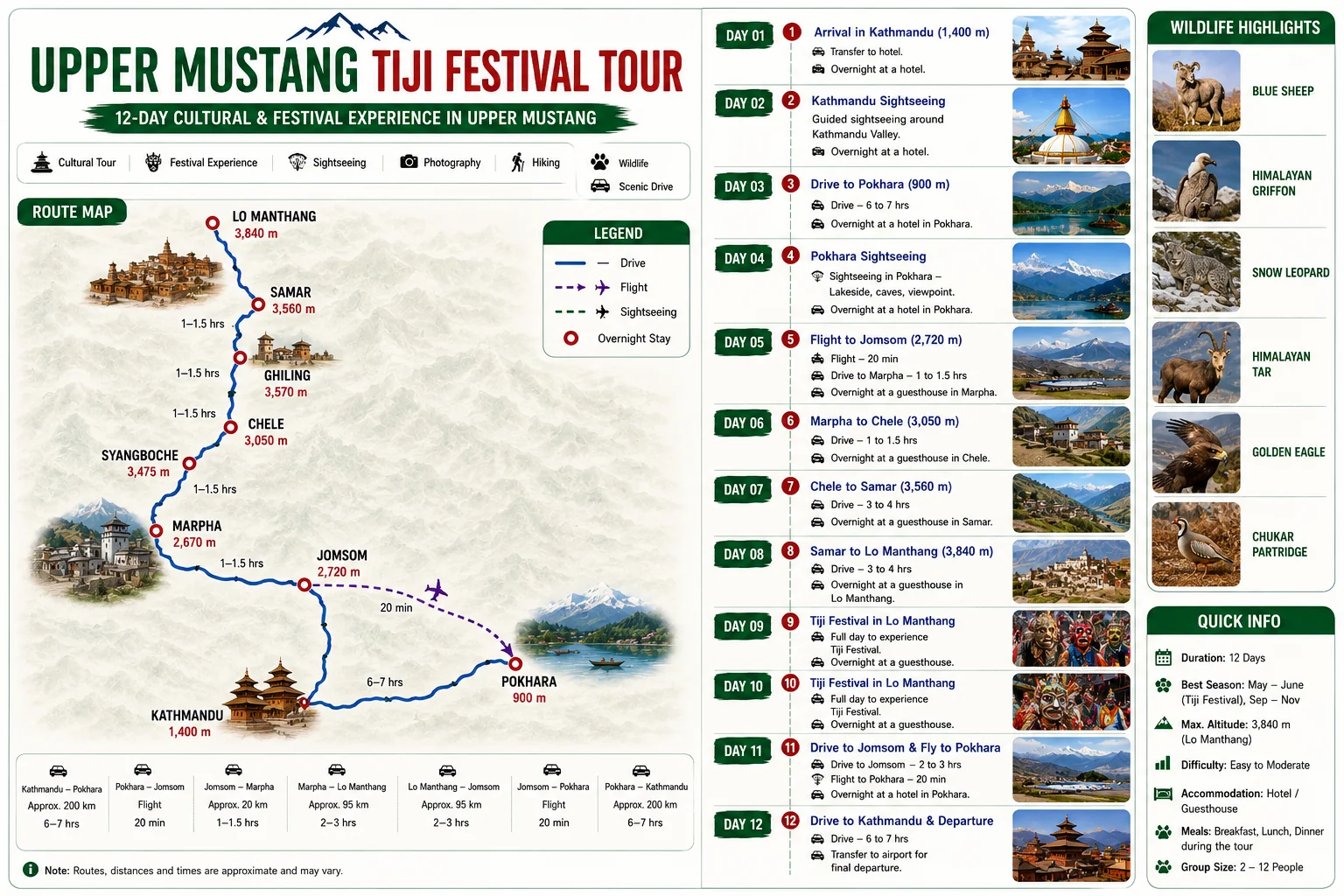
Gear List / Packing Guide
| Category | Essential Gear |
|---|---|
| Clothing | Warm jacket, fleece, thermal wear, comfortable pants |
| Footwear | Hiking shoes/boots, warm socks |
| Sun Protection | Sunglasses, sunscreen, sun hat |
| Personal Items | Toiletries, water bottle, small towel |
| Travel Gear | Daypack, power bank, headlamp |
| Documents | Passport, permits, travel insurance |
| Photography | Camera/phone, extra batteries |
| Health & Safety | Basic first-aid kit, personal medicines |
| Extras | Gloves, warm hat, neck warmer, snacks |
FAQ
The best time to visit Upper Mustang for the Tiji Festival is May to June, when the annual festival takes place in Lo Manthang. The period also offers favorable conditions for experiencing the region's unique landscapes and cultural heritage.
The Tiji Festival is celebrated annually in Lo Manthang, Upper Mustang. The 2027 festival is scheduled for June 1 to 3, 2027, while the 2028 festival is scheduled for May 21 to 23, 2028.
A 12-day Upper Mustang Tiji Festival Tour provides enough time to travel from Kathmandu to Lo Manthang, attend all three days of the festival, explore the Mustang region, and return to Kathmandu via Jomsom and Pokhara.
The Tiji Festival is a vibrant Buddhist celebration featuring traditional masked dances, religious rituals, colorful costumes, music, and centuries-old cultural traditions preserved in the remote Mustang region.
Key experiences include watching traditional masked dances, attending Buddhist ceremonies, exploring the ancient walled city, visiting cultural sites, photographing traditional architecture, and experiencing local Mustang culture.
The Tiji Festival is an important cultural and religious celebration in Upper Mustang, bringing together monks, local communities, pilgrims, and visitors for traditional Buddhist ceremonies and performances.
Travelers can expect colorful masked dances, Buddhist rituals, traditional music, ceremonial performances, local celebrations, and a unique cultural atmosphere throughout the three-day festival.
Yes. Upper Mustang is an excellent destination for cultural and heritage travel, with ancient settlements, monasteries, traditional architecture, Buddhist traditions, and strong Tibetan cultural influences.
Important destinations include Lo Manthang, Samar, Marpha, Jomsom, and traditional villages throughout the Mustang region. Lo Manthang is the main cultural highlight of the Tiji Festival Tour.
Upper Mustang is one of Nepal's leading offbeat cultural destinations, offering remote mountain landscapes, ancient settlements, Buddhist heritage, and distinctive Himalayan traditions away from Nepal's more established tourist routes.
Upper Mustang, particularly Lo Manthang, is one of the best places to experience ancient Tibetan-influenced culture, traditional Buddhist practices, historic architecture, and local Himalayan lifestyles.
The major experiences include dramatic Trans-Himalayan landscapes, traditional villages, ancient monasteries, the Kali Gandaki Valley, Tibetan-influenced culture, and the Tiji Festival in Lo Manthang.
Yes, Upper Mustang can be visited by first-time visitors to Nepal, particularly with an organized tour that handles transportation, accommodation, permits, and itinerary arrangements.
A well-planned itinerary can combine Kathmandu, Pokhara, Marpha, Samar, Lo Manthang, and Jomsom, with three dedicated days for experiencing the Tiji Festival before returning to Kathmandu.
For the Tiji Festival Tour, private road transportation provides a flexible way to travel through Pokhara, Marpha, Samar, and Lo Manthang while experiencing the changing landscapes of the Mustang region.
Yes. An Upper Mustang Tiji Festival Tour can be extended or customized according to travel dates, interests, preferred activities, accommodation requirements, and available travel time.
The cost of an Upper Mustang Tiji Festival Tour depends on group size, accommodation, transportation, permits, services, and itinerary requirements. A customized quotation can provide the exact tour price.
Travel to Upper Mustang requires specific travel permits and documentation. A licensed local travel agency can assist with the required permits and travel arrangements.
Essential items include warm clothing, layered clothing, comfortable walking shoes, sunglasses, sunscreen, a water bottle, personal medicines, travel documents, a daypack, and camera equipment.
A local travel expert can assist with permits, transportation, accommodation, festival arrangements, local logistics, and itinerary customization, helping travelers enjoy a smoother and more organized Upper Mustang experience.
More Details
 Upper Mustang Tiji Festival Tour Accommodation Types
The Upper Mustang Tiji Festival Tour combines comfortable hotel stays in Kathmandu and Pokhara with locally operated hotels and guesthouses in the remote Mustang region. Accommodation in major cities generally offers modern facilities, while stays in Marpha, Samar, and Lo Manthang provide a more authentic Himalayan experience.
Accommodation Overview
| Location | Accommodation Type |
|---|---|
| Kathmandu | 3★–5★ Hotels, Boutique Hotels & Guesthouses |
| Pokhara | 3★–5★ Hotels & Lakeside Hotels |
| Marpha | Hotels & Traditional Guesthouses |
| Samar | Mountain Guesthouses & Lodges |
| Lo Manthang | Hotels, Guesthouses & Traditional Lodges |
| Jomsom | Hotels & Guesthouses |
Room Facilities
Accommodation facilities vary depending on the location and property. Most hotels and guesthouses provide:
- Comfortable beds
- Blankets and pillows
- Basic furniture
- Private or shared bathrooms
- Hot water facilities where available
- Heating facilities in selected accommodations
- Clean and comfortable rooms
Dining Facilities
Hotels and guesthouses provide freshly prepared meals suitable for travelers throughout the journey.
Common food options include:
- Nepali cuisine
- Tibetan-influenced dishes
- Indian cuisine
- Chinese dishes
- Continental meals
- Tea, coffee, and other hot beverages
Additional Facilities
| Facility | Availability |
|---|---|
| Hot Shower | Available in selected accommodations |
| Wi-Fi | Available in major settlements, limited in remote areas |
| Mobile Charging | Available, sometimes at an additional cost |
| Drinking Water | Bottled, filtered, or boiled |
| Heating | Available in selected properties |
| Laundry | Available in selected locations |
What to Expect
As the journey moves deeper into Upper Mustang, accommodation becomes simpler due to the remote Himalayan environment. Travelers can expect clean rooms, basic facilities, local hospitality, and comfortable places to rest after long days of scenic travel.
Staying in locally operated guesthouses also provides an opportunity to experience the traditional lifestyle, culture, and hospitality of the Mustang region.
Accommodation Tips
- Book accommodation early during the Tiji Festival period.
- Carry warm sleeping clothes for cold mountain nights.
- Keep valuables and important documents secure.
- Carry a power bank for charging electronic devices.
- Carry sufficient Nepalese cash for personal expenses.
- Respect local customs and keep shared facilities clean.
- Confirm accommodation standards before booking customized or upgraded packages.
Important Note: Accommodation categories and facilities may vary depending on availability, location, travel season, and selected package.
 What to Expect from the Upper Mustang Tiji Festival Tour
The Upper Mustang Tiji Festival Tour offers a unique combination of Himalayan landscapes, ancient Buddhist culture, traditional villages, and the vibrant three-day Tiji Festival in Lo Manthang. The journey travels through Kathmandu, Pokhara, Marpha, Samar, and Lo Manthang before returning through Jomsom and Pokhara.
Himalayan Mountain Landscapes
The journey offers spectacular views of the remote Trans-Himalayan landscape, including:
- Dramatic mountain cliffs and valleys
- Dry and rugged Himalayan terrain
- Snow-covered mountain peaks
- Kali Gandaki Valley
- Traditional mountain settlements
- Unique high-altitude desert scenery
Tiji Festival Experience
The main highlight is the three-day Tiji Festival in Lo Manthang. Travelers can witness:
- Traditional masked dances
- Buddhist religious ceremonies
- Colorful ceremonial costumes
- Traditional music and performances
- Monastic rituals
- Local community celebrations
Lo Manthang Cultural Experience
Lo Manthang provides an opportunity to discover the unique heritage of the former Kingdom of Lo.
Travelers can experience:
- Historic walled settlements
- Ancient monasteries
- Traditional whitewashed houses
- Buddhist shrines and chortens
- Narrow traditional streets
- Tibetan-influenced culture and traditions
Traditional Mustang Villages
The route passes through several distinctive Himalayan settlements, including Marpha and Samar.
Village experiences include:
- Traditional architecture
- Local lifestyles
- Mountain farming
- Local hospitality
- Traditional cultural practices
- Spectacular surrounding landscapes
Photography Opportunities
The Upper Mustang Tiji Festival Tour offers excellent opportunities for travel, cultural, landscape, and festival photography.
Popular photography subjects include:
- Tiji Festival masked dancers
- Colorful prayer flags
- Traditional monasteries
- Lo Manthang architecture
- Mountain landscapes
- Traditional villages
- Local people and cultural activities
Buddhist Culture and Heritage
Upper Mustang is strongly influenced by Tibetan Buddhism, with religious traditions preserved across generations.
Cultural highlights include:
- Buddhist monasteries
- Prayer wheels
- Mani walls
- Chortens
- Prayer flags
- Sacred rituals
- Traditional Buddhist festivals
Scenic Road Journey
The tour includes scenic overland travel through some of Nepal's most distinctive landscapes.
The route includes:
Kathmandu → Pokhara → Marpha → Samar → Lo Manthang → Jomsom → Pokhara → Kathmandu
Local Food Experience
Travelers can enjoy a combination of Nepali, Tibetan, Indian, Chinese, and Continental cuisine during the journey.
Popular options include:
- Dal Bhat
- Momos
- Thukpa
- Tibetan bread
- Noodles
- Fried rice
- Vegetable curry
- Soups
What Makes the Tour Special?
The Upper Mustang Tiji Festival Tour brings together ancient Himalayan culture, sacred Buddhist traditions, dramatic landscapes, traditional villages, and the colorful Tiji Festival. The combination creates a memorable cultural journey into one of Nepal's most distinctive and remote regions.
 Best Time / Season to Visit Upper Mustang
The best time to visit Upper Mustang is from March to November, with May to June being the most important period for travelers attending the Tiji Festival in Lo Manthang. Upper Mustang lies in the Himalayan rain-shadow region, making the area considerably drier than many other parts of Nepal. Each season offers a different travel experience, but weather, road conditions, temperature, and festival dates should be considered when planning the journey.
Best Seasons at a Glance
| Season | Months | Weather | Travel Experience |
|---|---|---|---|
| Spring | March–May | Mild & Dry | Excellent for cultural tours and mountain scenery |
| Tiji Festival Season | May–June | Generally Dry | Best for experiencing the Tiji Festival |
| Summer / Monsoon | June–August | Relatively Dry in Mustang | Fewer visitors and unique landscapes |
| Autumn | September–November | Cool & Clear | Excellent mountain views and comfortable travel |
| Winter | December–February | Very Cold & Windy | Limited services and challenging conditions |
Spring: March–May
Spring is an excellent season for exploring Upper Mustang's landscapes and cultural heritage.
Highlights include:
- Mild daytime temperatures
- Increasingly dry conditions
- Clear Himalayan views
- Comfortable sightseeing conditions
- Excellent photography opportunities
- Traditional village and monastery visits
Tiji Festival Season: May–June
May and early June are the best months for the Tiji Festival experience in Lo Manthang.
The 2027 Tiji Festival is scheduled for June 1–3, 2027.
Key experiences include:
- Three days of Tiji Festival celebrations
- Traditional masked dances
- Buddhist rituals and ceremonies
- Colorful costumes and performances
- Local cultural experiences
- Excellent photography opportunities
Summer / Monsoon: June–August
Upper Mustang receives considerably less rainfall than many other regions of Nepal because of its rain-shadow location.
Travelers can experience:
- Dry Himalayan landscapes
- Fewer visitors
- Clearer conditions during suitable weather
- Unique Trans-Himalayan scenery
- Peaceful village experiences
Autumn: September–November
Autumn is another favorable period for exploring Upper Mustang.
Highlights include:
- Cool and comfortable temperatures
- Clear mountain views
- Generally favorable weather
- Excellent photography conditions
- Beautiful Himalayan landscapes
- Good conditions for cultural exploration
Winter: December–February
Winter brings very cold temperatures, strong winds, and difficult conditions in the higher Mustang region. Some services and accommodations may operate on a limited basis.
Travelers should expect:
- Very cold temperatures
- Strong mountain winds
- Limited tourism services
- Possible travel disruptions
- Challenging high-altitude conditions
Best Time for the Tiji Festival Tour
For travelers specifically interested in the Tiji Festival, late May to early June is the ideal travel period. Booking accommodation, transportation, permits, and other services early is recommended because demand increases around the festival dates.
Weather & Packing Tips
Regardless of the travel season, prepare for changing Himalayan conditions.
- Carry warm layered clothing.
- Pack a windproof jacket.
- Bring sunglasses and sunscreen.
- Carry comfortable walking shoes.
- Keep a waterproof bag for important documents.
- Carry a power bank.
- Be prepared for strong afternoon winds in Mustang.
Why May to June Is Recommended
May to June offers the best combination of cultural experiences and favorable travel conditions for the Upper Mustang Tiji Festival Tour. Travelers can experience the spectacular three-day Tiji Festival while exploring the ancient heritage, traditional villages, Buddhist culture, and dramatic Trans-Himalayan landscapes of Upper Mustang.
 Nearby Places to Explore in Upper Mustang
Upper Mustang offers a rich combination of ancient settlements, Buddhist heritage, dramatic Himalayan landscapes, and traditional villages. Travelers attending the Tiji Festival in Lo Manthang can explore several nearby cultural and natural attractions before or after the festival.
Lo Manthang
Lo Manthang is the historic walled capital of the former Kingdom of Lo and the main destination of the Tiji Festival Tour.
Highlights include:
- Historic walled city
- Ancient monasteries
- Traditional whitewashed houses
- Royal Palace
- Buddhist shrines and chortens
- Traditional Tibetan-influenced culture
Chhoser Village
Chhoser is located near Lo Manthang and is well known for its ancient cave settlements and unique Himalayan landscape.
Highlights include:
- Ancient cave dwellings
- Traditional village life
- Dramatic rock formations
- Buddhist cultural sites
- Excellent photography opportunities
Tsarang Village
Tsarang is a historic Mustang settlement known for its traditional architecture and Buddhist heritage.
Highlights include:
- Tsarang Monastery
- Historic palace
- Traditional stone and mud houses
- Colorful prayer flags
- Panoramic mountain scenery
Ghami Village
Ghami is one of the traditional villages of Upper Mustang, surrounded by spectacular barren mountain landscapes.
Highlights include:
- Traditional Mustang architecture
- Ancient Buddhist heritage
- Long mani walls
- Dry Himalayan landscapes
- Mountain viewpoints
Namgyal Monastery
Namgyal Monastery is an important religious site in the Upper Mustang region.
Travelers can experience:
- Buddhist religious architecture
- Peaceful monastery surroundings
- Traditional Buddhist practices
- Cultural and spiritual experiences
Marpha Village
Marpha is a beautiful traditional village located in the lower Mustang region and is included on the tour route.
Highlights include:
- Stone-paved streets
- Whitewashed traditional houses
- Apple orchards
- Thakali culture
- Mountain scenery
Jomsom
Jomsom is an important gateway and administrative center of the Mustang region.
Things to experience include:
- Kali Gandaki Valley
- Traditional Mustang culture
- Mountain scenery
- Local markets
- Views of surrounding Himalayan peaks
Kali Gandaki Valley
The Kali Gandaki Valley is one of the major natural highlights of the journey between Pokhara, Jomsom, and Upper Mustang.
Travelers can enjoy:
- Dramatic river valleys
- Deep Himalayan gorges
- Rocky mountain landscapes
- Traditional settlements
- Spectacular views of the surrounding mountains
Best Nearby Places for the Tiji Festival Tour
For travelers with limited extra time, the most recommended places around the main festival itinerary are:
Lo Manthang → Chhoser → Tsarang → Ghami → Marpha → Jomsom
These destinations provide a combination of cultural heritage, Buddhist traditions, traditional Himalayan villages, and spectacular Mustang landscapes.
 Foods Available During the Upper Mustang Tiji Festival Tour
The Upper Mustang Tiji Festival Tour offers a variety of simple and freshly prepared meals throughout the journey. Hotels and guesthouses generally serve Nepali, Tibetan, Indian, Chinese, and Continental dishes, with traditional Himalayan foods available in the Mustang region.
Breakfast Options
Breakfast provides a good start before long days of scenic driving and cultural exploration.
Common options include:
- Porridge
- Tibetan bread
- Chapati
- Pancakes
- Toast with jam or honey
- Eggs and omelets
- Muesli
- Tea and coffee
Lunch & Dinner Options
Depending on the location and accommodation, common meals include:
- Dal Bhat with vegetables
- Momos
- Thukpa
- Fried rice
- Fried noodles
- Vegetable curry
- Pasta
- Potato dishes
- Fresh soups
Traditional Mustang Foods
Travelers can experience local Himalayan flavors during the journey.
Recommended dishes include:
- Tibetan bread
- Thukpa
- Momos
- Yak cheese
- Traditional vegetable dishes
- Local-style soups
Vegetarian & Special Dietary Options
Vegetarian meals are generally available throughout the tour. Travelers requiring vegan, gluten-free, or other dietary options should inform the travel company before departure so suitable arrangements can be made.
Drinks Available
Common beverages include:
- Black tea
- Milk tea
- Ginger tea
- Lemon honey tea
- Coffee
- Hot chocolate
- Bottled water
- Boiled or filtered water
Food Safety Tips
- Choose freshly prepared meals.
- Drink boiled, filtered, or bottled water.
- Carry personal snacks for long journeys.
- Keep hands clean before meals.
- Avoid excessive alcohol consumption at higher elevations.
- Inform the travel company about food allergies and dietary requirements.
Dining Experience
Meals are generally served at hotels and guesthouses along the route. In remote Mustang villages, dining facilities are simpler, offering an opportunity to enjoy local hospitality and traditional Himalayan cuisine in a peaceful mountain setting.
Why Food Is Part of the Experience
Food adds an important cultural element to the Upper Mustang Tiji Festival Tour. From traditional Nepali Dal Bhat and Tibetan-style dishes to locally prepared meals in mountain villages, the dining experience provides travelers with another way to discover the culture, hospitality, and traditions of Upper Mustang.
 Culture and Etiquette of Upper Mustang
Upper Mustang is a culturally rich Himalayan region with deep Tibetan Buddhist traditions, ancient customs, traditional architecture, and local community practices. Respecting local culture and religious traditions helps create a meaningful and responsible travel experience during the Tiji Festival Tour.
Local Culture and Traditions
The culture of Upper Mustang reflects centuries of Himalayan and Tibetan Buddhist influence.
Travelers can experience:
- Tibetan Buddhist traditions
- Traditional Mustang architecture
- Ancient monasteries and chortens
- Prayer flags and mani walls
- Traditional festivals and ceremonies
- Local farming and mountain lifestyles
- Warm Himalayan hospitality
Tiji Festival Culture
The Tiji Festival is one of the most important cultural experiences in Lo Manthang. The three-day celebration features masked dances, religious rituals, traditional music, colorful costumes, and Buddhist ceremonies.
Visitors should observe the festival respectfully and avoid interfering with religious performances.
Religious Sites and Monasteries
Upper Mustang contains numerous important Buddhist religious sites.
Travelers may encounter:
- Ancient monasteries
- Chortens
- Prayer wheels
- Mani walls
- Prayer flags
- Sacred caves and shrines
Local Etiquette
Follow these simple guidelines when visiting villages, monasteries, and festival areas:
- Dress modestly at religious and cultural sites.
- Remove shoes when required inside monasteries.
- Ask permission before photographing people.
- Avoid touching religious objects without permission.
- Keep noise levels low during religious ceremonies.
- Do not interrupt monks or performers during rituals.
- Walk clockwise around chortens, stupas, and prayer wheels.
Photography Etiquette
Upper Mustang provides excellent photography opportunities, especially during the Tiji Festival. However, cultural sensitivity is important.
- Ask permission before taking close-up portraits.
- Avoid using flash during religious ceremonies when prohibited.
- Do not block festival performers or spectators.
- Respect photography restrictions at monasteries.
- Avoid photographing private or sacred activities without permission.
Responsible Tourism
Travelers can help preserve the culture and environment of Upper Mustang by:
- Supporting locally owned businesses
- Respecting local traditions
- Avoiding unnecessary plastic waste
- Keeping cultural sites clean
- Staying on designated routes
- Avoiding damage to ancient structures
- Respecting local communities and religious practices
Traditional Hospitality
Local hotels and guesthouses provide an opportunity to experience traditional Himalayan hospitality. Spending time with local communities, enjoying regional food, and learning about Mustang traditions can add meaningful cultural experiences to the journey.
Why Culture Makes the Tour Special
The Upper Mustang Tiji Festival Tour is more than a scenic journey through the Himalayas. Ancient Buddhist traditions, historic settlements, traditional architecture, local hospitality, and the spectacular Tiji Festival combine to create an authentic cultural experience in one of Nepal's most distinctive Himalayan regions.
 Safety and Security in Upper Mustang
Upper Mustang is a remote Himalayan destination with high-altitude terrain, winding mountain roads, changing weather, and limited facilities in some areas. Proper preparation, experienced local support, and following safety guidelines are important for a comfortable and enjoyable Tiji Festival Tour.
General Safety Tips
- Travel with an experienced local guide and professional driver.
- Follow the planned itinerary and local safety instructions.
- Avoid unnecessary rushing during road journeys and sightseeing.
- Stay hydrated throughout the journey.
- Carry essential personal medicines and a basic first-aid kit.
- Keep your passport, permits, and valuables secure.
- Inform the guide immediately if you feel unwell.
Altitude Safety
Lo Manthang is located at approximately 3,840 m / 12,598 ft, so travelers should allow time to adjust to the higher elevation.
Possible altitude-related symptoms include:
- Headache
- Dizziness
- Nausea
- Fatigue
- Loss of appetite
- Difficulty sleeping
- Shortness of breath
If symptoms become severe, inform the guide immediately and seek appropriate medical assistance.
Road Travel Safety
Upper Mustang involves travel on winding and rugged mountain roads.
For safer travel:
- Always use seat belts.
- Follow the driver's instructions.
- Avoid standing while the vehicle is moving.
- Keep personal belongings safely stored.
- Be prepared for occasional rough road sections.
- Allow extra travel time when road conditions change.
Weather Safety
Weather conditions can change quickly in the Himalayan region.
Carry:
- Warm jacket
- Windproof jacket
- Thermal clothing
- Gloves and warm hat
- Sunglasses
- Sunscreen
- Waterproof bag or backpack cover
Strong winds are common during afternoons in parts of Mustang, so appropriate clothing is recommended.
Festival Safety
During the Tiji Festival, large crowds may gather around the festival area.
Travelers should:
- Follow the instructions of festival organizers and guides.
- Avoid entering restricted ceremonial areas.
- Maintain a safe distance from performers.
- Do not touch ceremonial objects or costumes.
- Keep personal belongings secure in crowded areas.
- Avoid blocking pathways used by performers and monks.
Health & Hygiene
Maintaining good health is important during high-altitude travel.
- Drink boiled, filtered, or bottled water.
- Wash or sanitize hands before meals.
- Eat freshly prepared food.
- Get enough rest.
- Protect yourself from strong sunlight.
- Carry personal medicines.
- Stay hydrated throughout the day.
Travel Insurance
Comprehensive travel insurance is strongly recommended for Upper Mustang travel.
Insurance should ideally cover:
- Medical treatment
- Emergency evacuation
- Trip cancellation
- Trip interruption
- Travel delays
- Lost or delayed baggage
Essential Safety Gear
Recommended safety items include:
- Basic first-aid kit
- Personal medicines
- Reusable water bottle
- Power bank
- Headlamp
- Sunscreen
- Sunglasses
- Warm clothing
- Emergency contact information
Emergency Preparedness
Because Upper Mustang is a remote Himalayan destination, travelers should maintain flexibility during the journey. Road conditions, weather, and local circumstances can occasionally affect travel schedules.
Keep emergency contacts, travel insurance details, passport copies, and permit documents easily accessible.
Why Safety Matters
Following basic safety measures helps travelers enjoy the Tiji Festival, Lo Manthang, traditional villages, Buddhist heritage, and spectacular Himalayan landscapes with greater comfort and confidence. Proper preparation and experienced local assistance are important for a safe and memorable Upper Mustang experience.
 Transportation Facilities for Upper Mustang
The Upper Mustang Tiji Festival Tour includes scenic road travel through the diverse landscapes of Nepal, from the green hills of Pokhara to the dry and dramatic Trans-Himalayan terrain of Upper Mustang. Private transportation provides comfort, flexibility, and convenient access to remote settlements along the route.
Transportation Overview
| Route | Transportation | Approx. Duration |
|---|---|---|
| Kathmandu → Pokhara | Private Vehicle | 6–8 Hours |
| Pokhara → Marpha | Private Vehicle | 7–9 Hours |
| Marpha → Samar | Private Vehicle | 5–7 Hours |
| Samar → Lo Manthang | Private Vehicle | 5–7 Hours |
| Lo Manthang → Jomsom | Private Vehicle | 5–7 Hours |
| Jomsom → Pokhara | Private Vehicle | 7–9 Hours |
| Pokhara → Kathmandu | Private Vehicle | 6–8 Hours |
Private Transportation
Private transportation is arranged throughout the main road journey and offers:
- Comfortable private travel
- Flexible stops
- Experienced local driver
- Convenient access to remote areas
- Scenic photography opportunities
- Direct transportation between destinations
Kathmandu to Pokhara
The journey from Kathmandu to Pokhara follows scenic highways through river valleys, terraced hills, traditional villages, and rural landscapes.
Travelers can enjoy:
- Mountain and hill scenery
- River views
- Traditional villages
- Terraced farmland
- Scenic roadside stops
Pokhara to Marpha
The route gradually enters the Himalayan landscape through the Kali Gandaki Valley. The scenery changes from green hills to dramatic mountain terrain as the journey continues towards Marpha.
Transportation in Upper Mustang
Travel between Marpha, Samar, and Lo Manthang takes place along rugged mountain roads. The journey offers spectacular views of barren cliffs, deep valleys, traditional settlements, and the distinctive landscapes of Upper Mustang.
Lo Manthang to Jomsom
After the Tiji Festival, the return journey follows the mountain road from Lo Manthang to Jomsom through remote villages and dramatic Himalayan landscapes.
Luggage & Personal Belongings
Travelers should keep essential items in an easily accessible daypack.
Recommended items include:
- Passport and permits
- Mobile phone
- Camera
- Personal medicines
- Water bottle
- Warm clothing
- Snacks
- Valuable items
Transportation Tips
- Wear a seat belt throughout the journey.
- Keep valuables with you.
- Carry essential medicines in your daypack.
- Be prepared for winding and uneven mountain roads.
- Allow flexibility for changing road and weather conditions.
- Carry snacks and water for longer journeys.
- Take suitable clothing for changing temperatures.
Why Transportation Is Part of the Experience
The road journey is an important part of the Upper Mustang Tiji Festival Tour. Traveling through changing landscapes from Kathmandu and Pokhara to the remote valleys of Mustang provides opportunities to experience traditional villages, dramatic Himalayan scenery, ancient cultural sites, and the unique environment of the Trans-Himalayan region.
 Upper Mustang Tour Difficulty and Physical Fitness Required
The Upper Mustang Tiji Festival Tour is generally suitable for travelers with a moderate level of physical fitness. The itinerary mainly involves private road transportation with short walks around villages, monasteries, cultural sites, and the Tiji Festival area. However, the increasing altitude and remote mountain environment require proper preparation.
Tour Difficulty Overview
| Category | Details |
|---|---|
| Difficulty Level | Moderate |
| Highest Elevation | 3,840 m / 12,598 ft |
| Main Activity | Scenic Road Travel & Cultural Exploration |
| Walking | Short Walks & Festival Exploration |
| Technical Climbing | Not Required |
| Previous Trekking Experience | Not Required |
Physical Fitness Required
The tour is suitable for:
- Active travelers
- Cultural travelers
- Photography enthusiasts
- Adventure travelers
- First-time visitors to Upper Mustang
- Travelers comfortable with high-altitude environments
Altitude Considerations
The highest point of the itinerary is Lo Manthang at approximately 3,840 m / 12,598 ft. The elevation can make walking more demanding, particularly for travelers who are not accustomed to high-altitude environments.
Possible altitude-related symptoms include:
- Headache
- Dizziness
- Fatigue
- Nausea
- Loss of appetite
- Difficulty sleeping
Inform the guide immediately if any concerning symptoms develop.
Walking Requirements
The tour does not require long-distance trekking. Walking is mainly required for:
- Exploring Lo Manthang
- Visiting monasteries
- Exploring traditional villages
- Reaching festival areas
- Cultural sightseeing
- Photography
Comfortable walking shoes are recommended.
Physical Preparation
Regular preparation before the tour can improve comfort.
Recommended activities include:
- Regular walking
- Light hiking
- Stair climbing
- Cycling
- Cardio exercises
- Walking with a small daypack
Road Conditions
Upper Mustang travel includes winding and uneven mountain roads. Some sections can be rough depending on seasonal road conditions.
Travelers should be prepared for:
- Long driving hours
- Winding roads
- Uneven road sections
- Mountain terrain
- Changing weather conditions
Health & Hydration Tips
- Drink plenty of safe drinking water.
- Eat regular and nutritious meals.
- Get adequate rest.
- Avoid excessive alcohol at higher elevations.
- Protect yourself from strong sunlight.
- Carry necessary personal medicines.
- Inform the guide about any health concerns before the journey.
Who Should Consider Extra Preparation?
Additional preparation is recommended for travelers who:
- Have limited experience with high-altitude travel.
- Are not accustomed to long road journeys.
- Have low physical fitness.
- Plan additional trekking activities.
- Are traveling with older family members.
Why Physical Preparation Matters
Although the Upper Mustang Tiji Festival Tour does not involve demanding trekking, the combination of high altitude, remote terrain, long scenic drives, and walking during cultural sightseeing requires reasonable physical fitness. Proper preparation helps travelers enjoy Lo Manthang, the Tiji Festival, traditional villages, and the spectacular landscapes of Upper Mustang more comfortably.
 Upper Mustang Tiji Festival Tour Cost Breakdown
The Upper Mustang Tiji Festival Tour cost depends on the travel dates, group size, accommodation category, private transportation, permits, meals, guide services, and customized requirements. Festival-season travel may require early booking because accommodation and transportation availability can be limited.
Major Cost Components
| Expense | Cost / Status |
|---|---|
| Kathmandu Accommodation | Package Dependent |
| Pokhara Accommodation | Package Dependent |
| Marpha Accommodation | Package Dependent |
| Samar Accommodation | Package Dependent |
| Lo Manthang Accommodation | Package Dependent |
| Jomsom Accommodation | Package Dependent |
| Private Transportation | Package Dependent |
| Meals | According to Package |
| Upper Mustang Permits | Required |
| Guide Services | Package Dependent |
| Travel Insurance | Additional |
| Personal Expenses | Additional |
What Is Usually Included?
Depending on the selected package, the main inclusions can include:
- Hotel accommodation
- Guesthouse accommodation in Mustang
- Private transportation
- Breakfast and dinner
- Professional local guide
- Required travel permits
- Airport transfers
- Government taxes and service charges
Personal Expenses
Travelers should budget separately for:
- Lunch and additional meals
- Drinks and snacks
- Bottled water
- Souvenirs and shopping
- Laundry
- Personal medicines
- Tips
- Additional activities
- Travel insurance
Factors Affecting Tour Cost
The final price can vary according to:
- Number of travelers
- Travel dates
- Tiji Festival period
- Accommodation category
- Vehicle type
- Guide requirements
- Private or group travel
- Additional sightseeing
- Tour extensions
- Customized services
Private Tour vs. Group Tour
A private Upper Mustang Tiji Festival Tour generally provides greater flexibility with transportation, sightseeing, accommodation, and daily schedules. Group tours can offer a more economical option by sharing transportation and guide-related costs.
Money & Payment Tips
- Carry sufficient Nepalese Rupees for remote areas.
- Keep emergency cash separately.
- Confirm all package inclusions before payment.
- Check cancellation and refund policies.
- Keep payment receipts and booking confirmations.
- Ask for a detailed quotation before confirming customized services.
How to Get the Best Value
Travelers can improve overall value by:
- Booking early for the Tiji Festival
- Choosing accommodation according to budget.
- Traveling with a suitable group size.
- Confirming all inclusions before booking.
- Combining transportation and sightseeing where practical.
- Choosing a customized itinerary that matches available travel time.
Customized Tour Cost
The Upper Mustang Tiji Festival Tour can be customized and extended according to travel dates, group size, accommodation preferences, sightseeing interests, and budget. A personalized quotation provides the most accurate tour cost based on the selected services.
Important Note: Tour prices may vary according to travel dates, availability, group size, accommodation category, transportation, permits, and customized services.
 Tips for the Upper Mustang Tiji Festival Tour
Proper preparation is important for a comfortable, safe, and enjoyable Upper Mustang Tiji Festival Tour. The journey combines long scenic road travel, high-altitude environments, cultural sightseeing, and three days of festival celebrations in Lo Manthang. Packing suitable clothing, carrying essential documents, staying hydrated, and respecting local traditions will help make the journey more enjoyable.
Before the Tour
Prepare for the journey before arriving in Nepal.
- Confirm accommodation and transportation in advance.
- Book early for the Tiji Festival period.
- Prepare all required travel documents.
- Purchase comprehensive travel insurance.
- Check the complete itinerary before departure.
- Inform the travel company about dietary requirements.
- Prepare suitable clothing for cold and windy mountain conditions.
Packing Essentials
Important items for the Upper Mustang journey include:
- Warm jacket
- Fleece or sweater
- Thermal clothing
- Windproof jacket
- Comfortable walking shoes
- Warm socks
- Gloves and warm hat
- Sunglasses
- Sunscreen
- Reusable water bottle
- Small daypack
- Power bank
- Personal medicines
- Basic first-aid kit
- Camera or smartphone
During the Tour
Follow practical travel habits throughout the journey.
- Stay hydrated throughout the day.
- Walk at a comfortable pace.
- Take sufficient rest.
- Follow the guide's instructions.
- Keep important documents secure.
- Carry essential belongings in a daypack.
- Be prepared for changing weather conditions.
Tiji Festival Tips
The Tiji Festival attracts local communities, monks, and visitors to Lo Manthang.
- Arrive early at the festival area.
- Respect religious ceremonies and performances.
- Ask permission before photographing local people.
- Do not enter restricted ceremonial areas.
- Avoid touching religious objects or costumes.
- Keep noise levels low during rituals.
- Avoid blocking performers or spectators.
- Keep personal belongings secure in crowded areas.
Altitude & Hydration Tips
Lo Manthang is located at approximately 3,840 m / 12,598 ft, so travelers should take altitude seriously.
- Drink plenty of safe drinking water.
- Avoid excessive alcohol consumption.
- Eat regular meals.
- Get enough sleep.
- Avoid unnecessary physical exertion.
- Inform the guide immediately if feeling unwell.
Money & Communication Tips
Remote areas of Upper Mustang have limited banking and communication facilities.
- Carry sufficient Nepalese Rupees.
- Keep emergency cash separately.
- Carry a power bank.
- Keep important phone numbers saved offline.
- Expect limited mobile connectivity in remote areas.
- Carry essential items before leaving major towns.
Responsible Travel Tips
Help protect the natural and cultural heritage of Upper Mustang.
- Avoid single-use plastics whenever possible.
- Carry a reusable water bottle.
- Dispose of waste responsibly.
- Respect monasteries and religious sites.
- Support local hotels, guesthouses, and businesses.
- Avoid damaging ancient structures.
- Do not disturb wildlife or natural surroundings.
Photography Tips
Upper Mustang and the Tiji Festival provide excellent photography opportunities.
- Carry extra batteries or a power bank.
- Protect camera equipment from dust and wind.
- Ask permission before taking close-up portraits.
- Respect photography restrictions at religious sites.
- Avoid using flash when prohibited.
- Keep equipment safely stored during road travel.
Travel Flexibility
Mountain travel can sometimes be affected by weather, road conditions, local circumstances, or transportation delays. Keeping some flexibility in the schedule allows travelers to handle unexpected changes more comfortably.
Why These Tips Matter
The Upper Mustang Tiji Festival Tour combines cultural exploration, high-altitude travel, scenic mountain roads, and traditional festival experiences. Proper preparation, suitable clothing, responsible travel practices, and respect for local culture help ensure a safe, comfortable, and memorable journey through Upper Mustang and Lo Manthang.
 Documents Required for Upper Mustang Travel
Proper documentation is essential for traveling to Upper Mustang, Nepal, especially because the region is a restricted travel area. Travelers should prepare valid identification, travel documents, insurance details, and permit-related information before starting the journey.
Essential Documents
| Document | Requirement |
|---|---|
| Valid Passport | Required for international travelers |
| Nepal Tourist Visa | Required for applicable travelers |
| Passport-Sized Photos | Recommended for permit processing |
| Travel Insurance | Strongly Recommended |
| Passport Copies | Recommended |
| Flight Details | Recommended |
| Hotel / Tour Confirmation | Recommended |
| Emergency Contact Details | Recommended |
Passport Requirements
A valid passport is required for international travelers entering Nepal and traveling to Upper Mustang.
Travelers should:
- Carry the original passport throughout the journey.
- Keep several photocopies separately.
- Store a digital copy securely.
- Ensure sufficient passport validity for international travel.
- Keep passport details available for permit processing.
Nepal Tourist Visa
International travelers generally require a valid Nepal tourist visa unless eligible for visa-free entry under applicable regulations.
Visa requirements can vary according to nationality, so travelers should confirm the latest requirements before traveling to Nepal.
Travel Insurance
Comprehensive travel insurance is strongly recommended for the Upper Mustang Tiji Festival Tour.
Travel insurance should ideally cover:
- Medical treatment
- Emergency evacuation
- Trip cancellation
- Trip interruption
- Travel delays
- Lost or delayed baggage
Permit Documents
Upper Mustang requires special travel permits. The travel agency generally handles the permit application process using the required traveler information and passport details.
Travelers should carry:
- Original passport
- Passport copies
- Required photographs
- Permit documentation
- Tour and travel details
Flight & Travel Details
Keep copies of:
- International flight tickets
- Domestic flight tickets, if applicable
- Hotel confirmations
- Tour booking confirmation
- Transportation details
- Emergency contact information
Digital Document Copies
Keep digital copies of important documents on a phone, email account, or secure cloud storage.
Recommended digital copies include:
- Passport
- Visa
- Travel insurance
- Permits
- Flight tickets
- Hotel confirmations
- Emergency contacts
Document Safety Tips
- Keep original documents in a waterproof document pouch.
- Store photocopies separately from the original passport.
- Avoid leaving passports and permits unattended.
- Keep digital backups accessible offline.
- Carry essential documents during road journeys.
Permit Assistance
A registered local travel agency can assist with Upper Mustang permits, documentation, transportation, accommodation, and other required travel arrangements. Travelers should provide accurate passport information before permit processing.
Important Note: Permit and visa requirements can change according to government regulations. Confirm the latest requirements before traveling to Upper Mustang.
 Permits Needed for Upper Mustang Travel
Upper Mustang is a restricted travel area in Nepal, and travelers must obtain the required permits before entering the region. Permit arrangements are generally handled by a registered local travel agency as part of the tour preparation.
Main Permits Required
| Permit | Purpose |
|---|---|
| Upper Mustang Restricted Area Permit (RAP) | Required for entry into the restricted Upper Mustang region |
| Annapurna Conservation Area Permit (ACAP) | Required for travel through the Annapurna Conservation Area |
Upper Mustang Restricted Area Permit
The Upper Mustang Restricted Area Permit (RAP) is the main permit required for entering the restricted areas of Upper Mustang, including the route toward Lo Manthang.
The permit is generally arranged through a registered trekking or travel agency before entering the restricted area.
Annapurna Conservation Area Permit
The Annapurna Conservation Area Permit (ACAP) is required because the Upper Mustang travel route passes through the Annapurna Conservation Area.
The permit supports conservation and management of the protected area.
Documents Required for Permits
Travelers should provide:
- Valid passport
- Passport copy
- Passport-sized photographs
- Travel dates
- Required application details
- Travel agency and guide information
Permit Processing
A registered local travel agency can arrange the required permits before the Upper Mustang journey begins.
The process generally includes:
Passport Details → Permit Application → Government Processing → Permit Issued → Upper Mustang Travel
Important Permit Conditions
Travelers should:
- Carry permits throughout the journey.
- Follow the approved travel itinerary.
- Travel with the required licensed guide or authorized travel arrangement.
- Follow local regulations in restricted areas.
- Keep passport and permit details secure.
Why Upper Mustang Requires Special Permits
Upper Mustang is a culturally and environmentally sensitive Himalayan region. Special entry regulations help manage tourism, protect cultural heritage, and conserve the natural environment.
Important Note: Permit requirements, fees, and regulations may change according to government policies. Confirm the latest requirements before traveling to Upper Mustang.
 Booking and Payment Procedures for the Upper Mustang Tiji Festival Tour
Booking the Upper Mustang Tiji Festival Tour in advance is recommended, especially for the Tiji Festival period. Early confirmation helps secure preferred accommodation, private transportation, permits, and other essential travel services.
Booking Process
| Step | Booking Procedure |
|---|---|
| 1 | Choose the preferred tour itinerary and travel dates |
| 2 | Confirm group size and traveler details |
| 3 | Review tour inclusions and exclusions |
| 4 | Provide the required passport information |
| 5 | Pay the required booking deposit |
| 6 | Receive booking confirmation |
| 7 | Complete the remaining payment according to the agreed terms |
Information Required for Booking
Travelers may need to provide:
- Full name as shown on passport
- Passport copy
- Nationality
- Travel dates
- Flight details
- Emergency contact information
- Dietary requirements
- Accommodation preferences
Payment Options
Payment arrangements can be discussed with the travel company according to the selected package and booking terms.
Available arrangements may include:
- Bank transfer
- Online payment
- Other agreed payment methods
Booking Deposit
A booking deposit may be required to confirm the Upper Mustang Tiji Festival Tour. The deposit helps secure accommodation, transportation, permits, guide services, and other arrangements for the confirmed travel dates.
Final Payment
The remaining tour balance should be paid according to the agreed payment schedule provided during booking. Travelers should keep payment receipts and booking confirmations for reference.
Before Making Payment
Confirm the following details:
- Tour itinerary
- Accommodation
- Transportation
- Meals
- Permits
- Guide services
- Festival arrangements
- Tour inclusions and exclusions
- Cancellation and refund policy
- Payment terms
Booking During Tiji Festival
The Tiji Festival is held for only three days each year, making accommodation and transportation particularly important to arrange in advance. Early booking is recommended for travelers planning to attend the June 1–3, 2027 Tiji Festival in Lo Manthang.
Customized Tour Booking
The Upper Mustang Tiji Festival Tour can be extended or customized according to travel dates, group size, accommodation preferences, sightseeing interests, transportation requirements, and available travel time.
Why Book in Advance?
Early booking helps with:
- Securing preferred accommodation
- Arranging required permits
- Confirming private transportation
- Planning festival logistics
- Organizing guide services
- Creating a smooth travel schedule
Important Note: Booking terms, deposit requirements, cancellation policies, and payment schedules may vary according to the selected package and travel arrangements.
 Factors to Consider Before Choosing the Upper Mustang Tiji Festival Tour
Choosing the right Upper Mustang Tiji Festival Tour requires careful consideration of travel dates, festival schedules, transportation, accommodation, permits, physical fitness, budget, and personal travel preferences. Proper planning helps create a comfortable and well-organized journey through the remote Himalayan region.
Tiji Festival Dates
The Tiji Festival takes place for three days in Lo Manthang, making the festival dates the most important factor when planning a festival-focused tour.
For 2027:
- June 01, 2027: First Day
- June 02, 2027: Second Day
- June 03, 2027: Final Day
Travel dates should allow sufficient time to reach Lo Manthang before the festival begins.
Tour Duration
Consider the total travel time required for the Upper Mustang journey.
A 12-day itinerary provides time for:
- Kathmandu arrival
- Kathmandu to Pokhara
- Pokhara to Marpha
- Marpha to Samar
- Samar to Lo Manthang
- Three days of Tiji Festival
- Return through Jomsom and Pokhara
- Final departure from Kathmandu
Accommodation Preferences
Accommodation standards vary between Kathmandu, Pokhara, and remote Mustang settlements.
Consider:
- Hotel category
- Private or shared rooms
- Bathroom facilities
- Hot water availability
- Heating facilities
- Wi-Fi availability
- Festival-season availability
Transportation
Upper Mustang involves long journeys on mountain roads, so transportation should be considered carefully.
Check:
- Private or shared vehicle
- Vehicle type
- Experienced mountain driver
- Travel time
- Road conditions
- Flexible sightseeing stops
Permits and Travel Regulations
Upper Mustang is a restricted travel region, requiring specific permits and regulated travel arrangements.
Confirm:
- Upper Mustang Restricted Area Permit
- Annapurna Conservation Area Permit
- Guide requirements
- Required travel documents
- Current permit regulations
Physical Fitness
Although the tour primarily uses road transportation, Lo Manthang is located at approximately 3,840 m / 12,598 ft.
Consider personal ability to handle:
- High altitude
- Long road journeys
- Short walks
- Village exploration
- Festival-site walking
- Cold and windy conditions
Budget
The total cost depends on the selected services and travel arrangements.
Consider the cost of:
- Accommodation
- Private transportation
- Meals
- Permits
- Guide services
- Festival travel arrangements
- Travel insurance
- Personal expenses
Travel Season
May to June is particularly suitable for travelers attending the Tiji Festival. Autumn also offers favorable conditions for exploring Upper Mustang without the festival focus.
Consider:
- Weather conditions
- Festival dates
- Road conditions
- Accommodation availability
- Personal travel preferences
Cultural Respect
The Tiji Festival is a religious and cultural celebration, not simply a tourist performance.
Travelers should be prepared to:
- Respect Buddhist traditions
- Follow festival guidelines
- Dress appropriately
- Ask before photographing people
- Avoid restricted areas
- Respect monasteries and sacred objects
Photography Interests
Upper Mustang is ideal for landscape, cultural, architectural, and festival photography.
Consider carrying:
- Camera
- Extra batteries
- Power bank
- Memory cards
- Dust protection
- Weather protection
Food Preferences
Food choices become more limited in remote settlements.
Travelers should consider:
- Vegetarian requirements
- Food allergies
- Special dietary needs
- Availability of local dishes
- Personal snacks for long journeys
Travel Insurance
Comprehensive travel insurance is strongly recommended for Upper Mustang travel.
Coverage should ideally include:
- Medical emergencies
- Emergency evacuation
- Trip cancellation
- Trip interruption
- Travel delays
- Lost baggage
Group Size
Group size can affect the overall cost, transportation arrangements, accommodation, and travel experience.
Consider whether the preferred experience is:
- Private tour
- Small group tour
- Family tour
- Friends or private group
- Customized tour
Tour Customization
Travel preferences can vary significantly. An Upper Mustang Tiji Festival Tour can be extended or customized according to available travel time, interests, group size, accommodation preferences, and budget.
Possible additions include:
- Additional Kathmandu sightseeing
- Extra days in Pokhara
- Additional Mustang exploration
- Cultural sightseeing
- Photography-focused activities
- Extended Nepal tours
Local Travel Expertise
Choosing an experienced local travel company can simplify permits, transportation, accommodation, festival arrangements, guides, and emergency support.
Before booking, consider:
- Local experience
- Permit handling
- Transportation arrangements
- Accommodation quality
- Clear inclusions and exclusions
- Customer support
- Customization options
Important Note: Travel conditions, permit regulations, accommodation availability, transportation schedules, and festival arrangements may change. Confirm the latest details before booking the Upper Mustang Tiji Festival Tour.
Tour You Might Also Like


We are associated with