How Hard Is the Larke Pass Trek? 2027 Guide

Larke Pass (also spelled Larkya La Pass, 5,106m) is genuinely challenging, the toughest single day of the Manaslu Circuit Trek, involving a long ascent in cold, windy conditions above 5,000m followed by a steep descent to Bhimthang. Khushi Travels' own trip data rates the overall trek "moderate to challenging," with 6-8 hours of daily walking and real altitude sickness risk at the pass itself. With proper acclimatization, a licensed guide (mandatory by law), and an early morning start on crossing day, most reasonably fit trekkers complete it successfully.
What Larke Pass Actually Demands
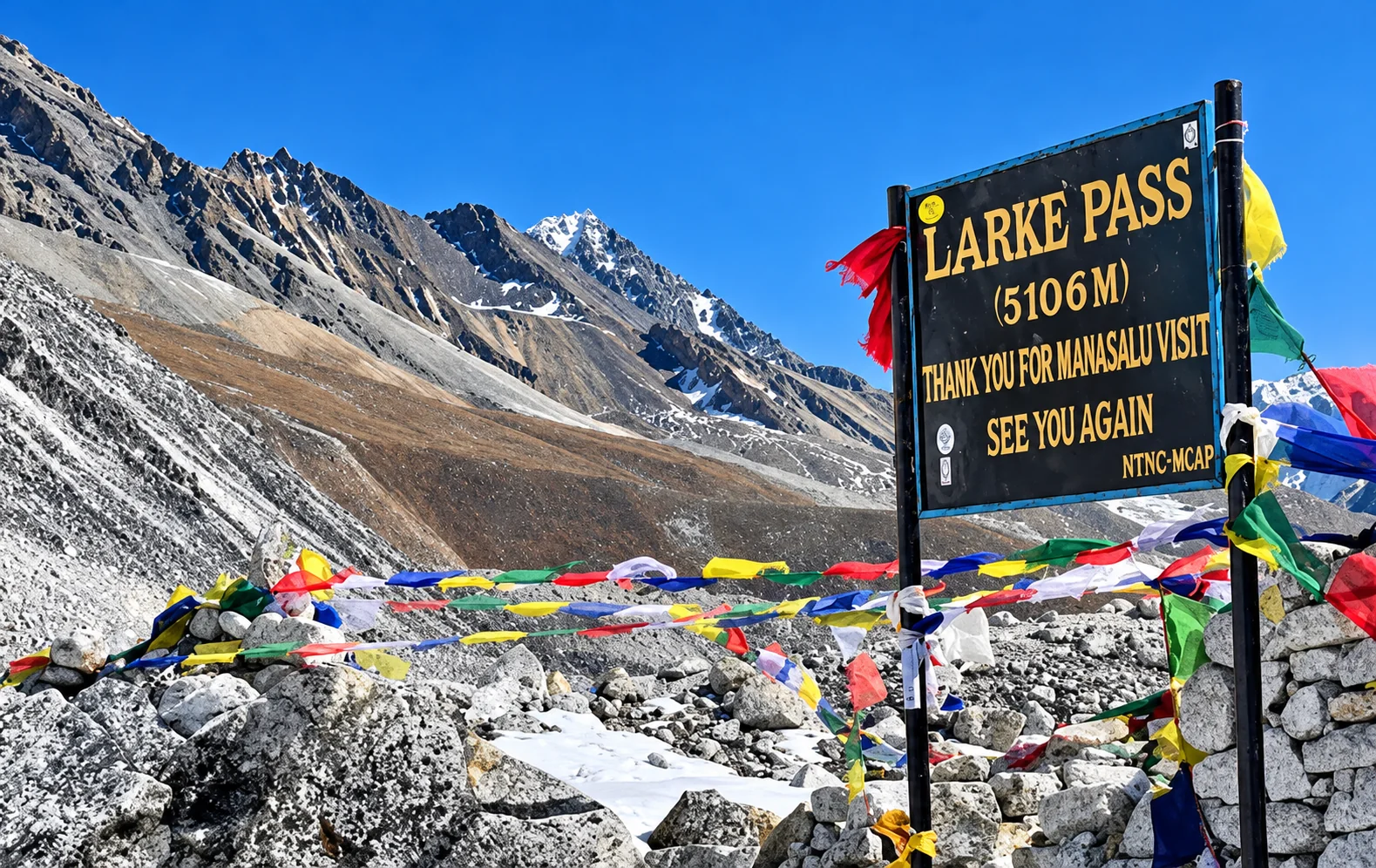
Larke Pass sits at the heart of the Manaslu Circuit Trek, a 14-day route around Mount Manaslu (8,163m), the world's eighth-highest mountain. The pass itself, at 5,106m, is the trek's single highest and most demanding point, and the crossing day is explicitly identified on Khushi Travels' own trip page as the most challenging section of the entire journey.
Three things combine to make the pass genuinely hard: the altitude (above 5,000m, where oxygen levels are significantly reduced), the duration of the crossing day (a long ascent followed by a steep descent, completed in a single push), and the cold (temperatures at the pass regularly drop to -8°C to -15°C, even colder with wind chill). None of these alone would be extreme by Himalayan standards, but together, on one demanding day, they're what separates Larke Pass from an easier short trek.
The Difficulty, By the Numbers
| Category | Detail |
|---|---|
| Difficulty rating | Moderate to challenging |
| Maximum elevation | 5,106m (Larke Pass) |
| Trek duration | 12-16 days (Khushi Travels' standard itinerary runs 14 days) |
| Daily walking hours | 6-8 hours, most days |
| Trail type | Forest trails, rocky paths, suspension bridges, glacial valleys, high mountain pass terrain |
| Technical climbing required | None, no mountaineering skills needed |
| Guide requirement | Mandatory by law, minimum 2 trekkers per group |
The Acclimatization Climb: Day by Day
Understanding how altitude builds across the Manaslu Circuit Trek makes clear why the trek is structured the way it is, and why rushing any part of it increases risk.
| Location | Elevation | Day |
|---|---|---|
| Machikhola | 870m | Day 2 |
| Jagat | 1,340m | Day 3 |
| Deng | 1,800m | Day 4 |
| Namrung | 2,630m | Day 5 |
| Lho | 3,180m | Day 6 |
| Samagaun | 3,530m | Day 7 |
| Samagaun (rest/acclimatization day) | 3,530m | Day 8 |
| Samdo | 3,875m | Day 9 |
| Dharamsala (Larke Phedi) | 4,460m | Day 10 |
| Larke Pass | 5,106m | Day 11 |
| Bhimthang (after crossing) | 3,790m | Day 11 |
| Dharapani | 1,860m | Day 12 |
Notice the built-in rest day at Samagaun (Day 8), a deliberate acclimatization stop before the final push toward the pass. Skipping or compressing this kind of rest day is one of the most common causes of altitude sickness on high-altitude treks generally, which is why a well-structured 14-day itinerary matters more than simply "getting to the pass faster."
Temperatures: Why the Cold Matters As Much As the Altitude
| Location | Daytime | Nighttime |
|---|---|---|
| Machha Khola | 18-28°C | 10-16°C |
| Namrung | 10-18°C | 2-8°C |
| Samagaun | 6-15°C | -5 to 2°C |
| Dharamsala | 0-8°C | -10 to -5°C |
| Larke Pass | -8 to 5°C | -15 to -10°C |
The temperature drop from Machha Khola to Larke Pass is dramatic, nearly 40°C colder at night by the time trekkers reach the highest point. Proper layering, a four-season sleeping bag, and an early morning crossing, before afternoon winds pick up at the pass, are essential rather than optional precautions.
What Makes the Crossing Day Itself So Hard
Day 11, the actual crossing of Larke Pass, is structured as a long single push: Dharamsala (4,460m) to Larke Pass (5,106m) to Bhimthang (3,790m). That's an ascent of roughly 650m followed immediately by a descent of over 1,300m, all completed before stopping for the night.
What makes the day demanding:
- Thin air at over 5,000m means every step requires more effort than lower elevations
- Cold, windy conditions at the pass, often below -10°C
- A steep, prolonged descent on the far side, hard on knees and requiring sustained concentration
- An early start (often well before dawn) to cross before afternoon winds strengthen
- No teahouse or rest option between Dharamsala and Bhimthang, meaning the full day must be completed once started
What makes it manageable for most trekkers:
- Gradual acclimatization through the preceding 9 days, including the dedicated Samagaun rest day
- A mandatory licensed guide experienced with the route and pace
- Trekking poles reducing strain on the descent
- A slow, steady pace rather than rushing
A Realistic Hour-by-Hour Look at Crossing Day
Numbers on a page don't fully capture what Day 11 actually feels like. Here's a general sense of how the day tends to unfold, based on the itinerary structure. Exact timing varies by group pace and conditions.
| Time | What's happening |
|---|---|
| Before dawn | Wake-up at Dharamsala (4,460m), quick breakfast, final gear check |
| Early morning | Depart in darkness or first light, steady uphill walking begins |
| Mid-morning | Continued ascent toward the pass; thinner air makes pace noticeably slower than lower elevations |
| Late morning | Arrival at Larke Pass (5,106m), prayer flags, photos, a brief pause, cold and wind limit how long anyone lingers |
| Midday | Steep descent begins toward Bhimthang |
| Afternoon | Continued descent, legs and knees doing most of the work now, elevation drops over 1,300m |
| Late afternoon | Arrival at Bhimthang (3,790m), the day's walking ends |
The entire push, from Dharamsala to Bhimthang, generally takes most of a full day. There's no shortcut and no earlier exit point once the ascent begins, which is exactly why guides insist on an early start: running out of daylight partway through the descent is a genuine risk worth avoiding entirely.
Is Larke Pass Harder Than Other Nepal Passes?
For context, Larke Pass (5,106m) sits in similar territory to other well-known Nepal trekking passes: Thorong La on the Annapurna Circuit (5,416m) is higher, while the Everest region's Cho La and Kongma La passes sit in a comparable range. What distinguishes the Larke Pass crossing specifically is the combination of remoteness (limited rescue infrastructure compared to busier routes) and the single long push with no intermediate stopping point, rather than the altitude figure alone.
How Larke Pass Compares to Other Himalayan Trekking Passes
| Pass | Altitude | Trek | Character |
|---|---|---|---|
| Thorong La | 5,416m | Annapurna Circuit | Higher, but with teahouse infrastructure on both approaches |
| Larke Pass | 5,106m | Manaslu Circuit | Remote, single long push with no intermediate stop |
| Cho La | 5,420m | Everest three-passes route | Higher and more technical, involves a glacier crossing |
| Kongma La | 5,535m | Everest three-passes route | The highest of the three Everest passes, rocky and exposed |
Larke Pass isn't the highest pass in Nepal, and it doesn't require glacier travel or technical scrambling the way some Everest-region passes do. What makes it distinctively demanding is the combination of remoteness, since the Manaslu region has fewer teahouses and less rescue infrastructure than the busier Everest or Annapurna regions, and the single uninterrupted push between Dharamsala and Bhimthang, with no village or shelter option partway through.
Who Should Attempt the Larke Pass Trek
Good candidates:
- Trekkers with prior multi-day hiking or trekking experience, even if not at high altitude before
- Good cardiovascular fitness, built through 6-8 weeks of pre-trip training
- Comfort with 6-8 hours of daily walking across multiple consecutive days
- Willingness to follow a guide's pacing and acclimatization instructions without rushing
Less suitable candidates:
- Complete beginners to multi-day trekking with no prior hiking experience
- Anyone with cardiac, respiratory, or other conditions affecting altitude tolerance, without medical clearance
- Travelers seeking a low-difficulty, short-duration itinerary (shorter, gentler options exist in the Khushi Travels catalog, covered below)
- Travelers unwilling or unable to commit 12-16 days to the full journey
Altitude Sickness: What to Actually Watch For
Acute Mountain Sickness (AMS) risk increases significantly above 4,000m, and Larke Pass at 5,106m sits well within that risk zone.
Common symptoms: headache, dizziness, nausea or vomiting, loss of appetite, fatigue, difficulty sleeping, shortness of breath, rapid heartbeat.
Prevention:
- Ascend gradually, following the recommended itinerary rather than compressing days
- Use the Samagaun acclimatization day as intended, rather than skipping it
- Drink 3-4 liters of water daily
- Eat nutritious, high-energy meals
- Avoid alcohol and smoking throughout the trek
- Walk at a slow, steady pace, especially above 3,500m
- Report symptoms to the guide immediately rather than pushing through them
If symptoms become severe: descending to a lower altitude is the correct response. Helicopter evacuation is available for serious medical emergencies, and comprehensive travel insurance covering high-altitude trekking and emergency helicopter evacuation is strongly recommended before departure.
This is general travel guidance, not medical advice. Anyone with a heart condition, respiratory condition, or other condition affecting altitude tolerance should consult a doctor before booking, and should tell Khushi Travels when enquiring.
If Something Goes Wrong: The Emergency Protocol
Understanding the actual emergency response chain before departure reduces anxiety and ensures faster action if something does happen.
- Report symptoms immediately. The single biggest factor in positive outcomes from altitude sickness is early reporting, not toughing it out.
- The guide makes the call to descend. A licensed guide is trained to recognize worsening symptoms and has the authority to end a trekker's ascent for safety reasons, even against the trekker's own wishes.
- Descent is the first-line treatment. Moving to lower altitude resolves most mild to moderate altitude sickness within hours.
- Basic health posts exist at select villages, including Samagaun, for initial assessment.
- Helicopter evacuation is the final option for serious cases, which is precisely why comprehensive travel insurance covering high-altitude trekking and helicopter evacuation isn't optional, it's the financial backstop for the worst-case scenario.
Physical Preparation: What Actually Helps
Khushi Travels' own guidance recommends beginning training 6-8 weeks before departure:
- Regular hiking and long-distance walking
- Stair climbing
- Running or jogging, and cycling or swimming for cardiovascular base
- Strength training for legs and core muscles
- Practice hiking with a loaded backpack, to simulate daypack conditions on the trek
Previous high-altitude trekking experience is helpful but not mandatory. Determination, proper preparation, and a steady, patient attitude toward the itinerary's pacing matter more than past summits.
A Sample 8-Week Training Timeline
For trekkers who want a more concrete plan than general advice, here's one way to structure preparation before a 2027 departure:
Weeks 1-2: Build a walking base. Three to four walks of 45-60 minutes, including some hills or stairs if available. Add light strength work for legs and core twice weekly.
Weeks 3-4: Increase duration. Two to three walks of 60-90 minutes, one longer weekend walk of 2-3 hours. Begin carrying a loaded daypack (5-8 kg) on longer walks.
Weeks 5-6: Add elevation and load. Seek out hilly terrain or stairs specifically. Increase daypack weight toward 8-10 kg. Continue strength training, with particular attention to the legs, since the Larke Pass descent demands sustained quad and knee strength.
Weeks 7-8: Taper and consolidate. Reduce training volume slightly in the final week before departure to arrive rested rather than fatigued. Break in trekking boots fully if not already done, there is no recovery time for blisters once the trek begins.
This is a general framework, not a prescribed program. Trekkers with existing fitness routines, or those working with a trainer or doctor, should adapt accordingly.
What to Eat and Drink at Altitude
Nutrition becomes genuinely important above 3,500m, where appetite often decreases even as the body's energy demands increase.
- Hydration matters more than almost anything else. 3-4 liters of water daily is the standard guidance, and dehydration mimics and worsens altitude sickness symptoms.
- Carbohydrates are the body's preferred fuel at altitude. Dal bhat, the traditional Nepali rice and lentil meal served at most teahouses, is specifically well-suited to this, which is part of why it remains the trekking staple it is.
- Garlic soup is a genuine local remedy, not just tradition. Many teahouses along the Manaslu route serve garlic soup specifically because it's believed to help with acclimatization, and it's worth trying regardless of the folk-medicine debate.
- Alcohol should be avoided entirely above 3,000m. Alcohol worsens dehydration and can mask early altitude sickness symptoms, delaying the moment a trekker or guide notices something is wrong.
- Small, frequent meals work better than large ones when appetite drops at higher elevations, rather than forcing a full plate.
Mental Preparation: The Part Fitness Training Doesn't Cover
Physical readiness gets most of the attention, but several trekkers who've completed demanding passes describe the mental side as equally important:
- Accepting the pace set by the guide, even when it feels frustratingly slow on a given day, since the guide's pacing is calibrated to altitude and group safety, not speed.
- Expecting discomfort as normal, not alarming. Mild breathlessness, cold, and fatigue are expected parts of the experience above 4,000m, distinct from genuine warning symptoms.
- Building in flexibility around the itinerary. Weather delays, a slower group member, or an extra rest day are normal parts of high-altitude trekking, not failures of planning.
- Trusting the acclimatization schedule, even when feeling strong enough to push harder on a given day. The itinerary is built around altitude physiology, not how any individual day happens to feel.
What's Included and What Isn't
Included: A traditional welcome on arrival at the international airport, hotel pickup and drop-off, 3-star Kathmandu hotel accommodation (BB plan), a professional trekking guide throughout, daily plan briefings and safety orientation, a basic first-aid kit carried by the guide, full-board meals during the trek, teahouse accommodation during the trek, the Manaslu Restricted Area Permit (MRAP), Manaslu Conservation Area Permit (MCAP), and Annapurna Conservation Area Permit (ACAP), all local and government taxes, 24/7 emergency support, and local sharing transportation during the trek.
Not included: Personal expenses (tips, laundry, beverages, bar bill), personal clothing and gear, costs from political disruption or events beyond the company's control, additional accommodation or meals outside the itinerary, international bank transaction fees, porter service (available at $20 per day), lunch and dinner during the Kathmandu stay, and a 10% company service charge.
Permits Required: A Restricted Area Trek
Unlike many Nepal treks, the Manaslu Circuit cannot be done independently. Three permits are mandatory:
- Manaslu Restricted Area Permit (MRAP): required for entry into the restricted Manaslu region, issued only through a registered trekking agency
- Manaslu Conservation Area Permit (MCAP): required for entry into the Manaslu Conservation Area
- Annapurna Conservation Area Permit (ACAP): required after crossing Larke Pass, since the trail enters the Annapurna Conservation Area on the descent toward Dharapani
A licensed guide is legally mandatory for the Manaslu Circuit Trek, and current regulations generally require a minimum of two trekkers per group (excluding the guide). All permit arrangements are handled by Khushi Travels when booking through the company.
Best Season for Crossing Larke Pass
| Season | Months | Conditions at the Pass |
|---|---|---|
| Spring | March-May | Mild and clear; blooming rhododendrons at lower elevations |
| Autumn | September-November | Widely regarded as the best season: stable weather, crystal-clear skies, the most reliable crossing conditions |
| Winter | December-February | Cold and dry; snow-covered trails near the pass; possible temporary pass closures during heavy snowfall |
| Monsoon | June-August | Warm and rainy; lush lower valleys but reduced visibility and higher landslide risk in lower sections |
Spring and autumn are the officially recommended windows for crossing Larke Pass, offering the safest combination of stable weather and manageable conditions at altitude.
What to Pack for Larke Pass
- Thermal base layers, trekking shirts, fleece, down jacket
- Waterproof jacket and trousers, trekking pants
- Warm hat, gloves, neck gaiter, 4-5 pairs of trekking socks
- Trekking boots, camp sandals
- A 25-35L daypack, duffel bag, rain cover
- A four-season sleeping bag (-15°C rated)
- Trekking poles, headlamp, sunglasses
- Water bottles or a hydration bladder, water purification tablets or filter
- Sunscreen, lip balm, toiletries
- Personal medicines, a first-aid kit, blister plasters, painkillers, rehydration salts
- Travel insurance covering altitude up to 5,106m and emergency helicopter evacuation
- Passport, Nepal visa, trekking permit documents
If Larke Pass Feels Like Too Much: Shorter Alternatives
For travelers who read through the altitude, duration, and cold above and decide this isn't the right trek for 2027, Khushi Travels offers considerably shorter Himalayan options:
- Ghorepani Poon Hill Trek: 6 days, reaching 3,210m, rated moderate
- Panchase Hill Eco Hike: 5 days, reaching 2,517m, rated low difficulty
- Pokhara to Ghandruk Trek: 3 days, reaching 1,940m, rated moderate
- Tamang Heritage Trail Trek: 9 days in the Langtang region, a gentler cultural alternative
For a full comparison of Pokhara-area short treks, see the guide to Short Treks from Pokhara.
After Crossing Larke Pass
Completing the Manaslu Circuit Trek, including the pass crossing, is a genuine physical and mental accomplishment. Good ways to recover:
- A full rest day in Kathmandu before any further activity
- The 1-Day Ayurvedic Wellness Experience to properly unwind
- The 4-Day Restorative Yoga & Wellness Retreat for a longer, deeper wind-down
Book the Manaslu Circuit Trek Across Larke Pass
The Manaslu Circuit Trek is run by Khushi Travels & Consulting Group, a Kathmandu-based company established in 2025 by a team with more than 17 years of travel experience, associated with NMA, NTB, TAAN, KEEP, and the Himalayan Rescue Association. See the full registrations and why travel with us pages. The itinerary can be customized, including extensions to Tsum Valley or Manaslu Base Camp, use Customize Trip to build a personalized version. Contact us or message WhatsApp for current pricing and availability.
Frequently Asked Questions
1. How hard is the Larke Pass crossing?
Crossing Larke Pass is rated the most challenging single day of the Manaslu Circuit Trek, involving a long ascent above 5,000m in cold, windy conditions followed by a steep descent to Bhimthang, completed in one continuous push without an intermediate stopping point.
2. What is the exact altitude of Larke Pass?
Larke Pass sits at 5,106 meters, the highest point of the Manaslu Circuit Trek.
3. Why is Larke Pass considered the hardest part of the Manaslu Circuit Trek?
Larke Pass combines three demanding factors on a single day: extreme altitude above 5,000m, sustained cold temperatures often below -10°C, and a long single push with no rest option between Dharamsala and Bhimthang.
4. Is the Manaslu Circuit Trek harder than the Annapurna Circuit?
The Manaslu Circuit Trek is generally considered more remote and physically demanding than the Annapurna Circuit, with fewer teahouses, stronger Tibetan cultural influence, and a mandatory restricted area permit and licensed guide requirement that the Annapurna Circuit does not have.
5. Do trekkers need technical climbing skills for Larke Pass?
No technical climbing or mountaineering skills are required to cross Larke Pass. The crossing involves demanding high-altitude trekking rather than technical mountaineering.
6. Is altitude sickness a real risk when crossing Larke Pass?
Yes, altitude sickness risk increases significantly above 4,000m, and Larke Pass at 5,106m carries genuine Acute Mountain Sickness risk. Proper acclimatization, including the built-in rest day at Samagaun, substantially reduces this risk.
7. How many acclimatization days are included before crossing Larke Pass?
The standard Manaslu Circuit Trek itinerary includes a dedicated rest and acclimatization day at Samagaun (3,530m) before the final ascent toward Larke Pass.
8. What should a trekker do if altitude sickness symptoms appear near Larke Pass?
A trekker experiencing headache, dizziness, nausea, or shortness of breath near Larke Pass should inform the guide immediately. Descending to a lower altitude is the correct response if symptoms become severe.
9. Is travel insurance required for the Larke Pass crossing?
Travel insurance is not included in the Manaslu Circuit Trek package but is strongly recommended, and should specifically cover high-altitude trekking up to 5,106m and emergency helicopter evacuation.
10. Is helicopter evacuation available near Larke Pass if needed?
Helicopter evacuation is available for serious medical emergencies on the Manaslu Circuit Trek, including sections near Larke Pass, though basic health posts exist only in selected villages such as Samagaun.
11. What fitness level is needed to cross Larke Pass?
Good cardiovascular fitness and the ability to walk 6-8 hours daily across multiple consecutive days are recommended for the Larke Pass crossing. Previous trekking experience is helpful but not mandatory with proper preparation.
12. How should a trekker train before attempting the Larke Pass crossing?
Recommended training before the Larke Pass crossing includes regular hiking, long-distance walking, stair climbing, running or cycling, strength training for legs and core muscles, and practicing with a loaded backpack, ideally beginning 6-8 weeks before departure.
13. Is the Manaslu Circuit Trek suitable for a first-time high-altitude trekker?
A first-time high-altitude trekker can attempt the Manaslu Circuit Trek with proper physical preparation, gradual acclimatization, and a licensed guide, though determination and patience with the pacing matter as much as prior experience.
14. What is the best season for crossing Larke Pass?
Autumn (September to November) is widely regarded as the best season for crossing Larke Pass, offering stable weather, clear skies, and the most reliable trekking conditions. Spring (March to May) is also strongly recommended.
15. Can Larke Pass be crossed in winter?
Larke Pass can be crossed in winter, offering peaceful trails and snow-covered scenery with fewer trekkers, though heavy snowfall can cause temporary pass closures and temperatures drop significantly.
16. How cold does it get at Larke Pass?
Daytime temperatures at Larke Pass typically range from -8°C to 5°C, while nighttime temperatures can drop to -15°C to -10°C, making proper cold-weather gear essential.
17. Why do trekkers start the Larke Pass crossing early in the morning?
Trekkers start the Larke Pass crossing early in the morning to cross before strong afternoon winds develop at the pass, which can make conditions significantly more difficult later in the day.
18. What permits are required for the Larke Pass trek?
Three permits are mandatory for the Larke Pass trek: the Manaslu Restricted Area Permit (MRAP), the Manaslu Conservation Area Permit (MCAP), and the Annapurna Conservation Area Permit (ACAP), since the trail enters the Annapurna Conservation Area after crossing the pass.
19. Is a guide mandatory for crossing Larke Pass?
Yes, a licensed guide is legally mandatory for the Manaslu Circuit Trek, and current regulations generally require a minimum of two trekkers per group, excluding the guide.
20. Can an independent trekker attempt the Larke Pass crossing without a trekking company?
No, independent trekking is not permitted on the Manaslu Circuit Trek because the region is a restricted area, requiring bookings through a registered trekking agency with a licensed guide.
21. How long does the full Manaslu Circuit Trek, including the Larke Pass crossing, take?
The full Manaslu Circuit Trek, including the Larke Pass crossing, typically takes 12 to 16 days, with Khushi Travels' standard itinerary running 14 days.
22. How much does the Manaslu Circuit Trek across Larke Pass cost?
The Manaslu Circuit Trek starts from $1,111 per person, reduced from $1,190, with final pricing depending on group size and travel dates.
23. What's included in the Manaslu Circuit Trek package?
Included items cover hotel accommodation in Kathmandu, a licensed guide, teahouse accommodation and full-board meals during the trek, all three required permits, government taxes, and 24/7 emergency support.
24. Is porter service available for the Larke Pass trek?
Porter service is available for the Manaslu Circuit Trek at an additional cost of $20 per day, helping reduce physical strain during the trek, though it's not included in the standard package.
25. Can the Manaslu Circuit Trek itinerary be extended beyond Larke Pass?
Yes, the Manaslu Circuit Trek itinerary can be extended to include Tsum Valley or a side trip to Manaslu Base Camp for travelers with additional time and interest.
26. How do travelers book the Manaslu Circuit Trek across Larke Pass?
Travelers can contact Khushi Travels, message WhatsApp, or email info@khushiservice.com to book the Manaslu Circuit Trek.
27. What is the single most important piece of gear for crossing Larke Pass?
A warm, reliable sleeping bag rated to at least -15°C is widely considered essential gear for the Larke Pass crossing, since nighttime temperatures at Dharamsala and near the pass drop well below freezing.
28. Are trekking poles necessary for the Larke Pass descent?
Trekking poles are strongly recommended for the Larke Pass descent toward Bhimthang, since the steep, sustained downhill section places significant strain on the knees.
29. Will there be mobile signal or Wi-Fi near Larke Pass?
Mobile network coverage is limited in the remote villages near Larke Pass, and Wi-Fi, where available in lower teahouses, typically comes at an additional charge.
30. Are ATMs available along the Manaslu Circuit route?
No reliable ATM facilities exist along the Manaslu Circuit trekking route, so trekkers should carry sufficient Nepalese Rupees in cash for personal expenses before beginning the trek.
31. What food is available near Larke Pass and Dharamsala?
Food options become more limited at higher elevations like Dharamsala, though teahouses still typically serve dal bhat, noodle soups, and hot beverages, with freshly prepared meals becoming simpler as altitude increases.
32. How much water should a trekker drink per day on the Larke Pass crossing?
Guidance for the Manaslu Circuit Trek recommends drinking 3 to 4 liters of water daily, increasing hydration specifically on the Larke Pass crossing day.
33. Does alcohol affect altitude sickness risk near Larke Pass?
Yes, alcohol worsens dehydration and can mask early altitude sickness symptoms, which is why avoiding alcohol is specifically recommended above 3,000m on the approach to Larke Pass.
34. Is Larke Pass higher than Everest Base Camp?
Everest Base Camp sits at approximately 5,364m, slightly higher than Larke Pass at 5,106m, though the two treks differ considerably in route, infrastructure, and overall difficulty profile.
35. Is crossing Larke Pass similar to crossing Thorong La on the Annapurna Circuit?
Thorong La (5,416m) is higher than Larke Pass (5,106m) but benefits from more established teahouse infrastructure on both sides. Larke Pass involves a longer single push without an intermediate stopping point, making the two crossings demanding in different ways.
36. Why is the Manaslu region less crowded than Everest or Annapurna?
The Manaslu region sees fewer trekkers than Everest or Annapurna largely because of the mandatory restricted area permit, required licensed guide, and minimum group size regulations, which filter out independent and last-minute trekkers.
37. When should a trekker book a 2027 Larke Pass crossing?
Booking 2 to 3 months in advance is recommended for spring and autumn 2027 departures, since restricted area permits require passport details in advance and teahouse space can fill during peak season.
38. Does weather affect whether Larke Pass can be crossed on a scheduled date?
Yes, heavy snowfall can cause temporary closures of Larke Pass, particularly during winter months, which is why spring and autumn remain the most reliable seasons for a planned 2027 crossing.
39. Can a 2027 Larke Pass trek be privately customized rather than joining a fixed group?
Yes, Khushi Travels & Consulting Group offers private and customized Manaslu Circuit Trek itineraries for 2027, adjustable for travel dates, pace, and additional destinations such as Tsum Valley.
Ready to Cross Larke Pass?
Contact Khushi Travels or message WhatsApp to book the Manaslu Circuit Trek for 2027. Reach Mr. Dinesh (9768988868) or Mr. Sunil Sharma (9768988869) directly by phone.
Khushi Travels & Consulting Group Pvt. Ltd. | Sorahkhutte, Kathmandu, Nepal | info@khushiservice.com | khushiservice.com
Similar Blogs
We are associated with